Mapping Memory Across Continents
Manish Pushkale, Daisy Loongkoonan, and the Art of Marking the Land
- Vikram Bachhawat 
Art history is often organised through categories. Indian art and Aboriginal Australian art occupy different chapters. Modernism and Indigenous traditions are discussed through separate frameworks. Contemporary abstraction is usually placed far from cultural storytelling and ancestral knowledge.
Yet occasionally artists working in entirely different worlds arrive at remarkably similar visual solutions.
The works of Manish Pushkale (b. 1973) and Daisy Loongkoonan (c. 1910–2018) present one such fascinating encounter. Separated by geography, language, and cultural history, both artists developed visual languages built upon repetition—dots, marks, lines, grids, and accumulative gestures that transform the painted surface into something resembling a map, a memory field, or a living terrain.
The similarities are striking.
Yet they emerge not from influence but from a shared engagement with land, memory, and the preservation of knowledge.
Two Self-Taught Artists
One of the most remarkable aspects of this comparison is that neither artist emerged through conventional academic art training.
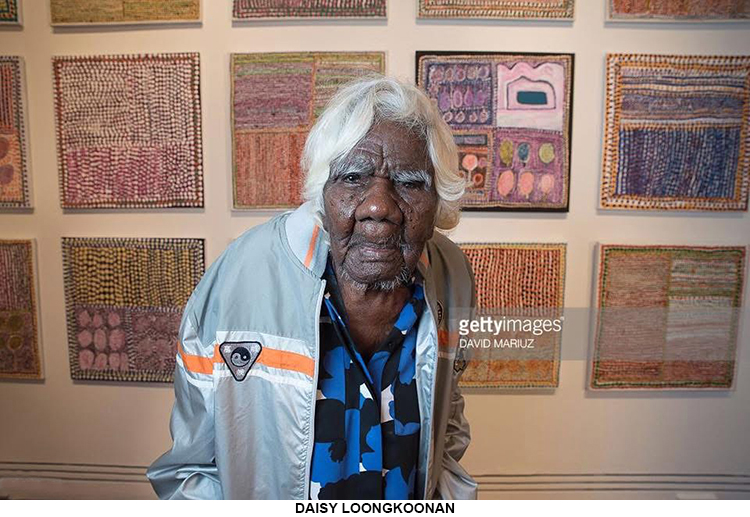 Daisy Loongkoonan, a senior Nyikina elder from the Kimberley region of Western Australia, began painting only in her nineties. Her artistic language emerged not from art schools or modernist theory but from a lifetime of lived cultural knowledge. Her paintings grew out of an intimate relationship with Country—the Aboriginal understanding of land as an interconnected system of ancestry, law, memory, ecology, and spirituality.
Manish Pushkale’s path was equally unconventional.
Unlike many prominent Indian contemporary artists, Pushkale did not attend art school. Instead, his artistic education emerged through experience, observation, and immersion within one of the most important cultural experiments in post-Independence India: Bharat Bhavan in Bhopal.
Established in 1982, Bharat Bhavan represented a radical rethinking of cultural practice in India. Conceived as an interdisciplinary institution where painters, poets, musicians, theatre practitioners, writers, and thinkers could interact freely, it sought to create a modern Indian cultural space independent of both colonial legacies and rigid academic structures.
Pushkale grew up within this environment.
As he has often reflected, Bharat Bhavan became his silent teacher.
It offered an education through exposure rather than instruction, shaping his sensibility long before he formally considered himself an artist.
Witnessing the Birth of a New Tradition
An equally significant influence on Pushkale was another extraordinary event occurring simultaneously in central India: the emergence of contemporary Gond painting. 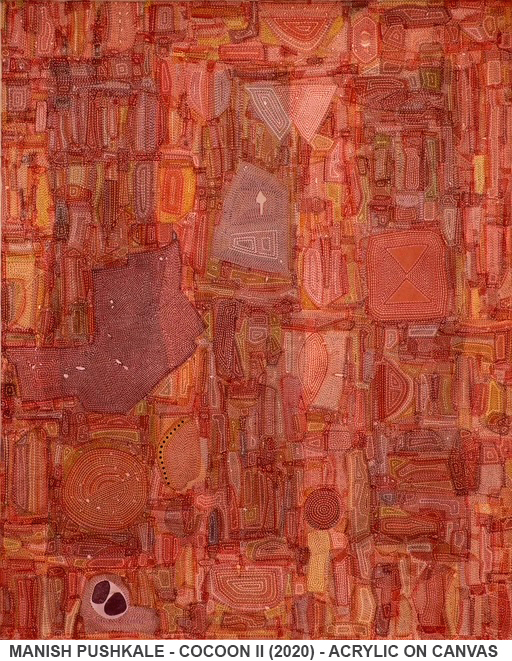
Today Gond painting occupies a respected position within global contemporary art. Yet during Pushkale’s formative years, it was only beginning to enter public visibility through artists such as Jangarh Singh Shyam and others associated with Bharat Bhavan.
For Pushkale’s generation, this was a rare historical moment.
Most artists inherit traditions.
Few witness the birth of one.
The transformation of Gond visual culture from oral and ritual traditions into a contemporary pictorial language demonstrated that new artistic vocabularies could still emerge in the modern world. It revealed that tradition was not a fixed inheritance but an evolving process.
This understanding remains visible throughout Pushkale’s practice.
His paintings are not simply abstract compositions. They function as repositories of memory, cultural traces, landscapes, symbols, and fragments of knowledge continuously accumulating across the surface.
Painting as Cartography
At first glance, Pushkale’s paintings appear abstract.
Closer examination reveals an intricate world of marks, dashes, dots, stitched lines, grids, and symbolic notations.
Trained initially in geology, Pushkale approaches painting almost like an archaeologist or surveyor. His compositions often resemble excavated landscapes, ancient manuscripts, river systems, agricultural terraces, or partially erased maps.
His repeated marks recall kantha embroidery, inscriptions, pathways, geological strata, and forgotten scripts.
Rather than depicting a landscape directly, he reconstructs it through memory.
The paintings become acts of excavation.
Country as Living Knowledge
Loongkoonan approached the land differently, yet arrived at similarly powerful visual results. 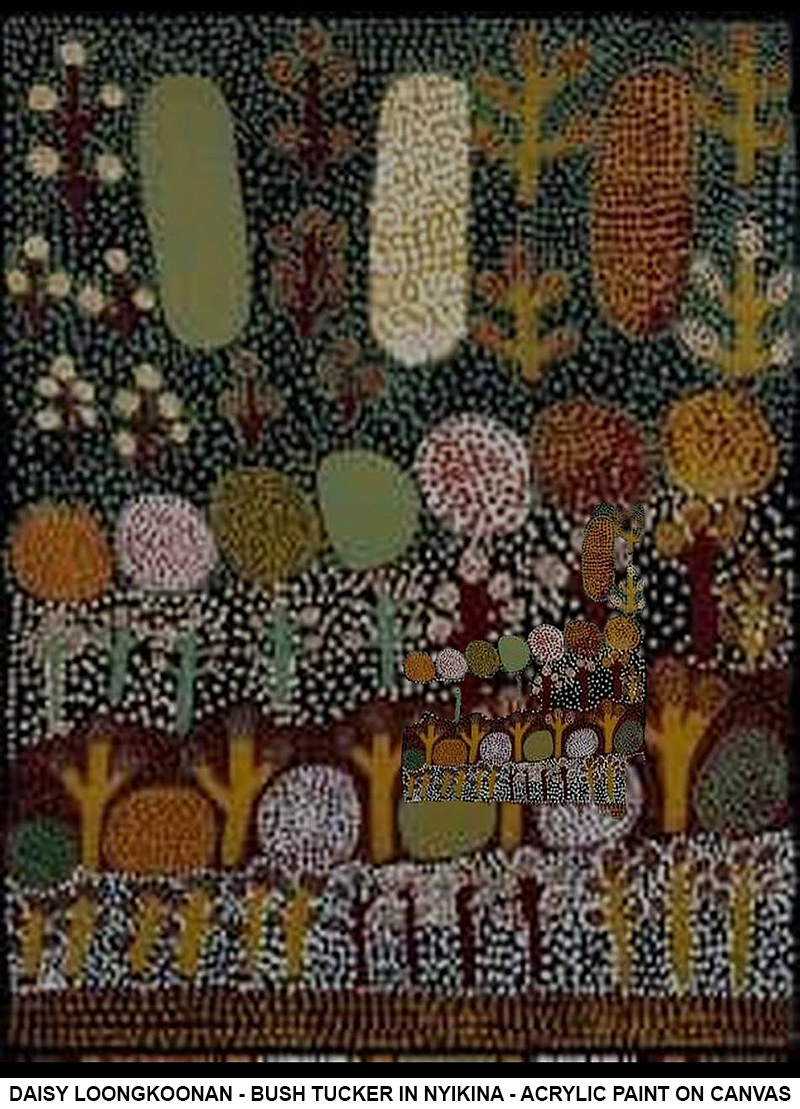
Her paintings map the Mardoowarra (Fitzroy River) and the surrounding Nyikina Country through dense fields of dots, lines, and symbolic motifs. These works are not landscape paintings in a Western sense. They function as repositories of cultural knowledge, preserving stories, ecological understanding, ancestral memory, and lived experience.
For Aboriginal artists, Country is not merely a place.
It is a living relationship.
Loongkoonan’s paintings communicate this relationship through visual systems developed over generations.
Viewed from a distance, the works shimmer with extraordinary energy.
Viewed closely, they reveal countless individual gestures, each carrying meaning within a larger network of knowledge.
The Aerial Imagination
One of the most striking formal connections between Pushkale and Loongkoonan is their shared use of an elevated or aerial perspective.
Neither artist paints the world from eye level.
Instead, both create images that seem suspended above the landscape. 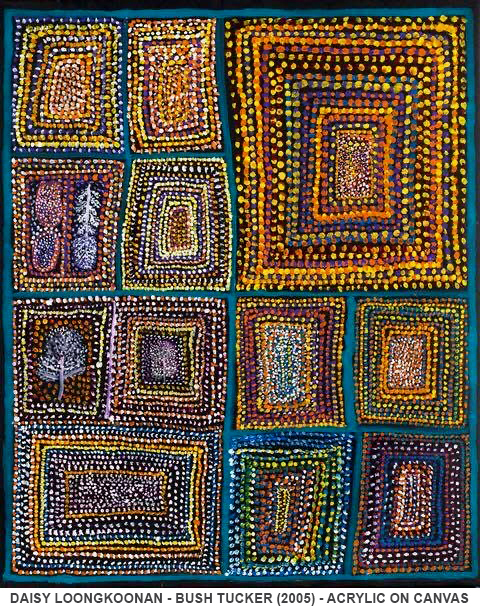
For Loongkoonan, this perspective reflects Indigenous ways of mapping Country and tracing ancestral journeys.
For Pushkale, it recalls archaeology, cartography, geology, and the act of reading landscapes through traces rather than appearances.
In both cases, painting becomes a way of understanding land as a system of relationships rather than a visual spectacle.
Memory Through Repetition
The visual power of both artists lies in repetition.
Thousands of individual marks accumulate across the surface.
Dots become rivers.
Stitches become pathways.
Lines become memory.
The smallest gesture acquires meaning through accumulation.
This process creates a unique sense of temporality. Viewers become aware not only of the image itself but also of the labour, patience, and concentration required to construct it.
The paintings unfold gradually.
They ask to be read rather than merely viewed.
A Shared Language of Place
 It would be simplistic to suggest that Pushkale and Loongkoonan are doing the same thing.
Their histories, cultural contexts, and artistic intentions remain fundamentally different.
Pushkale’s work emerges from contemporary Indian abstraction, the intellectual environment of Bharat Bhavan, geological thinking, and the experience of witnessing the emergence of a new artistic tradition.
Loongkoonan’s paintings arise from Nyikina cultural knowledge, oral traditions, and a lifelong connection to Country.
Yet their comparison remains productive because both artists address similar questions.
How can memory be preserved?
How can knowledge be transmitted?
How can landscape become language?
How can painting function as an archive?
Across continents and cultures, both artists transform the smallest of marks into expansive fields of meaning.
Their works remind us that painting remains one of humanity’s oldest methods of recording relationships—with land, with history, and with one another.
In an increasingly fragmented world, their art offers a powerful reminder that memory is not only stored in books and archives.
Sometimes it survives through a dot, a stitch, or a line repeated thousands of times across a painted surface.
Footnotes
Manish Pushkale, Artist Statement, 2025.
Exhibition catalogue, Carte Blanche: To Whom the Bird Should Speak?, Musée Guimet, Paris, 2023–24.
Bharat Bhavan archives and publications, Bhopal.
Jagdish Swaminathan and the establishment of the Roopankar Museum, Bharat Bhavan.
Research on contemporary Gond painting and the work of Jangarh Singh Shyam.
Mangkaja Arts Resource Agency publications on Daisy Loongkoonan and Nyikina visual culture.
Ian McLean, How Aborigines Invented the Idea of Contemporary Art (2011).
Selected Bibliography
McLean, Ian. How Aborigines Invented the Idea of Contemporary Art.
Bharat Bhavan publications and archives.
Musée Guimet exhibition publications on Manish Pushkale.
Mangkaja Arts Resource Agency catalogues.
Literature on Gond painting and contemporary Indigenous art.
Most read articles
A Star Amongst Too Many: Chandra Bhattacharjee at Birla Academy of Art & Culture
Chittaprosad Bhattacharya: Art as Witness, Image as Resistance
The Resurgence of the Indian Art Market
The Indian Art Market Comes of Age

Ramkinkar Baij’s Bronze Sculptures: A Modernist Legacy in Form and Vitality.
Comments
Join the Discussion
Please login to post comments.
Login