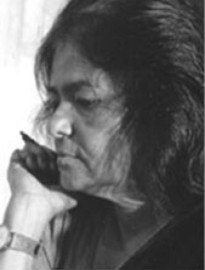
Anita Roy Chowdhury – Between Gesture and Abstraction
Anita Roy Chowdhury (1938–2017) stands as a significant yet under-recognized figure within the post-Independence modernist movement of Bengal. Born in Kolkata, she received her formal training at the Government College of Art & Craft, Kolkata, where she was mentored by artists such as Satyen Ghosal and Gopal Ghosh. A contemporary of Dhiraj Choudhury, Sunil Das, and Jogen Chowdhury, she developed an early sensitivity to form, gesture, and mood that would later define her mature abstractions. In 1959, she became a member of the Society of Contemporary Artists, one of India’s oldest and most influential artist collectives, and in 1969 she joined the Calcutta Painters, affirming her position among Bengal’s leading modern voices.
Her first solo exhibition was held in 1962 under the auspices of the Society of Contemporary Artists, followed by notable shows at AIFACS, New Delhi (1964); Jehangir Art Gallery, Mumbai (1966); and multiple exhibitions at the Academy of Fine Arts, Kolkata (1968, 1977, 1980). Later retrospectives at the Birla Academy of Art & Culture, Kolkata (1995 and 1998) reaffirmed her evolving artistic trajectory. Throughout her career, she participated in numerous group exhibitions across India and abroad, contributing to the wider dialogue on modernism emerging from Bengal during the latter half of the twentieth century.
Anita’s practice evolved through distinct but interconnected phases—beginning with her figurative explorations of human form and intimacy, and later transforming into gestural abstractions that bridged landscape, memory, and inner vision. The smaller works on paper from the 1960s and 1970s display a lyrical immediacy: fluid lines and subdued chromatic washes construct figures that hover between the real and the metaphoric. These compositions reveal a sensitivity to emotional rhythm rather than anatomical precision, situating her within the broader expressionist current of Bengal modernism.
Her oil paintings from the 1990s and 2000s, often on large canvases, represent a more architectonic and mature synthesis of form. Executed with a bold, confident hand, these works use layered brushwork, organic geometry, and earthen tonalities—ochres, greens, browns, and muted reds—to evoke landscapes that are both real and psychological. Elements such as fish, ladders, huts, trees, and flowing rivers emerge and dissolve within painterly strata, forming a symbolic vocabulary of regeneration and continuity. This visual language reflects her enduring preoccupation with the cyclicality of nature and the interdependence between human existence and environment.
Anita’s art resists rigid categorization: it moves between the gestural vitality of abstract expressionism and the poetic introspection characteristic of the Bengal school’s late modernist idiom. Her works share an affinity with the semi-abstract canvases of Ramkumar or Akbar Padamsee, yet her sensibility remains rooted in the Bengali experience—marked by lyricism, ecological awareness, and quiet spirituality. Her compositions are not constructed around conceptual frameworks but emerge from the intuitive flow of gesture and memory, embodying what critics have termed “a language of living signs.”
Though she did not seek overt recognition, Anita Roy Chowdhury’s contribution to modern Indian art has gradually gained renewed attention. Her works have been exhibited in Kolkata, Mumbai, New Delhi, and featured in private and institutional collections in India and abroad. Within Bengal’s post-Independence narrative, she represents a vital bridge between the early modernist experiments of the 1950s and the later generation’s engagement with form, matter, and consciousness.
Anita Roy Chowdhury’s art is ultimately about transmutation—the conversion of lived experience into painterly rhythm. In her gestural arcs, overlapping forms, and subdued luminosity, one perceives not only the external world but the pulse of an inward journey. Her canvases, marked by both sensitivity and strength, situate her among those Indian painters who transformed abstraction into a deeply human, almost meditative act of self-realization. In rediscovering her oeuvre today, one encounters an artist who navigated the thresholds of figuration and abstraction with unwavering authenticity, leaving behind a visual testament to the enduring lyricism of Bengal modernism.