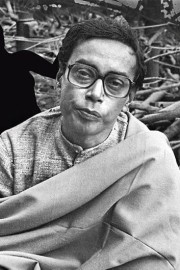
Ganesh Pyne was one of the most significant figures in modern Indian art, celebrated for his distinctive visual language that blends memory, myth, and melancholy. Born in Kolkata in 1937, Pyne studied at the Government College of Art & Craft, where he was trained in the Bengal School tradition but later forged a deeply personal idiom.
His early experiences—stories told by his grandmother and the trauma of witnessing the 1946 communal riots—profoundly shaped his inner world. Working first as an animator, Pyne developed an acute sensitivity to line and movement, which later translated into his mature style of small-scale tempera paintings. Through layers of translucent pigment and finely worked textures, he created haunting compositions that evoke dreamlike atmospheres filled with skeletons, masked figures, and mythic beasts.
Often described as the poet of darkness, Pyne explored existential themes of life, death, solitude, and transcendence. His subdued palette of blues, browns, and ochres and his intricate play of light and shadow convey a sense of introspection that distinguishes his work within the broader field of Bengal modernism.
Over five decades, Pyne exhibited widely across India and abroad, receiving the Abanindra Puraskar (2004), Star Ananda Lifetime Achievement Award (2008), and Raja Ravi Varma Award (2011). His works are part of major collections at the National Gallery of Modern Art, Birla Academy, and numerous private institutions worldwide.
Ganesh Pyne’s art remains a touchstone for understanding the psychological and symbolic dimensions of Indian modernism. His paintings—intimate, mysterious, and timeless—invite viewers into a world where imagination, memory, and mortality converge in quiet contemplation.