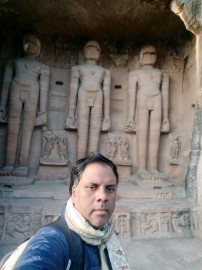
Mithun Dasgupta is a contemporary Indian painter whose practice
engages critically with questions of meaning, temporality, and perception in
the context of post-truth society. Born in 1980, he completed his Master of
Visual Arts (M.V.A.) from Rabindra Bharati University, Kolkata, where his
academic training provided a strong conceptual and theoretical foundation for
his evolving visual language.
Dasgupta’s paintings function as visual propositions rather
than fixed narratives. His work explores the metamorphosis of meaning over
time, examining how images, symbols, and ideas shift as they pass through
layers of memory, ideology, and cultural mediation. Rooted in philosophical
inquiry, his practice addresses the synthetic and constructed nature of
meaning-making in contemporary society, where truth is often fragmented,
contested, and reassembled through social, political, and media-driven forces.
Formally, his paintings balance conceptual rigor with
painterly sensitivity. Rather than offering definitive statements, they invite
contemplation, encouraging viewers to negotiate ambiguity and contradiction.
This open-endedness situates his work within a broader discourse on
contemporary abstraction and conceptual painting in India.
Dasgupta has participated in numerous curated and group
exhibitions in India and internationally. Notable presentations include the
Birla Academy Kala Mela (2007), Concern for Art Fair (2005), Social &
Political Injustice at Aakriti Art Gallery, Kolkata (2011), and Tagore: Lost
& Found at Art Bull, New Delhi (2013). He also participated in a significant
group exhibition at Christie’s, London, in 2010, marking an important
international exposure.
His practice has received notable international recognition
through the Pollock–Krasner Foundation Grant (New York), awarded twice—in 2016
and 2021—underscoring the critical relevance and sustained strength of his
artistic inquiry.
Mithun Dasgupta lives and works in Kolkata, West Bengal,
and continues to develop a practice that reflects on the instability of meaning
and the evolving conditions of contemporary visual culture.