News & Blog
Shaping Bengal: A Chronicle of Modern Sculpture
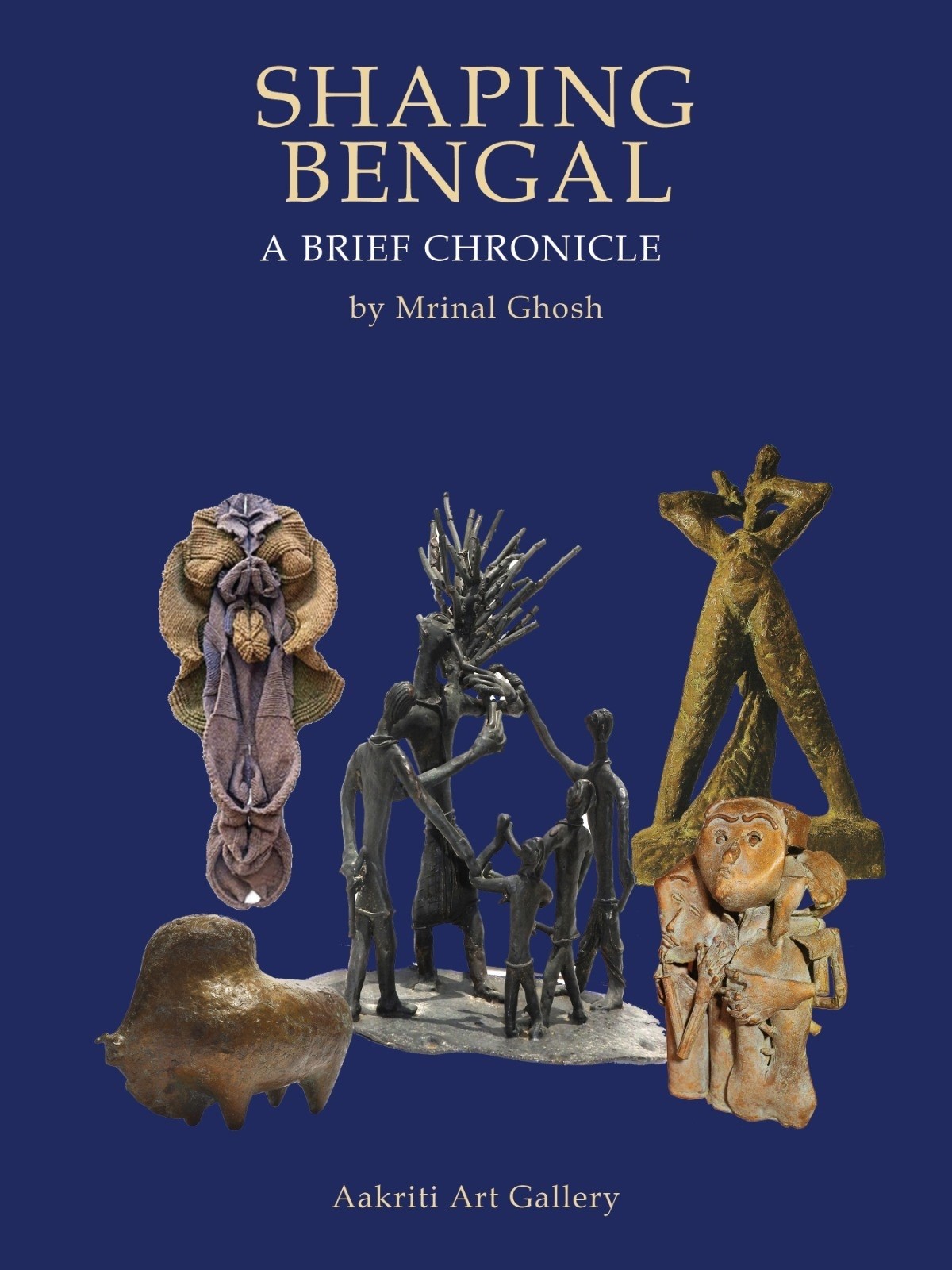
Shaping Bengal: A Brief Chronicle is a seminal and timely publication that meticulously documents the journey of modern and contemporary sculpture in Bengal over the past one and a half centuries. Conceived and published by Aakriti Art Gallery as a commemorative volume marking their 20th anniversary, this richly illustrated book brings to light the creative legacy of a region that has been at the forefront of India’s sculptural imagination.
This is arguably the first ever comprehensive survey of
Bengal’s sculptors, compiling a diverse range of practitioners—from pioneers
and pathbreakers to mid-career and emerging artists—into a cohesive historical
narrative. Presented as a limited edition of 500 copies, the book is destined
to become a collector’s item for artists, scholars, curators, and connoisseurs
alike.
A Scholarly Framework
with Deep Roots
The volume opens with an illuminating introduction by Prof.
R. Siva Kumar, one of India’s most respected art historians, whose framing of
Bengal’s sculptural journey provides the intellectual scaffolding for the
chapters that follow. His insight situates the evolution of sculpture in Bengal
within a larger matrix of colonial pedagogy, nationalist revivalism,
post-independence experimentation, and global modernism.
Author Mrinal Ghosh, an accomplished art critic and historian, navigates through this vast timeline with clarity and care, ensuring that each sculptor’s context, contribution, and stylistic evolution is situated within the sociopolitical and aesthetic dynamics of their time.
Tracing 150 Years of
Sculptural Practice (1850s–2024)
The narrative spans across five major phases:
>> 1850–1924: The book begins by examining the roots of sculptural training in colonial Calcutta, marked by the foundation of the Government School of Art in 1854. Artists trained under British academic influence focused on realistic busts and public monuments, but by the turn of the century, early stirrings of indigenous identity and Swadeshi revival began to appear, influenced by figures like Abanindranath Tagore and the nationalist fervor of the Bengal Renaissance.
>> 1925–1950: This transitional phase sees the rise of individual visionaries like Ramkinkar Baij, whose monumental works at Santiniketan signaled a radical break from academic realism and a move toward expressive modernism rooted in rural Bengal. His work forms a cornerstone for understanding sculptural modernism in India.
>> 1951–1980: The post-independence decades witnessed the emergence of several important sculptors such as Pradosh Dasgupta, Chintamoni Kar, and Prodosh Das Gupta, who combined Indian themes with formalist abstraction. Institutions like the Government College of Art & Craft and Kala Bhavana shaped the new generation of artists, while public sculpture began to flourish in urban spaces.
>> 1980–2000: This period showcases the flowering of conceptual diversity and material experimentation. Artists such as Meera Mukherjee and Mrinalini Mukherjee introduced folk metal-casting techniques and organic fiber sculptures respectively, pushing the boundaries of both form and medium. Somnath Hore’s haunting sculptural work on human suffering and Ajit Chakravarty’s formal innovations also find detailed discussion.
>> 2001–2024: The most contemporary section highlights the pluralism of the present moment—sculptors working with new media, performance, installations, and public art. Here, both internationally acclaimed and emerging voices are brought together, demonstrating Bengal’s continuing vitality in India’s sculptural discourse.
Visual Wealth and
Archival Richness
The book is illustrated with a wide array of sculptures,
archival photographs, sketches, and studio images. From bronze and terracotta
to fiber, wood, and found objects—the diversity of mediums is explored through
crisp reproductions and thoughtful layout. Many rare and previously unpublished
works are documented here for the first time, giving it significant archival
value.
A curated selection of works by artists like Meera
Mukherjee, Mrinalini Mukherjee, Ramkinkar Baij, Somnath Hore, and Ajit
Chakravarty features prominently in the visual presentation of the book,
including on the cover, offering an immersive experience to the reader.
A Tribute to Bengal’s
Artistic Spirit
What sets Shaping Bengal apart is not just the scope of its
historical coverage but also the emotional depth with which it celebrates the
sculptural community of Bengal. By capturing the pedagogical lineages,
socio-political backdrops, material choices, and spiritual quests of each
artist, it transcends the format of a mere catalogue or encyclopedia. It is a
living chronicle.
This publication also serves as a tribute to Bengal’s
cultural resilience and artistic innovation, a testament to how sculpture in
the region evolved from colonial workshops to the global art stage—while never
losing its rootedness.
Final Word
In bringing together over a hundred sculptors across
generations, Shaping Bengal: A Brief Chronicle achieves what no single volume
has done so far. It is a landmark reference book and a sincere homage to the
state’s indomitable creative legacy. Aakriti Art Gallery must be commended for
initiating and publishing this vital documentation, reinforcing their role as
one of India’s most important platforms for Indian modern and contemporary art.
This book is a must-have for every library, art institution,
and private collector interested in South Asian sculpture, art history, and
Bengal’s cultural renaissance.