News & Blog
Anita Roy Chowdhury: Lyrical Modernism and the Quiet Interior
The history of Indian modernism is punctuated by bold gestures, public interventions, and avant-garde ruptures, yet running parallel to these dominant narratives is a quieter lineage of artists who shaped the aesthetic vocabulary of post-Independence India through introspection, lyricism, and a deeply personal relationship with nature. Among this constellation, the work of Anita Roy Chowdhury (1938–2017) occupies a significant but insufficiently documented place. Although her career spanned five decades and her presence was felt across several major artistic collectives in Kolkata, her legacy remains relatively absent from mainstream scholarship. A critical re-engagement with her oeuvre reveals an artist whose visual language enriches our understanding of Bengal’s post-Independence artistic evolution and challenges conventional narratives of Indian modernism.
Born in Kolkata into an educated bhadralok family, Anita’s formative years were shaped by the cultural atmosphere of a city still resonant with the intellectual energy of the Bengal Renaissance. Early recollections describe a child drawn instinctively to drawing, fascinated by natural forms, the shifting light of afternoons, the sound of crows along rooftops, and the sensory textures of daily life. These early experiences, though mundane, would later crystallise into the core motifs that recur throughout her paintings and drawings. Her temperament—gentle, contemplative, sensitive to nuance—formed the emotional substrate of a career committed not to spectacle but to inwardness.
Her entry into the Government College of Art & Craft, Calcutta in the mid-1950s placed her at the heart of an institution undergoing a complex transition from academic realism toward emergent modernist idioms. Under the guidance of Satyen Ghosal, she acquired the disciplined foundations of drawing and composition, while her second-year mentor Gopal Ghosh introduced her to the expressive possibilities of watercolour. Ghosh’s encouragement “to use colour freely,” now repeated across gallery biographies, was more than technical advice; it dismantled academic caution and allowed her to explore the medium with the spontaneity that would become her signature. Her peers—Sunil Das, Jogen Chowdhury, Dhiraj Choudhury—would go on to become major figures in Indian modernism. While Anita’s trajectory remained quieter, her artistic growth within this cohort was no less significant.
Her early alignment with the Society of Contemporary Artists (SCA) in 1959 positioned her within a progressive collective challenging the conservative exhibition structures of the time. The SCA organised her first solo exhibition in 1962, a rare early milestone for a woman artist of her generation. The exhibition marked her entry into the national circuit at a moment when Indian modernism was consolidating its institutions, audiences, and idioms. Over the following decade she participated in exhibitions at AIFACS in Delhi, Jehangir Art Gallery in Bombay, the Academy of Fine Arts in Kolkata, and Sarala Art Centre in Madras—creating a pan-Indian arc of visibility.
A significant shift occurred in 1969, when she joined the Calcutta Painters, an influential group that sought to redefine modernist sensibility in Bengal by embracing experimentation, structural innovation, and a move beyond the lyrical-romanticism associated with earlier Bengal School artists. Her association with the group throughout the 1970s and beyond—confirmed by repeated mentions in The Telegraph and Millennium Post—attests not only to her commitment to collective artistic discourse but also to her relevance within Kolkata’s shifting cultural milieu.
Across these decades, Anita forged a mature visual language that resisted easy categorisation. Her early figurative drawings, including her renowned Crow Series, reveal an extraordinary sensitivity to gesture, rhythm, and negative space. With minimal strokes she captured the alertness, personality, and movement of birds that populated the landscape of Kolkata—turning an ordinary motif into a meditation on stillness and vitality. These works demonstrate a technical mastery that firmly situates her among India’s most accomplished draftspersons of the twentieth century.
Her watercolours, however, are the heart of her practice. Unlike many contemporaries who approached the medium as preparatory or secondary, Anita treated watercolour as a primary site of expression. Her washes are fluid yet controlled, her chromatic fields subtle yet emotionally charged. Blues dissolve into greys, earthen ochres seep into soft greens, creating atmospheres that evoke memory rather than depict landscape. Her watercolour landscapes—sometimes titled Memoryscape, Echoes of the River, Reverie, Hillscape—embody a sensibility where nature is not observed externally but experienced internally. The forms in these works are often incomplete, suspended, or blurred, inviting viewers to inhabit the interstices between recognition and emotion. They are not landscapes of place, but landscapes of affect.
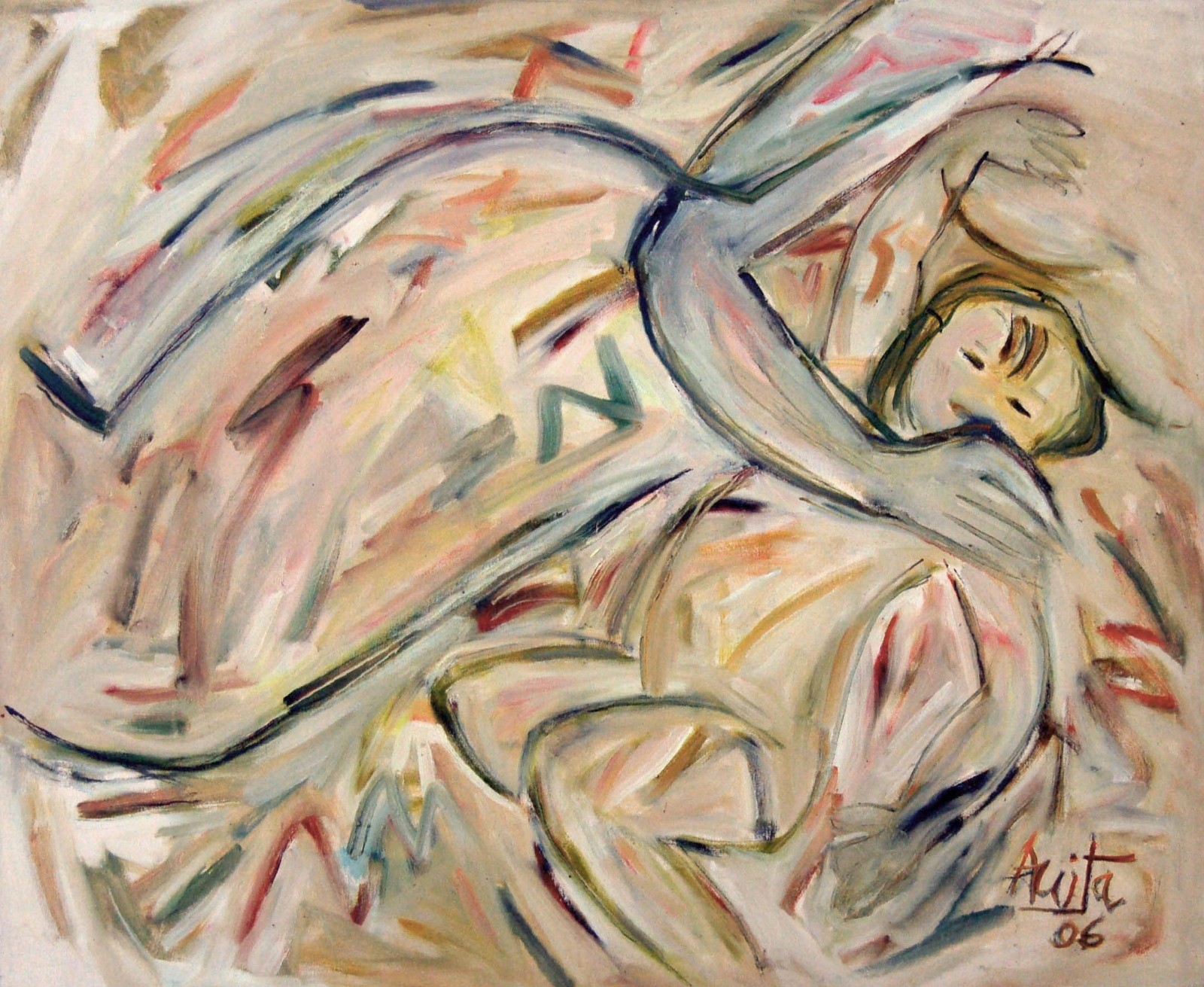
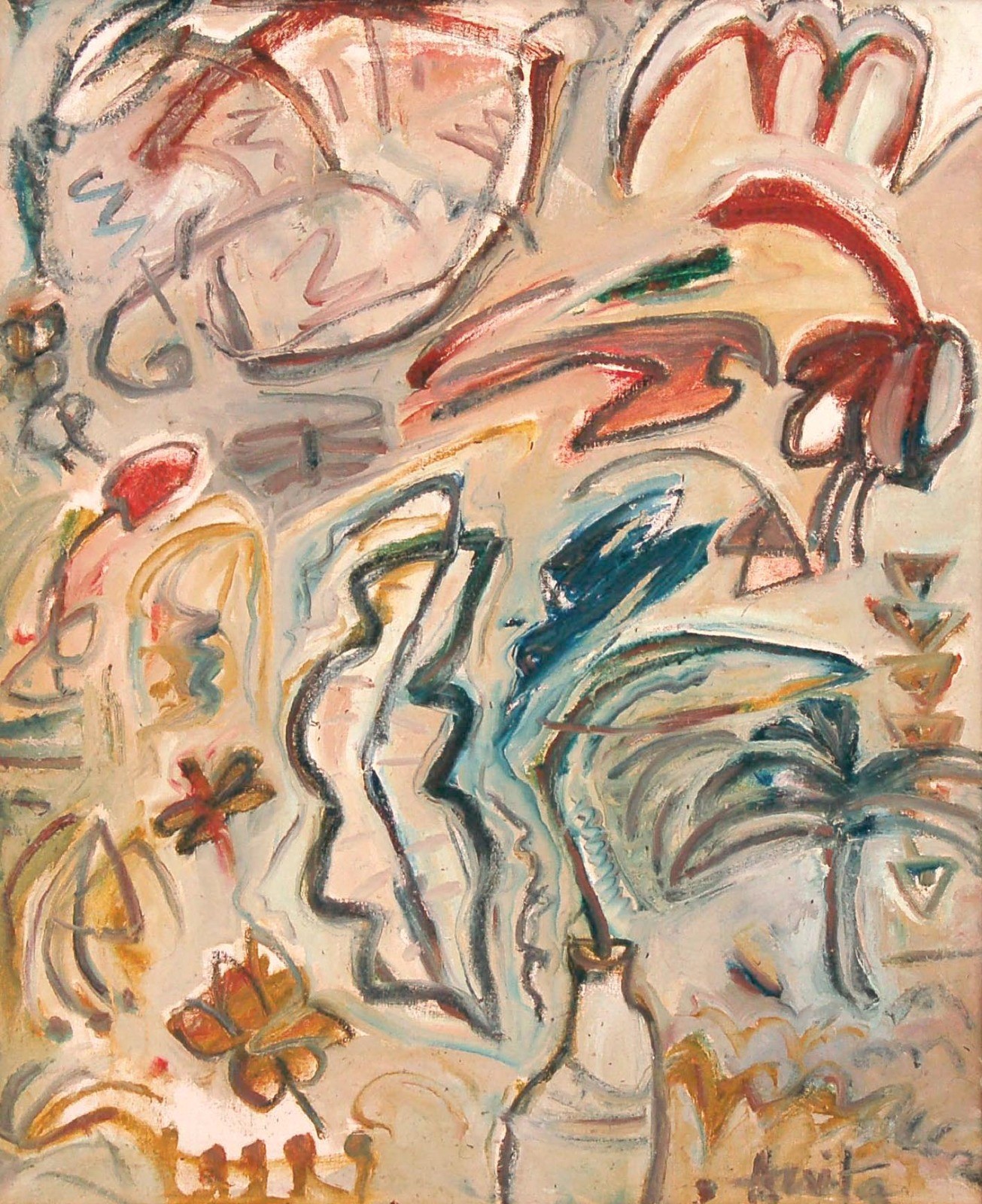
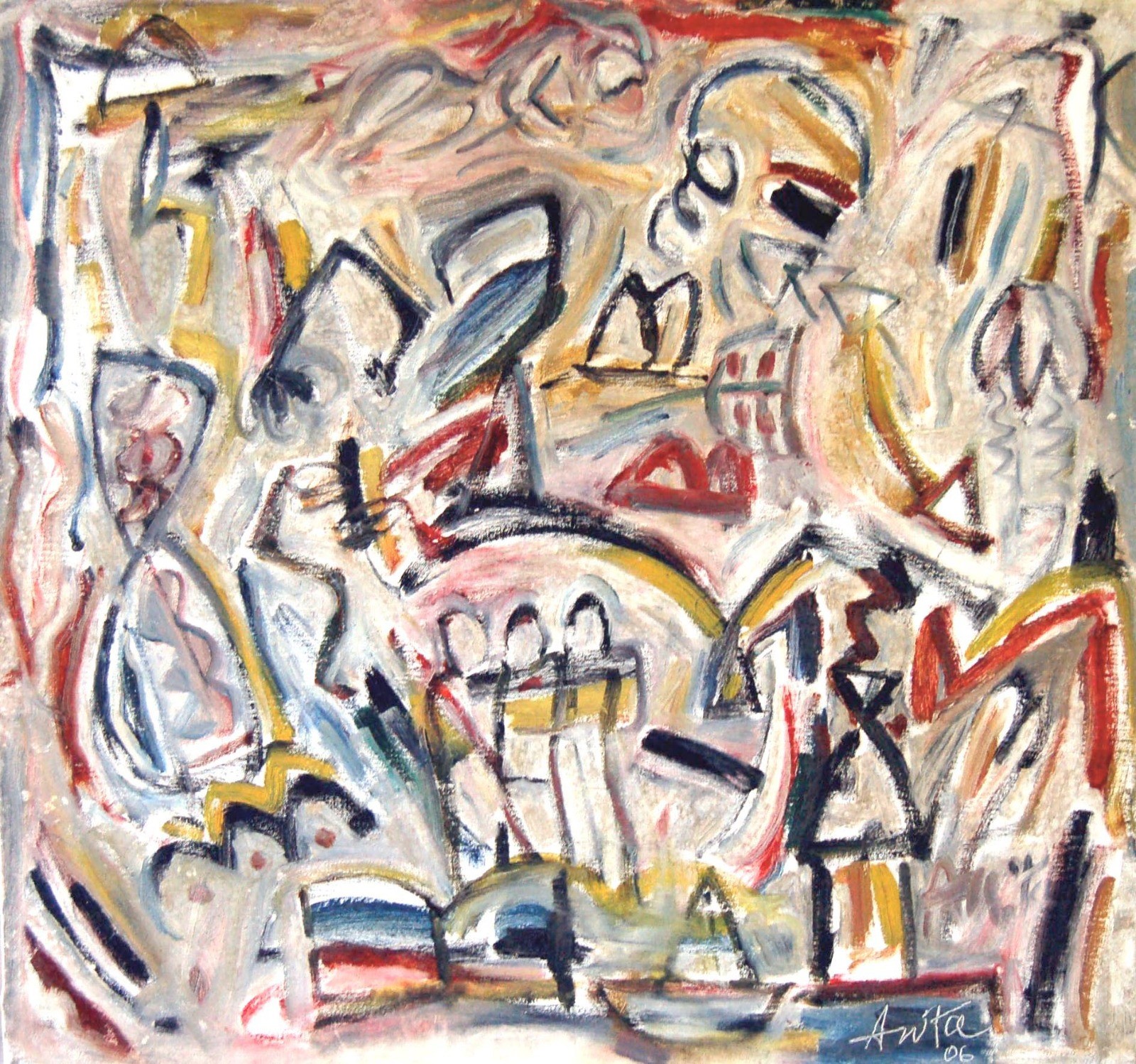
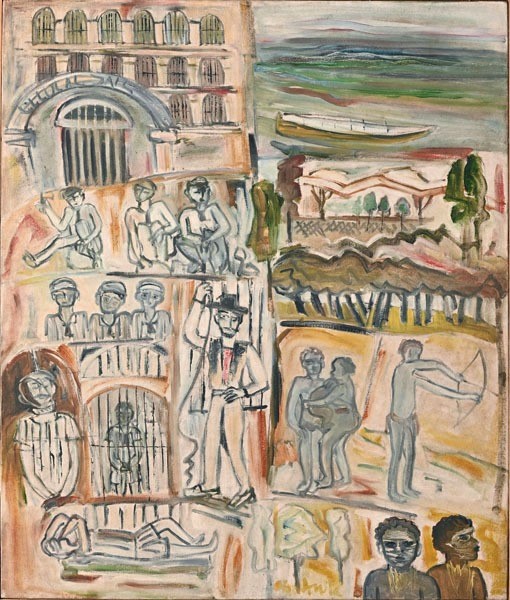
Her oil and acrylic works carry similar sensibilities, albeit with denser structure. Although never strictly abstract, her canvases flirt with abstraction through dislocated planes, floating forms, and rhythmic brushwork. The composition remains anchored by a quiet architectural logic—likely a residue of her training—yet the emotional register is unmistakably lyrical. Her figures, often women, are marked by introspection and silence. Unlike the exaggerated distortions of some male contemporaries, Anita’s figures are gentle presences inhabiting private emotional spaces. They reflect a feminine interiority rarely foregrounded in narratives of Indian modernism.
This interior world finds further articulation in her memoir Kotha Geli, a unique contribution to the sparse corpus of writings by Indian women artists. The book interweaves prose, poetry, anecdote, and sketch, mirroring the fragmentary and meditative qualities of her visual art. Through its reflections on childhood, solitude, nature, and the act of seeing, the memoir provides scholars with an invaluable lens into her creative process. It also situates her within a lineage of Bengali women who blended visual and literary expression—a lineage that includes pioneers like Sunayani Devi and later practitioners like Meera Mukherjee and Shanu Lahiri.
In her later years, Anita remained active within the Calcutta Painters and in various group exhibitions, even as contemporary art narratives shifted toward newer forms and media. Her final works reveal a deepening of her abstraction, a softening of boundaries, and a heightened attention to atmosphere. She passed away in 2017, leaving behind a substantial but dispersed body of work preserved in private collections, scattered gallery archives, and a handful of institutional holdings.
Her legacy today demands scholarly attention. Her oeuvre expands the understanding of modernism in Bengal by foregrounding lyricism, memory, and feminine introspection—qualities often overshadowed by more assertive, ideologically driven modernist articulations. In a field where women artists have historically been marginalized, a reappraisal of Anita Roy Chowdhury not only restores a missing voice but also complicates and enriches the broader narrative of Indian modernism. Her landscapes of memory, her delicate yet disciplined watercolours, her intimate drawings, and her thoughtful writings collectively invite us to reconsider the quiet, inward pathways through which modernism unfolded in post-Independence India.
Anita Roy Chowdhury’s art is, ultimately, an invitation to pause—to enter the silent spaces she so carefully created, where the external world dissolves into mood, memory, and meditative stillness. It is in this quiet that her modernism resides, and it is from this quiet that her enduring significance emerges.