News & Blog
Variations and Academic Realism: Artistic Processes within the Jubilee Art Academy and Bengal’s Realist Tradition (c.1880s–1940s).
The late nineteenth and early twentieth centuries in Bengal mark one of the most intricate chapters in Indian art history, defined by the coexistence of colonial pedagogy and nationalist reform. Within this context, the Jubilee Art Academy, founded in 1897 by Ranada Prasad Gupta, emerged as a counterpoint to the rising neo-Bengal School led by Abanindranath Tagore. While the latter sought to revive indigenous aesthetics through wash technique and lyrical symbolism, the Jubilee Art Academy remained loyal to the discipline of Western academic realism. Its curriculum emphasized drawing from life, perspective, anatomy, and chiaroscuro—principles rooted in the Royal Academy tradition but adapted to an Indian environment. The academy’s notable alumni—Atul Basu, Narendranath Sarkar, Phanindranath Basu, Jagendranath Shil, Basanta Kumar Gangopadhyaya, Hemendranath Mazumdar, and Pramatha Mallik—would sustain this lineage of naturalism well into the 1930s, creating what scholars now call the Bengal Academic Realist school (Banu 2009, 161–163).
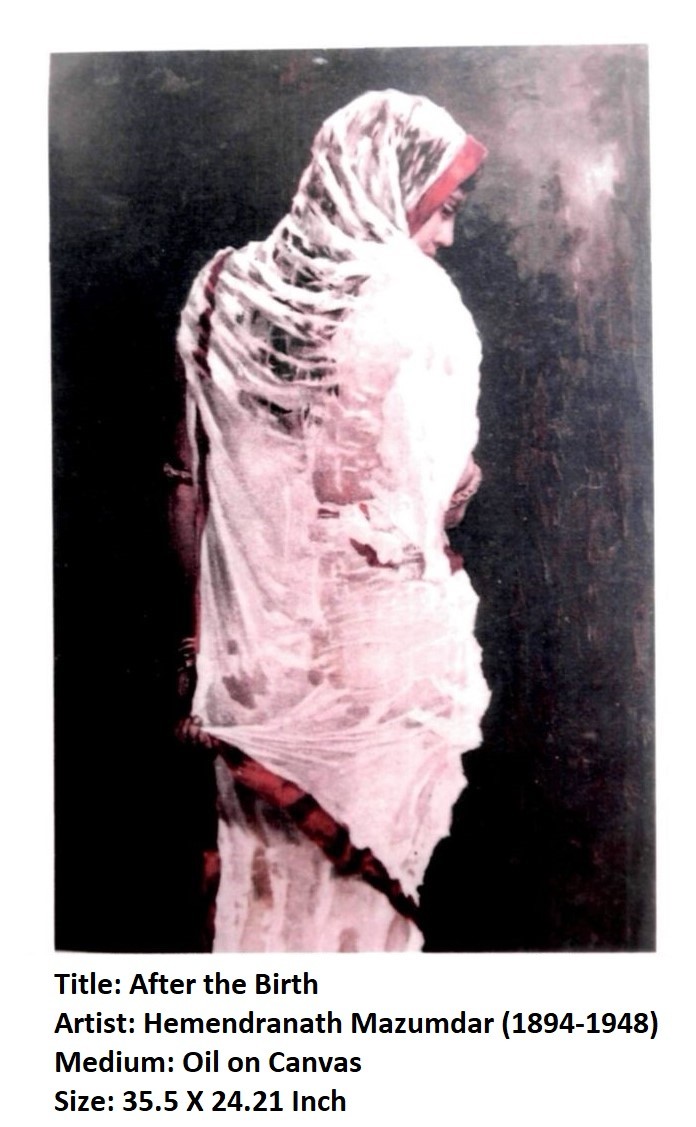
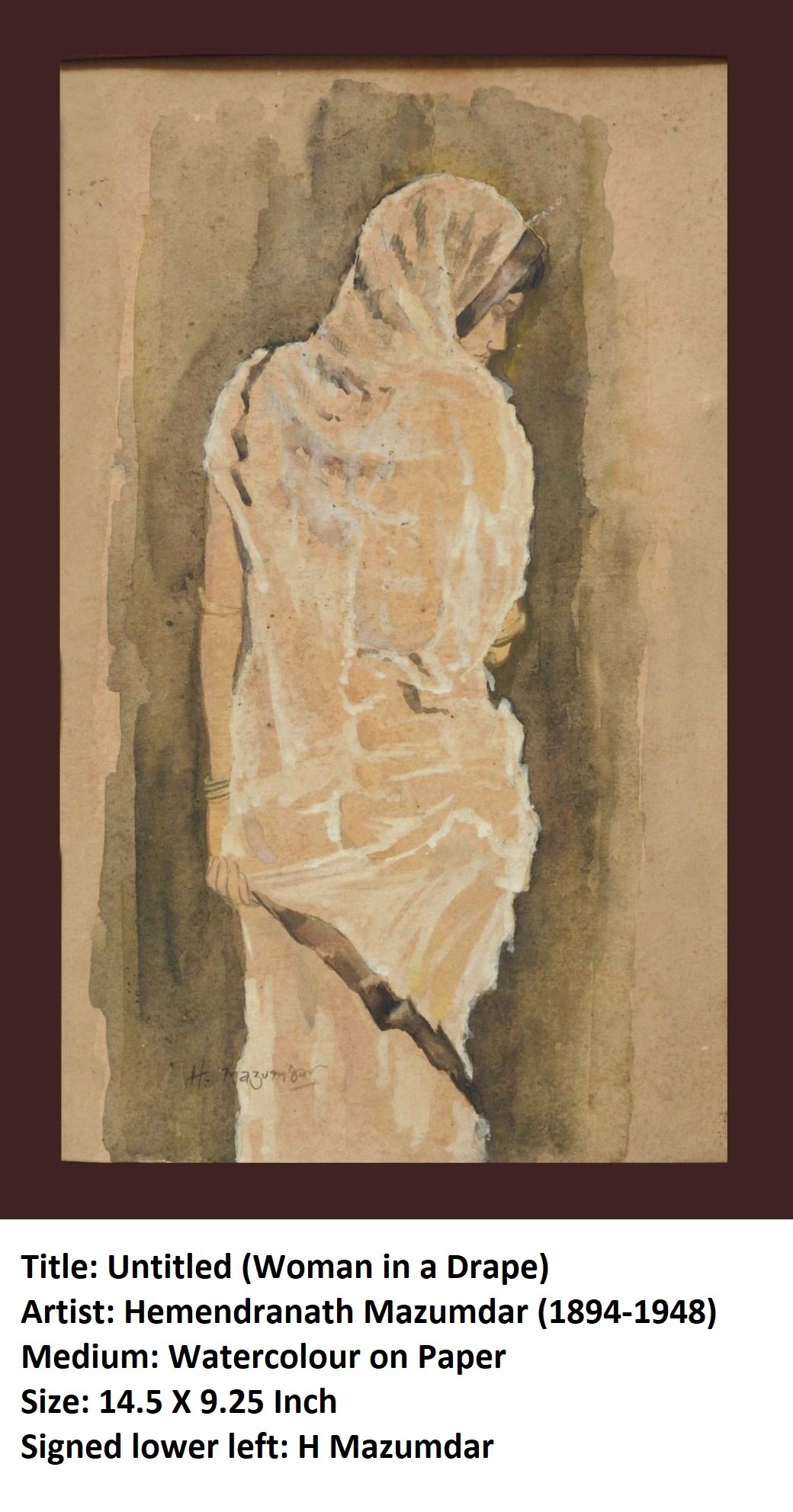
The practice of variation—creating multiple versions of the same composition, often first in watercolor and later in oil—formed the cornerstone of this academic method. It was less an act of repetition than of refinement, allowing the artist to internalize the subject through successive technical and emotional adjustments. Hemendranath Mazumdar’s Untitled (Woman in a Drape), a signed watercolor study, and its larger oil counterpart After the Bath offer an illuminating example. The watercolor, modest in scale at 14.5 × 9.25 inches, presents the figure with a subdued palette and delicate dry-brush handling. Its purpose was not display but discovery: a space where Mazumdar could study the behavior of light on translucent fabric, the tonal recession of flesh, and the mood of introspective stillness. The later oil, broader in treatment and more opulent in color, transforms this quiet study into a public work of art—an idealized synthesis of sensuality and restraint. Such a transformation reveals the Jubilee method at its core: observation leading to expression through the disciplined translation of medium.
This process of preparatory study and final realization was not unique to Mazumdar. Atul Bose followed a similar trajectory in his portrait commissions, producing graphite or wash sketches before executing the formal oils, such as the Portrait of Justice Rankin (Calcutta High Court). Basanta Kumar Gangopadhyaya’s Seated Woman exists both as a charcoal interior study and as a completed oil in a domestic setting, while Pramatha Mallik’s Bather sequence moves from tempera on cardboard to a luminous oil exhibited at the 1931 Indian Society of Oriental Art Annual. These variations reflect an academic habit that merged practice and introspection, an ethos of learning through iteration that characterized Jubilee pedagogy. Each version was a new conversation between realism and feeling, never a mere copy.
The relationship between media in this period was one of psychological and material differentiation. Oils were considered public statements—grand, textured, and performative—while watercolors, pastels, and temperas were private reflections. Mazumdar’s watercolors are particularly telling in this respect: their muted tonality and diffused light substitute the overt sensuality of his oils with a quiet emotionality. The translucency of his medium echoes Bengal’s own atmospheric sensibility—humid air, filtered light, and the tactile softness of textile and skin. His method of modulating dry and wet brushwork to evoke the texture of muslin exemplifies the technical adaptability of Bengal’s realist painters, who localized Western conventions to their own climatic and cultural realities.
At the philosophical level, the Jubilee Academy’s allegiance to Western realism did not amount to imitation. Its artists reinterpreted academic methods within Indian moral and aesthetic frameworks. Their subjects—domestic interiors, portraits of civic leaders, or solitary women in postures of repose—spoke of a new urban modernity that sought virtue in poise and modesty rather than in spiritual abstraction. Mazumdar’s contemplative female figures, Bose’s civic portraits, and Gangopadhyaya’s genre scenes collectively represent an evolving Indian modernism—empirical in method yet emotive in spirit. Runa Shelina Banu’s research aptly concludes that “the trend of western realism was sustained chiefly by the efforts of the Jubilee Art Academy for about three decades,” underscoring its pivotal role in shaping modern Indian pictorial language (Banu 2009, 163).
In this continuum, variation becomes more than a technical exercise; it signifies a mode of thinking, a bridge between study and expression. The watercolor study embodies analysis and intimacy; the oil realization, performance and synthesis. Through this dialectic, the Bengal Academic Realist painters negotiated the divide between colonial influence and indigenous identity. Their iterative processes exemplified a modernity grounded not in rupture but in refinement—a modernity that learned through doing, observed before declaring, and found originality through disciplined repetition. Mazumdar’s transition from the quiet lyricism of his watercolor to the poised confidence of his oil stands as an enduring metaphor for the evolution of Bengal’s academic realism: the journey from practice to poetics.
References:
- Runa Shelina Banu. A Critical Study of the Progressive Art Movement in Bengal. Aligarh Muslim University, 2009.
- Mrinal Ghosh. “The Tradition of Academic and Representational Art of Bengal,” in Exhibition of Art of Bengal 1850–1999: Prabaha, Academy of Fine Arts, Kolkata, 1999.
- Jaya Appaswamy. Indian Art and the Academic Realists. New Delhi: ICCR Papers, 1985.
- Percy Brown. Indian Painting under the British Raj. London: Faber & Faber, 1939.
- Tanmoy Santa. A.B. Tagore and Art of His Time. Kolkata: Visva Bharati Press, 2008.