- Guest Editor’s Column
- Hard Talk
- All Roads Lead to Delhi's New Art Street
- Art Nouveau : New Art Furniture
- Book Review
- Visualising Sastriya Music :
- Jamini Roy's Conviction & Marketing Strategy
- In the News
- The month that was
- Art's eye-view
- Art Bengaluru
- Photographing Rickshaws through Theatrical Eyes
- The Newspaper, the Text & the Critique
- Artist Index and Statistics
- Market Insight
- Auction Reports : What happened
- Auction Reports : what's forthcoming
- Dakshin Paschim
- Progress of Non-Abstract Geometry
- Indian Life and Landscape by Western Artists
- Recent Works by Prabhavathi Meppayil
- April Salon
- In Transition: New Art from India
- Modern Folk
- Nothing Lost in Transition
- Different hues of Aakriti
- Sotheby’s : Important Watches
ART news & views
Art's eye-view
Volume: 2 Issue No: 4 Month: 5 Year: 2010
Defining a retrospective
Just how many national, non-partisan art institutions are there in the country? While you go figure that (it shouldn't take you very long, actually!), here's a thought: who is best qualified to host a retrospective of an artist's work? And should an exhibition that is dictated by commercial interests be allowed to use the term 'retrospective'?These are debates that we will have to take up sooner rather than later, and there might be no easy answers. The National Gallery of Modern Art, clearly, has that mandate and ability, while a private museum (think Devi Art Foundation or the Kiran Nadar Museum of Modern Art), however altruistic, may be somewhat guided by personal interest in a way that state-owned institutions likely won't, or at least shouldn't. And yet, galleries that host increasingly large and representational shows of an artist's works have taken to labeling them retrospectives for easy reference. But can an exhibition primarily aimed at selling its works and without the consequence of exhibiting the artist's most iconic works that are in museum or private collections, qualify for that marker? It's a tricky question, and I'm glad to be doing the asking instead of the answering.
Iconoclastic Souza
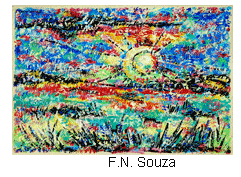
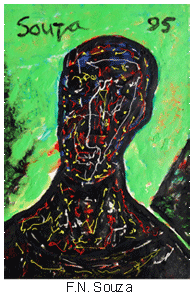 The reason these thoughts are with me is because New Delhi saw a huge F N Souza show a selection of 200 works from the Dhoomimal Gallery's collection of about twice that number but though the gallery or the catalogue itself did not refer to it as a retrospective, that was the term on everybody's lips. And perhaps that is what took away some of the pleasure in the show: there were some early, revelatory works, and then after a long gap, many (or most) works from the eighties and nineties. “The early works are lyrical compositions of houses and trees, many of them drawn from the pastoral landscapes of Goa,” wrote curator Yashodhara Dalmia in the catalogue, but he was soon to move on to “fractured heads, frankly sexual women” and “blistering, chaotic landscapes”. But in the still later years of his life, the frenzied brush would be more controlled, and though his subjects would not change, it was as though the content had moved from the macabre to the voyeuristic. At a discussion on the artist, Anjolie Ela Menon narrated a conversation in which she asked Souza why he painted women with such bulbous breasts. “You wouldn't have asked me that question if you knew the women I'd met,” she recalled the artist telling her!
 If it was like watching two very different artists' works with the bridge linking them nowhere in sight, there was no escaping the significance, and of course the pleasure in being allowed to view so many Souzas under the same roof. Nor is the interest in Souza anywhere near peaking. People are bringing out drawings, paintings and chemicals from his prolific output to see what best price they can get from those of a later generation and not lucky enough to have been able to buy their Souzas at the (still) throwaway prices of the last century.
Unreasonable worth?
 You can blame the irrational expectations of prices on the auctions which, in March, did so much better than was anticipated. While this has put the art fraternity in a more positive frame of mind (and made collectors somewhat wary), the takeaway hasn't been the best for everyone concerned. At least some deals for works that were to change hands on an agreed price have been stymied with sellers holding out for more. However unethical it might appear, there's no ombudsman you can appeal to, so until prices stabilise again, both buyers and sellers are approaching any transactions with great caution. Which is why, like the weather, at no point is everybody happy with the outcome because there's always scope to complain and hold out for a better contract.
 All eyes on the 'public' good
 With the Commonwealth Games round the corner, the art trade is wondering if this will be the moment the state will step out of its straitlaced city planning to deliver on the front of public art. New Delhi lacks the will (perhaps more than a budget) for creating iconic works of art for its public spaces, and in the recent past, at least, the only examples we have are the city-based designer Vibhor Sogani's Sprouts at the AIIMS grid separator, and Goa-based artist Subodh Kerkar's installation of boats on the DND flyway.
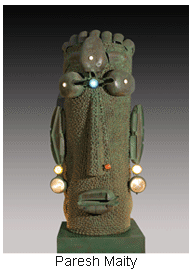
What the capital's government does will remain to be seen, but a private initiative has at least kicked off with the upscale Select Citywalk mall lending its public arenas for rotating public art. It started last month with Khoj's interactive project that saw video installations, assemblages and performance art taking centre stage, while the summer will witness Paresh Maity's gigantic sculptures from motorcycle scrap being in the spotlight. A larger, shared arena for more galleries should take over the same space after the summer vacations public art in a private space?
These views are personal and do not reflect those of
the organisation with which the writer is associated.