Profile:
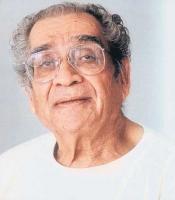
Akbar Padamsee was one of the most important figures in post-Independence Indian modernism. Born in Mumbai in 1928, he studied at the Sir J. J. School of Art, where he received formal training in painting. While still a young artist, he became closely associated with the wider circle of the Progressive Artists’ Group, whose members and associates sought to create a modern visual language suited to the cultural realities of independent India.
Padamsee moved to Paris in the early 1950s, where his engagement with European modernism broadened his artistic outlook. His first exhibition was held in Paris in 1952, followed by an early solo exhibition at Jehangir Art Gallery, Mumbai, in 1954. Although international modernism influenced his development, he did not adopt any single European style. Instead, he constructed an independent visual language grounded in sustained enquiry into colour, form, space, and the human presence.
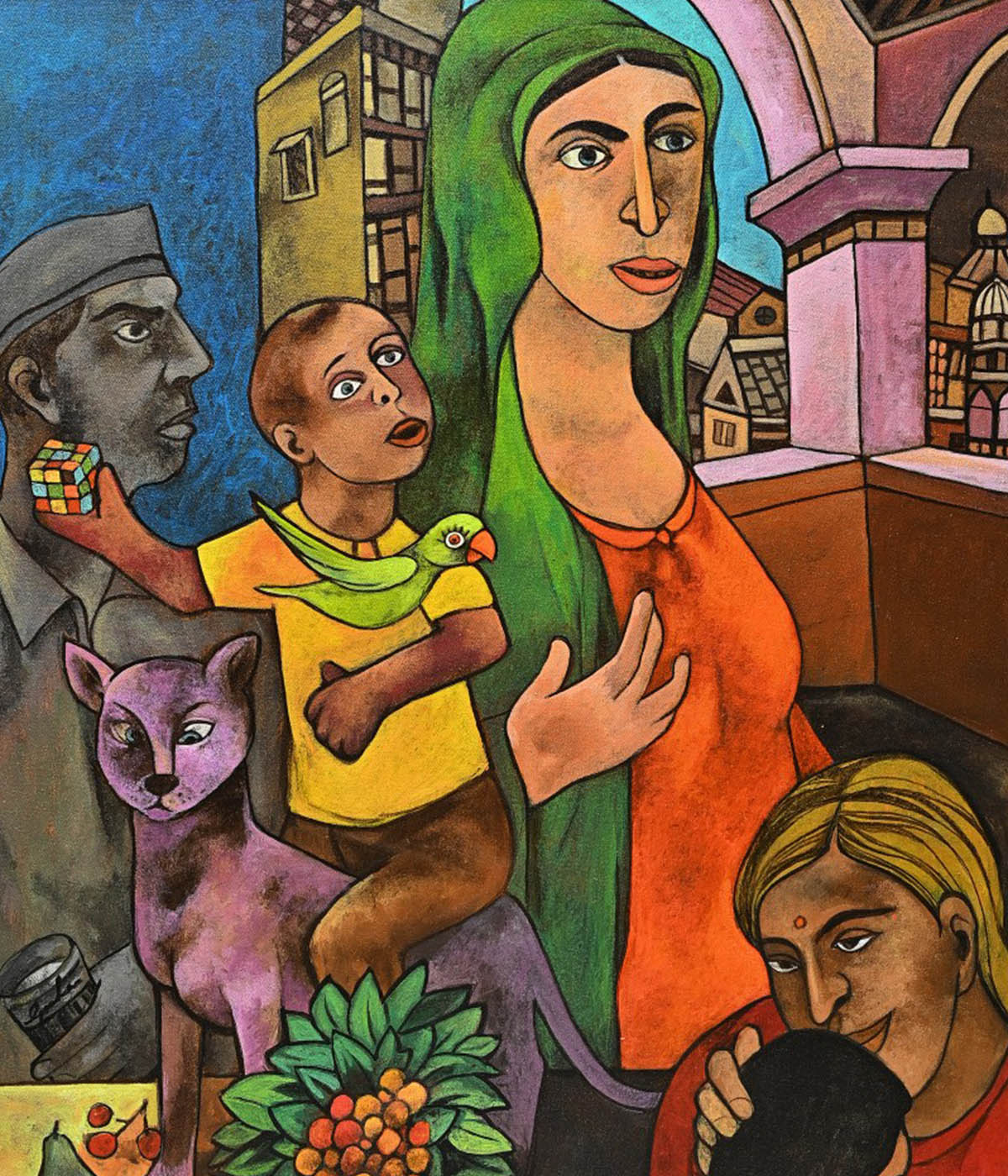
His early paintings included sombre heads, human figures, and landscapes rendered through heavily worked surfaces and restrained tonalities. In works often described as his Grey Series, colour was reduced to subtle variations of black, white, and grey. These paintings examined the emotional and structural possibilities of limited colour while creating a strong sense of psychological intensity.
Padamsee later developed the celebrated Metascapes, in which mountains, fields, skies, suns, and horizons were transformed into imagined landscapes. These works were not direct representations of nature. Instead, they used colour and spatial divisions to create meditative pictorial environments situated between landscape and abstraction. His Mirror Image paintings similarly explored duality, reflection, symmetry, and the relationship between opposing yet interconnected visual fields.
The artist’s practice extended beyond painting. He worked in drawing, printmaking, photography, sculpture, film, and computer-generated imagery. His experiments with Compugraphics placed him among the earliest Indian artists to explore the computer as a creative tool. He also established the Vision Exchange Workshop, an interdisciplinary initiative that encouraged experimentation with film, photography, and new visual technologies.
Padamsee exhibited widely in India and internationally throughout a career spanning nearly seven decades. His solo exhibitions included presentations in Paris, Mumbai, New Delhi, New York, and Montreal, while his work appeared in numerous museum and institutional exhibitions devoted to modern Indian art.
His contribution was recognised through major honours, including the Jawaharlal Nehru Fellowship, the Kalidas Samman, the Lalit Kala Akademi Fellowship, and the Padma Bhushan in 2010. He died on 6 January 2020, leaving behind a body of work that remains central to the history of Indian modernism.
Akbar Padamsee’s significance lies in his sustained investigation of the fundamental elements of art. Whether working with the human head, the body, landscape, photography, or digital imagery, he treated artistic practice as a field of intellectual and visual enquiry. His paintings continue to be valued for their formal discipline, contemplative depth, and uncompromising modernist vision.