Profile:
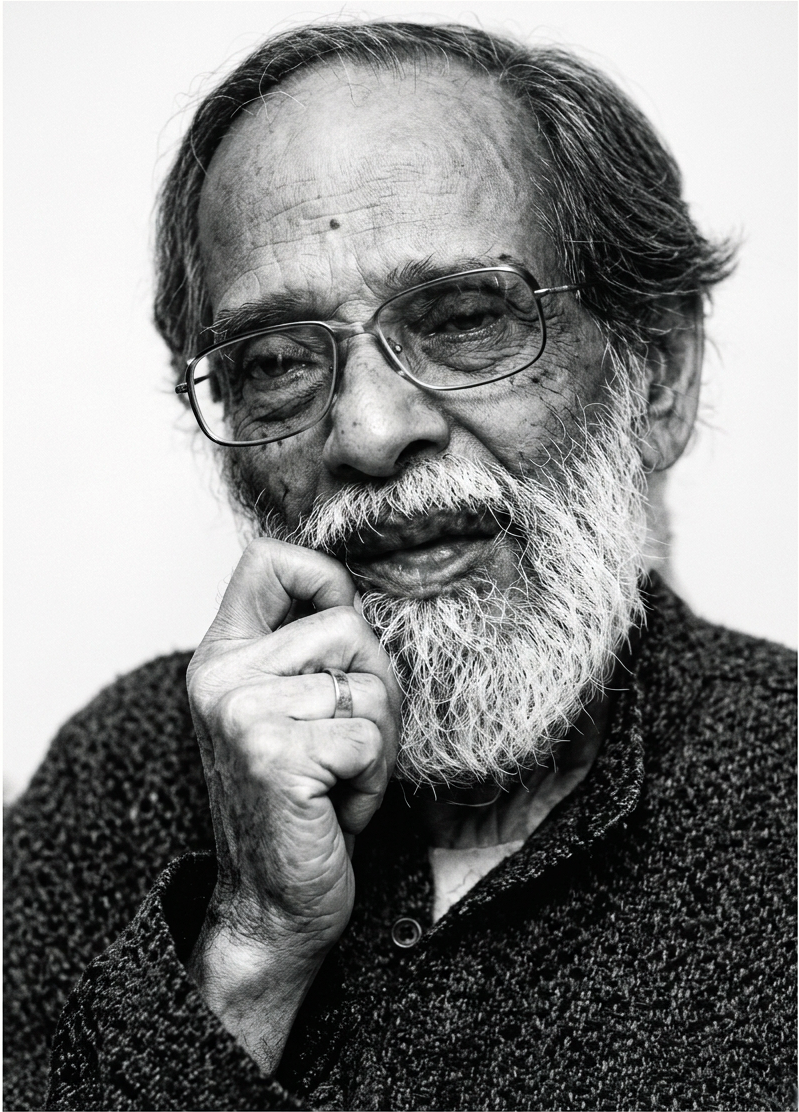
Amitabha Banerjee was an important Indian painter and printmaker whose practice contributed significantly to the development of modern graphic art in Bengal. Born in 1928 in Bengal, he received his formal training at the Government College of Art & Craft, Calcutta. Although he worked across painting and drawing, he became especially recognised for his mastery of printmaking, particularly etching, engraving, and intaglio. Some online records give 1929 as his birth year; Aakriti Art Gallery’s archival material records 1928.
Banerjee emerged as a major printmaker during the 1970s, a period when graphic art was gaining renewed institutional importance in India. His participation in the Smithsonian Printmaking Workshop and All India Graphic Art Camp in New Delhi in 1970 brought him into dialogue with artists such as Shyamal Dutta Ray, Lalu Prasad Shaw, Suhas Roy, and Sanat Kar. The workshop was directed by American printmaker Paul Lingren and contributed to the wider exchange of technical and conceptual ideas in Indian printmaking.
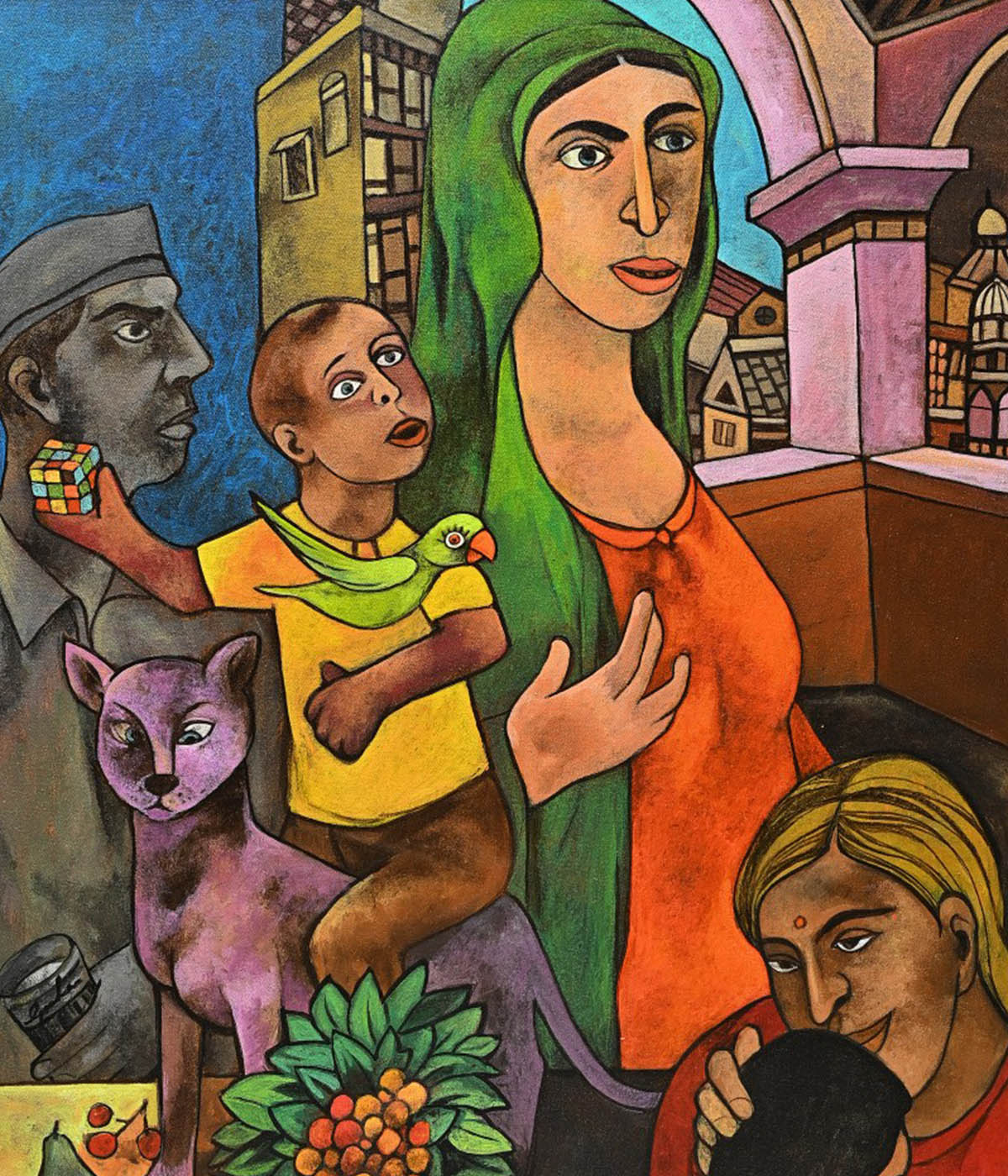
His prints demonstrate a sophisticated command of process without allowing technique to overwhelm artistic expression. Banerjee used the incised line, tonal depth, and layered textures of the intaglio medium to construct psychologically charged images. His work frequently moves between figuration and symbolic suggestion, presenting human forms, interior spaces, and enigmatic situations through a restrained but emotionally resonant visual language.
A notable feature of Banerjee’s practice is the close relationship between technical discipline and imaginative freedom. His compositions are carefully structured, yet they retain a sense of ambiguity and poetic unease. The printed surface becomes a field in which memory, solitude, anxiety, and the complexities of human existence are explored. His approach helped establish printmaking as an independent form of contemporary artistic expression rather than merely a reproductive technique.
Banerjee participated in several major national and international exhibitions. Important presentations included the Third British International Print Biennale (1972), the Western Pacific Print Biennale, Australia (1976), and editions of Intergrafik in Germany in 1978 and 1984. His work was also included in major exhibitions of Indian graphic art and in presentations organised by institutions and artist collectives across India.
His artistic achievements were recognised through several important honours, including the All India Award presented by Group 8 (1971), an award from the Birla Academy of Art & Culture (1972), the AIFACS Award (1975), the National Award of the Lalit Kala Akademi (1981), and recognition for etching in Chandigarh in 1983. In 2007, the Government of West Bengal honoured him for his lifetime contribution to art.
Banerjee was closely associated with the development of collective printmaking practices in Bengal. He participated in graphic portfolios and exhibitions involving members of the Society of Contemporary Artists, alongside figures such as Ganesh Haloi, Ganesh Pyne, Somnath Hore, Lalu Prasad Shaw, Sanat Kar, and Shyamal Dutta Ray. His inclusion in these initiatives situates him within an important network of artists who strengthened modern printmaking in eastern India.
His works are held in significant institutional collections, including the National Gallery of Modern Art, New Delhi, the Lalit Kala Akademi, and the Birla Academy of Art & Culture, Kolkata, as well as numerous private collections in India and abroad.
Amitabha Banerjee’s legacy lies in his ability to combine technical mastery with emotional and philosophical depth. Through his sustained exploration of etching, engraving, and intaglio, he helped expand the expressive possibilities of modern Indian printmaking and remains an important figure in the history of graphic art in Bengal.