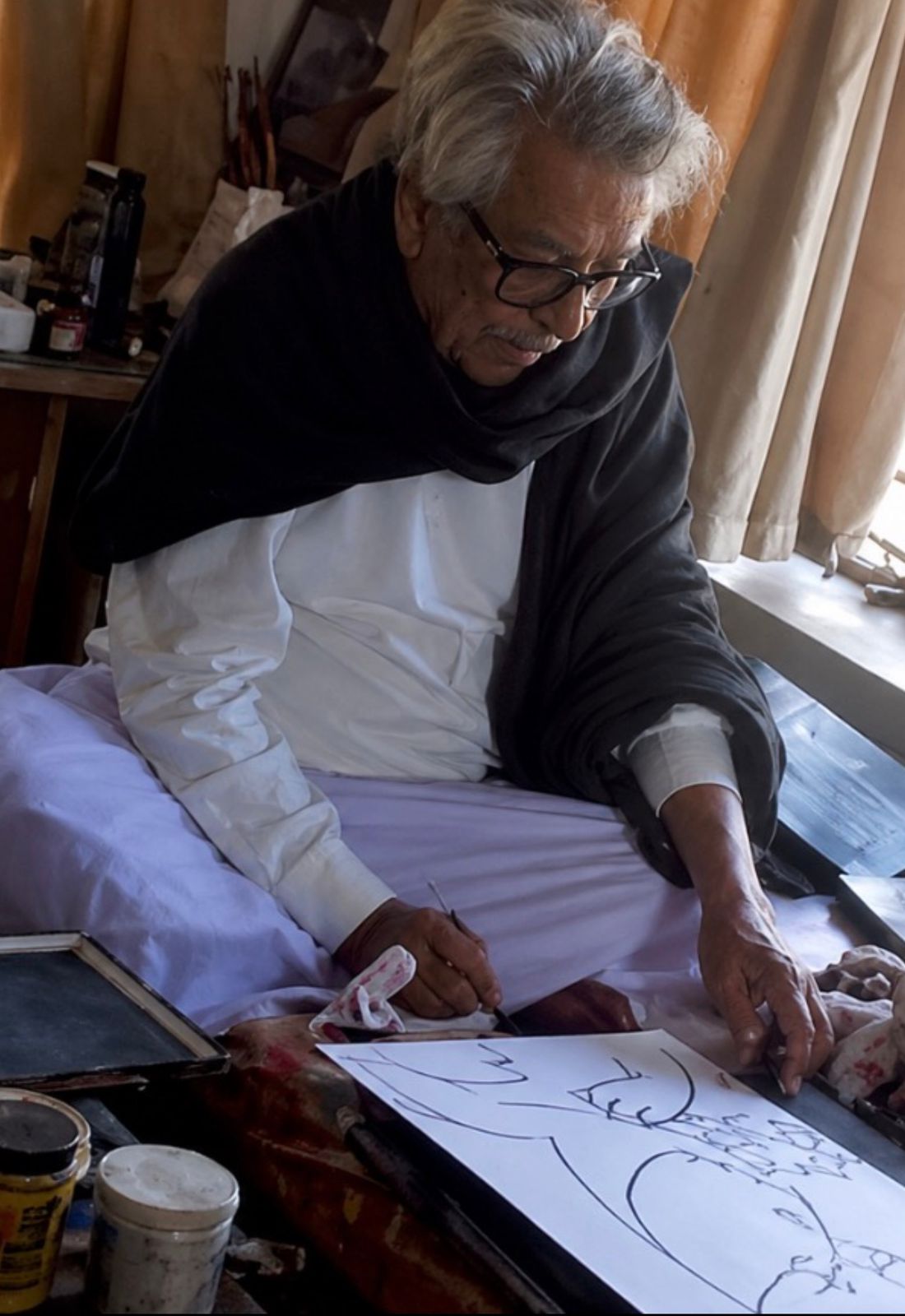
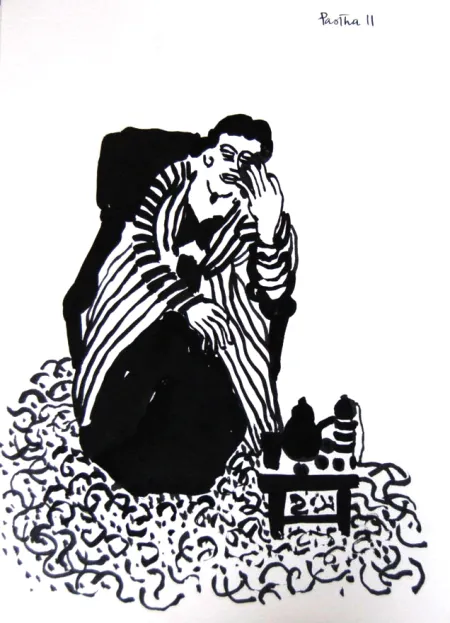
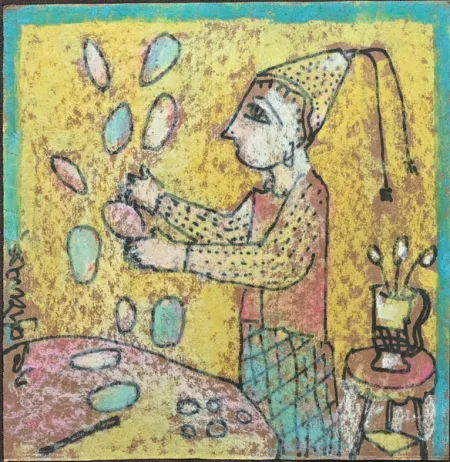
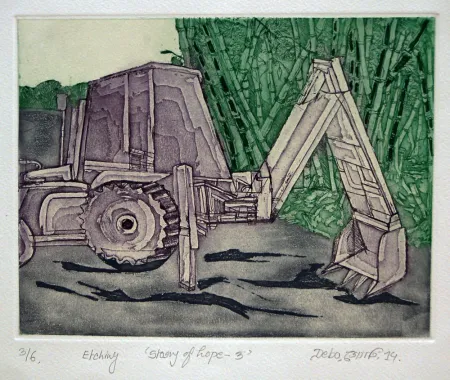
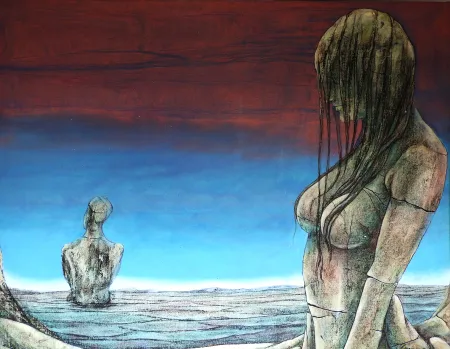
Sanat Kar was a major Indian painter, printmaker, teacher, and institutional figure whose experiments significantly expanded the language of modern printmaking in India. Born on 29 July 1935 in Kolkata, he studied at the Government College of Art & Craft, Calcutta, graduating in 1955. Over a career extending across more than six decades, he worked in painting, drawing, tempera, etching, engraving, wood intaglio, and other experimental print processes.
During his student years, Kar helped establish the Artists’ Circle with fellow artists including Arun Bose and Prokash Karmakar. He later became one of the founding members and joint secretaries of the Society of Contemporary Artists, formed in Kolkata in 1960. The collective played an important role in encouraging experimentation and strengthening the position of modern art and printmaking in Bengal.
Printmaking and Technical Innovation
Kar is particularly remembered for his pioneering experiments with wood intaglio. In conventional woodcut, ink is generally transferred from the raised surface of a carved block. Kar reversed this relationship by printing from incised areas, adapting the principles of intaglio to wooden plates. When conventional materials became difficult or expensive to obtain, he experimented with plywood, sunmica, cardboard, and other accessible surfaces. These innovations allowed him to produce richly textured prints and extended the technical possibilities available to Indian printmakers.
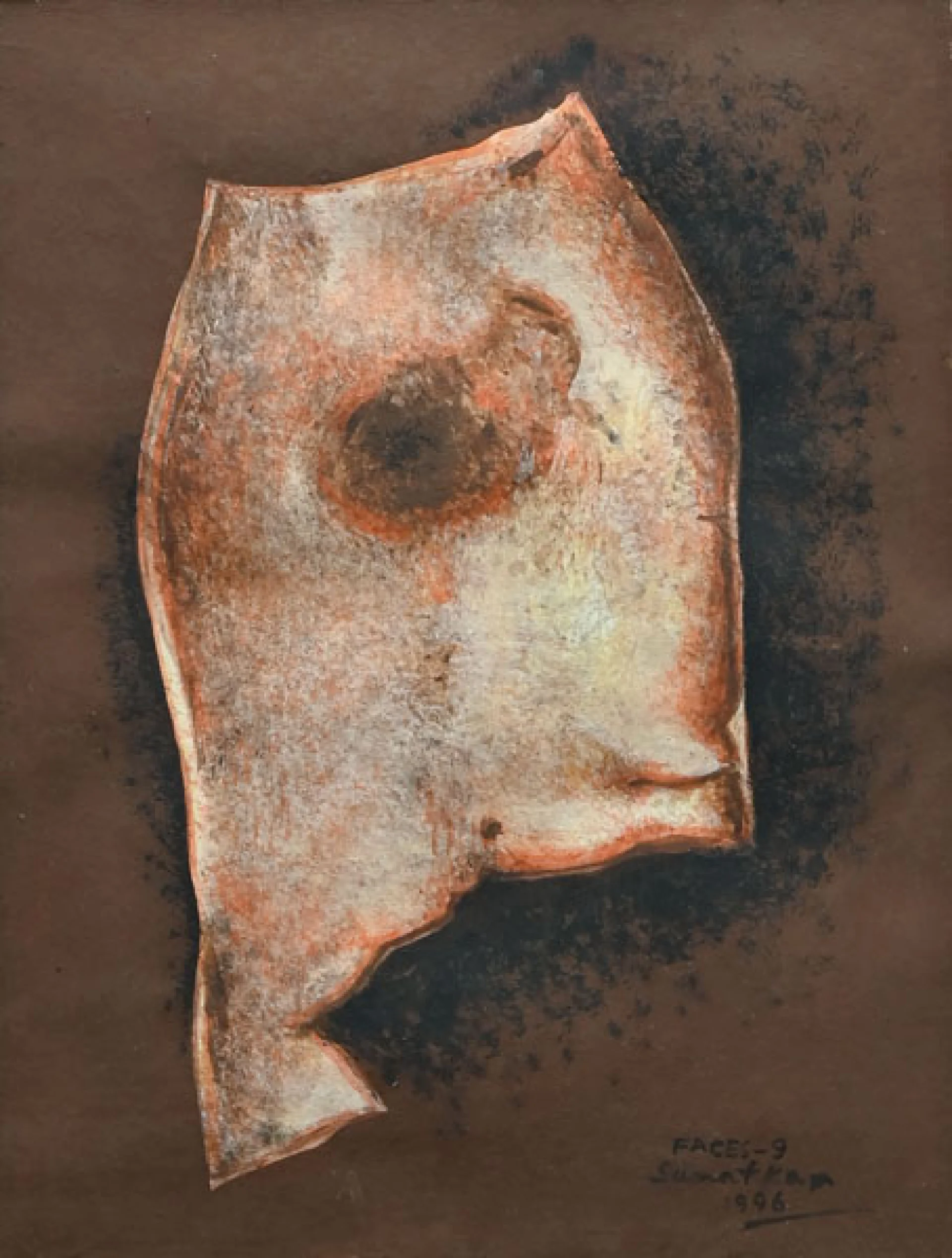
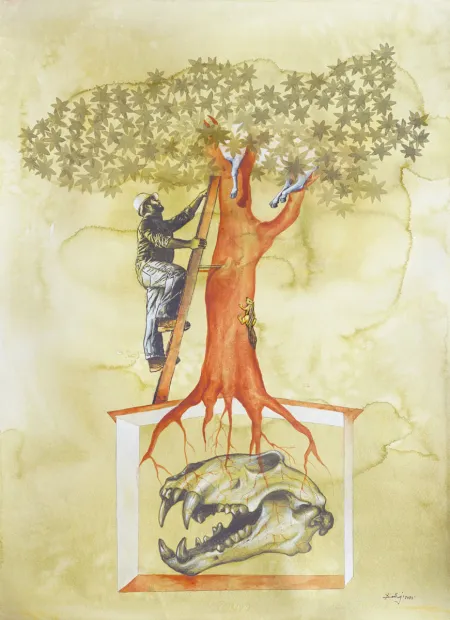
His technical experimentation was never an end in itself. It supported a visual language concerned with memory, fantasy, mortality, desire, and the hidden regions of the mind. Human faces, skeletal figures, animals, trees, birds, and dreamlike beings emerge from dark, densely worked surfaces. His imagery often appears simultaneously fragile and unsettling, suspended between reality and imagination.
The eye is a recurring motif in Kar’s work. Enlarged or intensely focused eyes appear as signs of consciousness, fear, memory, and inward vision. Figures often seem to look beyond the visible world, suggesting psychological states that cannot be expressed through conventional narrative. His mature works are therefore frequently associated with surrealism, although their imagery developed from personal experience, Indian visual traditions, and his own imaginative world rather than from a direct adoption of European models.
Painting and Major Series
Alongside printmaking, Kar produced an extensive body of paintings and works on paper. He worked in tempera, ink, pastel, and mixed media, creating compositions distinguished by restrained colour, fine linear detail, and mysterious spatial relationships.
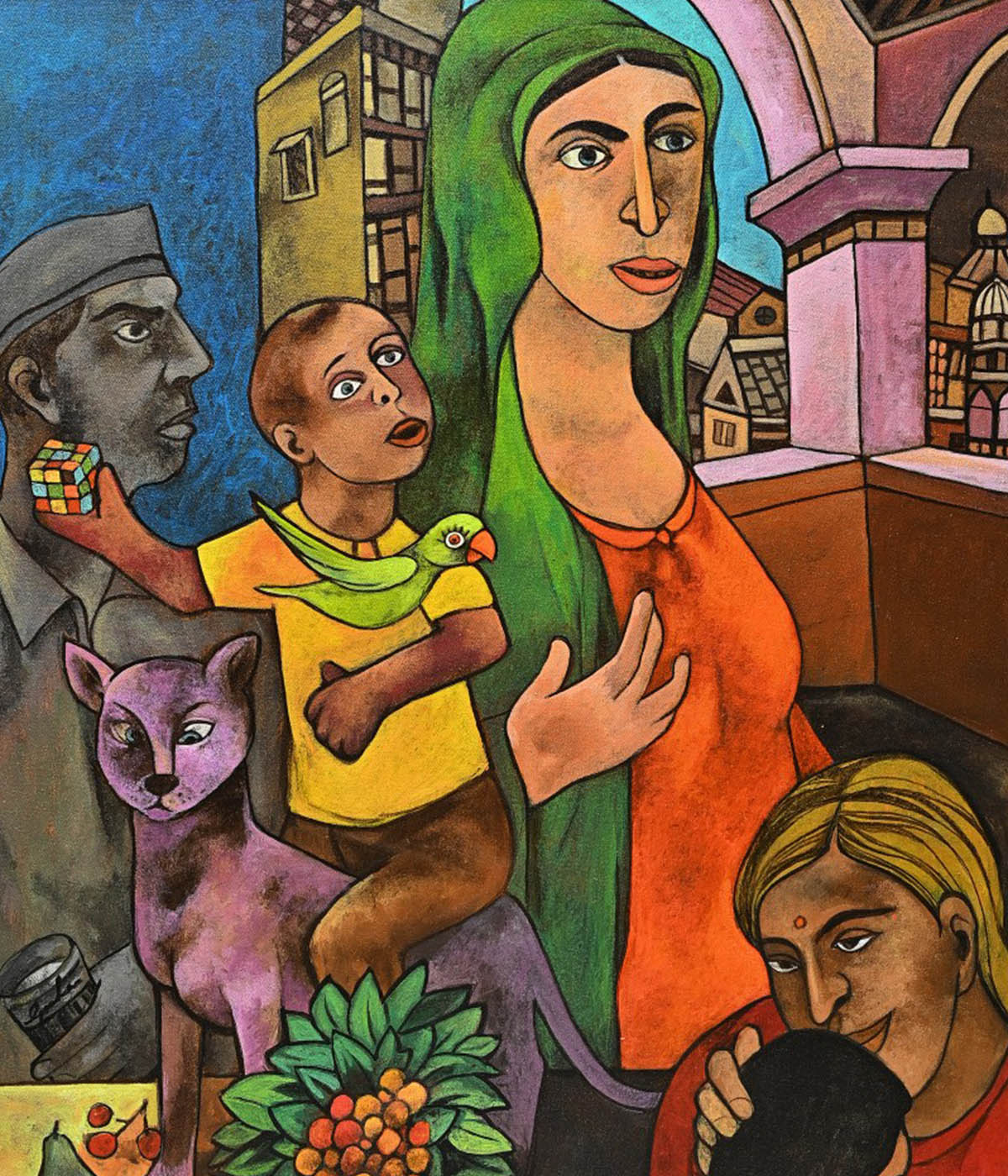
His important series include Ikebana, Leaves, Maya, Dreamers, and Homage to Kalighat Pats. The Maya works examine illusion, uncertainty, and the changing nature of human experience. His Dreamers often present solitary figures absorbed in private psychological worlds, while the Homage to Kalighat Pats series reinterprets the bold contours, simplified forms, and satirical energy of nineteenth-century Kalighat painting through a modern visual language.
Nature also remained an important presence in his work. Leaves, flowers, branches, birds, and organic forms frequently appear, but they are rarely treated as straightforward botanical studies. They become symbols of transformation, decay, regeneration, and the fragile continuity of life.
Teaching and Kala Bhavana
Kar joined the Department of Graphic Art at Kala Bhavana, Visva-Bharati, Santiniketan, in 1974. He later became Head of the Department and eventually served as Principal of Kala Bhavana. After his retirement in 1995, he was appointed Professor Emeritus.
His contribution as a teacher was closely connected with his experimental approach to materials. He encouraged students to understand printmaking as an independent creative discipline and to explore inexpensive, locally available surfaces rather than remain dependent on established European procedures. Through his teaching, he influenced several generations of painters and printmakers.
Kar also participated in educational projects connecting children’s drawings, writing, lithography, and bookmaking. These collaborative activities reflected the broader Santiniketan belief that artistic education should connect imagination, craft, literature, and community life.
Exhibitions and Honours
Kar held his first solo exhibition in Kolkata in 1962 and subsequently exhibited widely in India. Important presentations included exhibitions at Triveni Kala Sangam, New Delhi, Art Heritage, New Delhi, Pundole Art Gallery, Mumbai, the Birla Academy of Art & Culture, Kolkata, Akar Prakar, Gallery Sanskriti, and other institutions. A major retrospective was presented by CIMA, Kolkata, in 2019.
His honours included the AIFACS Award, awards from the West Bengal State Lalit Kala Akademi and Paschimbanga Rajya Charukala Parishad, the Shiromani Puraskar, Kala Vibhushan, the Gagan-Abani Puraskar, the Abanindra Puraskar, the Shilpi Maha Samman, and the Zainul Abedin Puraskar. In 2022, the Birla Academy of Art & Culture honoured him with a Lifetime Achievement Award.
Association with Aakriti Art Gallery
Sanat Kar’s work forms an important part of Aakriti Art Gallery’s engagement with modern printmaking and art from Bengal. The gallery has presented and documented his prints, paintings, and works on paper through its collection, curated exhibitions, publications, and online archive.
His practice is particularly relevant to Aakriti’s research into the development of graphic art in Bengal and the role played by the Society of Contemporary Artists in establishing printmaking as an independent modern medium. The final website version should include the precise titles and dates of his exhibitions with Aakriti after these are verified from the gallery’s internal records and catalogues.
Sanat Kar died at Santiniketan on 9 January 2023. His importance lies in the unity he achieved between technical invention and poetic imagination. Through wood intaglio, experimental engraving, painting, and drawing, he developed a deeply personal visual world concerned with dreams, illusion, memory, and mortality. His contribution as an artist and teacher places him among the most significant figures in the history of modern Indian printmaking.