“Europe Belongs to Picasso… India Belongs Only to Me” || Why Amrita Sher-Gil Chose India as Her Artistic Destiny
Amrita Sher-Gil could have remained a celebrated European-trained painter. Instead, at the height of her early success in Paris, she consciously returned to India, convinced that her artistic future lay here. Drawing upon her letters, travels and paintings, this article explores the remarkable decision that transformed both her career and the course of modern Indian art.
-- Research & Compiled by Aakriti Art Gallery team
When discussing Amrita Sher-Gil (1913–1941), most biographies begin with familiar details: she was born in Budapest, trained in Paris, and died tragically at the age of twenty-eight. While all of this is true, it overlooks the single decision that defines her artistic legacy.
Amrita Sher-Gil chose India.
At a time when Paris was unquestionably the centre of the modern art world, she walked away from a promising European career and returned to a country whose modern artistic identity was still being formed. It was not a sentimental homecoming or an act of nostalgia. It was an artistic conviction.
Her now-famous declaration captures this with extraordinary confidence:
“Europe belongs to Picasso, Matisse, Braque and many others. India belongs only to me.”
Few statements by an Indian artist have been quoted more often. Yet few have been understood in their full context.
Sher-Gil was not claiming ownership over India. She was recognising an artistic challenge. Europe already possessed its modern masters. India, she believed, was still waiting for a visual language capable of expressing its own modern identity.
That belief would shape every important painting she created during the final years of her life.
The Hungarian Uncle Who Changed Everything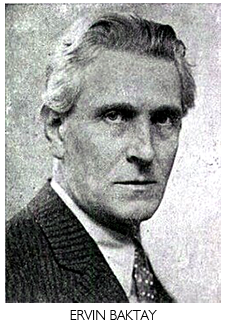
The story begins not in Paris, but with an uncle.
Ervin Baktay—Indologist, writer, translator and a painter in his younger years—was one of the first to recognise Amrita’s extraordinary artistic talent. During visits to the family home, he encouraged rigorous observation rather than copying academic conventions. He asked the young Amrita to sketch domestic workers, servants and ordinary people, believing that truthful observation formed the foundation of good drawing.
Years later, Sher-Gil acknowledged his influence with remarkable generosity, writing that she owed her ability to draw to Baktay’s early guidance.
His advice was simple but profound: learn to see before attempting to interpret.
That principle remained with her throughout her career.
Paris Gave Her Technique—but Not Her Subject
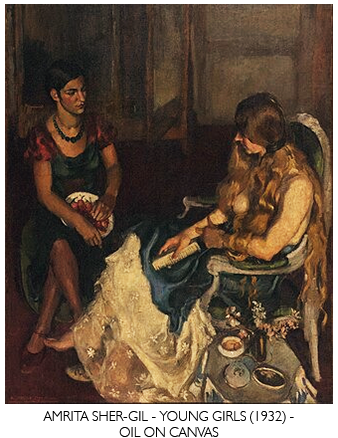 At sixteen, Sher-Gil moved to Paris, studying first at the Académie de la Grande Chaumière before entering the prestigious École des Beaux-Arts under Lucien Simon.
She absorbed European academic training with astonishing speed. Anatomy, composition, colour and oil painting became second nature.
Recognition followed quickly.
Her 1932 painting Young Girls, portraying her sister Indira alongside a French friend, earned her election as an Associate of the Grand Salon—a distinction rarely achieved by such a young artist and virtually unprecedented for an Asian woman.
By conventional standards, her future seemed assured.
Yet success brought dissatisfaction rather than fulfilment.
Paris had refined her technique, but it had not given her an artistic purpose.
She later confessed to feeling an overwhelming desire to return to India—a place she believed contained the subjects, colours and emotional depth she had been searching for.
Discovering India Anew
Sher-Gil returned to India in late 1934.
Rather than settling immediately into studio practice, she travelled extensively across the country. Her journeys through South India and her encounters with the Ajanta cave murals became transformative experiences.
Unlike many European-trained artists who sought exotic subjects, Sher-Gil approached India with remarkable humility.
She studied.
She observed.
She absorbed.
The quiet dignity of village women, the sculptural solidity of Ajanta’s painted figures, the restrained elegance of Mughal miniatures and the lyrical simplicity of Pahari painting gradually entered her visual vocabulary.
She was not interested in imitation.
She sought synthesis.
Her ambition was to unite European structural discipline with an Indian emotional and cultural sensibility.
Beyond Revivalism
Sher-Gil’s position within Indian art was unusually independent.
Although deeply inspired by India’s artistic heritage, she resisted mere revivalism. She admired the achievements of the Bengal School but believed that simply recreating historical styles could not produce a genuinely modern Indian art.
At the same time, she had little interest in becoming a European painter working in India.
Her project lay somewhere between these worlds.
She retained the compositional strength and painterly confidence acquired in Paris while rejecting the polished elegance often associated with European salon painting. Equally, she embraced India’s visual traditions without allowing them to become decorative quotations.
This independence explains why her work still feels remarkably contemporary.
The South Indian Trilogy
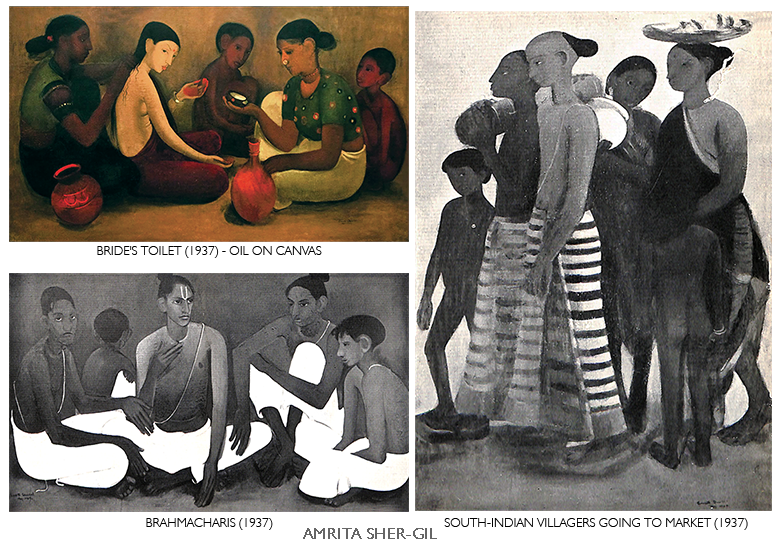 Sher-Gil’s artistic vision reached a new level of maturity in what is now known as the South Indian Trilogy—Bride’s Toilet, Brahmacharis and South Indian Villagers Going to Market (1937).
These paintings represent one of the defining moments in twentieth-century Indian art.
In Bride’s Toilet, the central figure is neither idealised nor theatrical. The women occupy a private psychological space, their expressions restrained yet emotionally resonant. The muted earth colours and simplified forms echo Ajanta while remaining unmistakably modern.
Brahmacharis presents young ascetics not as religious symbols but as monumental human presences. The composition possesses a sculptural stillness that recalls ancient mural traditions without becoming archaeological.
Perhaps the most celebrated of the three, South Indian Villagers Going to Market, transforms an everyday rural procession into a timeless statement about labour, community and human dignity. There is no sentimentality, no picturesque romanticism—only quiet observation elevated through extraordinary formal control.
Together, these works announced the arrival of a distinctly Indian modernism.
Painting the People History Ignored
One of Sher-Gil’s greatest achievements was her choice of subject.
She did not paint princes or patrons.
She painted village women.
Peasants.
Labourers.
Children.
Brides.
Musicians.
Ordinary people whose lives had rarely occupied the centre of academic painting.
Yet she refused to sentimentalise poverty.
Her figures possess weight, silence and psychological presence. Their stillness is never passive. It invites contemplation rather than spectacle.
In doing so, Sher-Gil expanded the possibilities of modern portraiture in India, replacing idealised beauty with emotional truth.
A Small Oeuvre, An Immense Legacy
Amrita Sher-Gil produced only around 170 known oil paintings before her untimely death in Lahore in December 1941.
Measured purely by numbers, her output was remarkably small.
Measured by influence, it transformed Indian art.
She demonstrated that modern Indian painting need not imitate Europe nor retreat into historical nostalgia. Instead, it could engage deeply with India’s own people, traditions and landscapes while remaining fully modern in vision.
Today, many of her paintings are recognised as National Art Treasures and are preserved by the National Gallery of Modern Art in New Delhi. Her letters—later compiled and edited by her nephew, artist Vivan Sundaram—reveal an intellect as compelling as her paintings, offering rare insight into the doubts, ambitions and convictions that shaped her remarkable career.
An Artistic Homecoming
Amrita Sher-Gil’s declaration that “Europe belongs to Picasso… India belongs only to me” was never an expression of arrogance.
It was a statement of responsibility.
She believed India deserved an artistic language that was neither derivative of Europe nor imprisoned by the past. Her brief but extraordinary career became an attempt to create precisely that language.
Less than three decades after her birth, her life came to an abrupt end.
Yet the question she posed continues to resonate.
What does it mean to create an art that is profoundly modern while remaining deeply rooted in one’s own culture?
Few artists have answered that question with greater courage—or greater beauty—than Amrita Sher-Gil.

Comments
Join the Discussion
Please login to post comments.
Login