Fanindra Nath Bose: The Indian Sculptor Who Conquered Britain Before Independence
Long before Indian artists became regular names in international museums and biennales, a young sculptor from Bengal quietly broke barriers in Edinburgh and Paris, becoming the first Indian sculptor to gain recognition in Britain and the first Asian elected to the Royal Scottish Academy.
-- Research & Compiled by Aakriti Art Gallery team
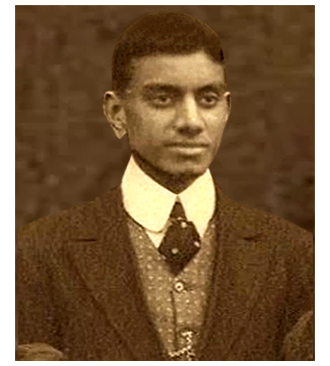
The history of modern Indian sculpture is often told through names like Ramkinkar Baij, Debi Prasad Roy Chowdhury, or Sankho Chaudhuri. Yet decades before these artists transformed Indian sculpture, another remarkable figure had already made history in Europe.
His name was Fanindra Nath Bose (1888–1926).
Today, his achievements are little known outside specialist circles, but during his lifetime he accomplished something extraordinary. He became one of the earliest Indian sculptors to establish an international reputation, the first Indian sculptor to gain mainstream recognition in Great Britain, and the first Asian artist elected to the Royal Scottish Academy.
His story deserves to be restored to the centre of Indian art history.
From Bengal to Scotland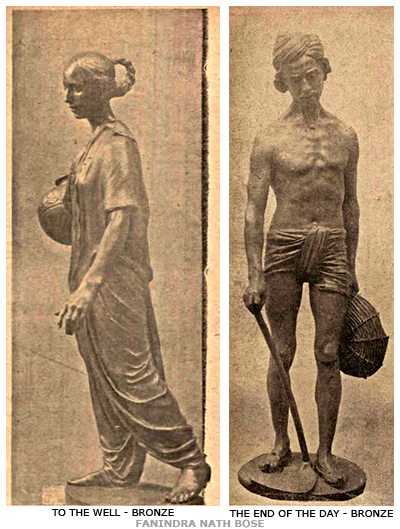 Born in Bohor, Bikrampur, Bengal (present-day Bangladesh) in 1888, Fanindra Nath Bose displayed artistic promise from an early age. He studied at the Jubilee Art Academy and later at the Government School of Art, Calcutta, where he came under the influence of E.B. Havell, one of the most influential art educators of the period.
Unlike many of his contemporaries who turned towards painting, Bose was drawn to sculpture. He became fascinated by anatomy, modelling, and the challenge of giving permanent form to the human body.
Determined to pursue advanced training, he travelled to Europe in the first decade of the twentieth century.
The journey was far from easy.
He reportedly faced rejection from several prestigious institutions, including the Royal College of Art in London and academies in Italy, reflecting the racial and institutional barriers confronting colonial artists at the time.
Rather than returning home, Bose persisted.
His determination led him north to Scotland.
Edinburgh: Where Talent Found Recognition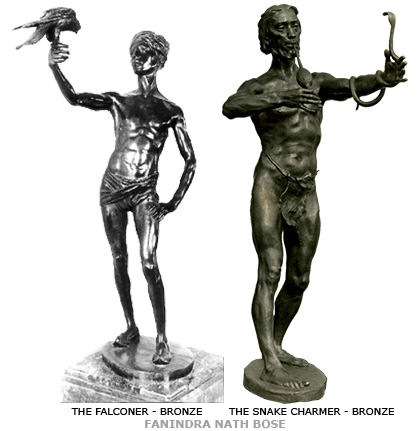 In 1905, Bose enrolled at the Board of Manufacturers School of Art in Edinburgh. When the institution evolved into the newly established Edinburgh College of Art (ECA) in 1908, he became part of its very first cohort of students.
His exceptional ability was quickly recognised.
While studying at the Royal Scottish Academy Life School, he won the prestigious Stuart Prize for Figure Drawing, demonstrating an extraordinary command of anatomy and modelling.
More importantly, he came under the mentorship of sculptor Percy Portsmouth, Head of Sculpture at Edinburgh College of Art.
Portsmouth later wrote with admiration:
"Bose excelled in small sculpture; he had a phenomenal control of minutiae. It was most interesting to watch his beautiful hands manipulate his tools… he was an exquisite craftsman."
Such praise from one of Scotland’s leading sculptors speaks volumes about Bose’s technical mastery.
Paris and the Influence of Rodin
After graduating with a Diploma in Sculpture in 1911, Bose was awarded a competitive travelling scholarship jointly supported by the University of Edinburgh and the Government of Bengal.
The scholarship took him to Paris.
There, between 1912 and 1915, he encountered the artistic environment shaped by Auguste Rodin and Antonin Mercié, two of the most influential sculptors of the era.
Rodin’s emphasis on movement, emotion, and expressive modelling left a lasting impression.
Rather than producing rigid academic monuments, Bose embraced a sculptural language that celebrated gesture, psychological depth, and the subtle rhythms of the human body.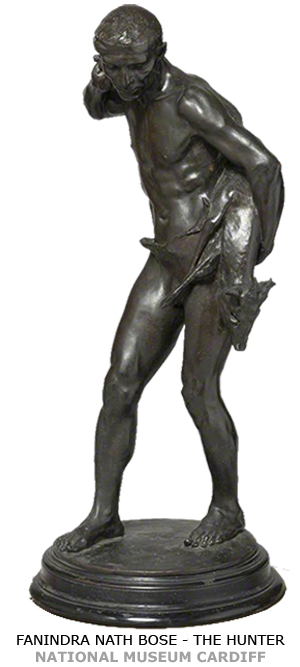
His work became closely aligned with what historians now identify as the “New Sculpture” movement—a late nineteenth and early twentieth-century development that rejected static Victorian monumentality in favour of fluid realism and intimate bronze figures.
A Royal Patron from India
Returning to Edinburgh, Bose established an independent studio in Dean Village.
One sculpture in particular changed the course of his career.
His statuette The Hunter, exhibited in 1913, attracted the attention of Maharaja Sayajirao Gaekwad III of Baroda.
Impressed by its vitality and anatomical precision, the Maharaja appointed Bose as Court Sculptor and commissioned numerous works for the magnificent Lakshmi Vilas Palace.
This royal patronage connected European academic training with Indian princely patronage, demonstrating how Bose successfully navigated both worlds.
A Different Vision from the Bengal School
Bose’s career unfolded during the same period that the Bengal School was redefining Indian painting through wash techniques, Mughal miniatures, and Ajanta-inspired aesthetics.
Yet his artistic path diverged significantly.
While many Bengal School artists rejected Western academic realism, Bose embraced it.
His sculptures reveal careful anatomical observation, muscular modelling, and expressive physical movement rooted in European training while maintaining Indian subjects and sensibilities.
Public Sculpture and Civic Memory
Bose’s achievements extended beyond studio sculpture.
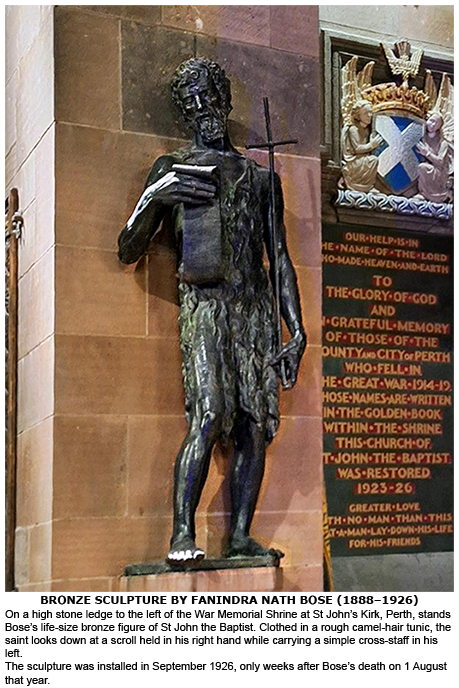
He executed important public commissions including the Ormiston War Memorial (1925) in East Lothian, Scotland, and St John the Baptist for a church in Perth.
These works demonstrated that an Indian sculptor could contribute meaningfully to Britain’s own civic and commemorative landscape during the colonial era.
It was an extraordinary reversal of expectations.
Where Are His Works Today?
Ironically, much of Fanindra Nath Bose’s legacy survives outside India.
His sculptures are held in important British institutions including the National Museum Cardiff, the Royal Scottish Academy, and the Hunterian Museum in Glasgow.
The Ormiston War Memorial remains an enduring public monument in Scotland.
As a result, many Indian audiences remain unfamiliar with an artist whose career unfolded largely overseas.
Why Has He Been Overlooked?
Several factors contributed to Bose’s relative obscurity.
His early death in 1926 curtailed what might have become an even more influential career.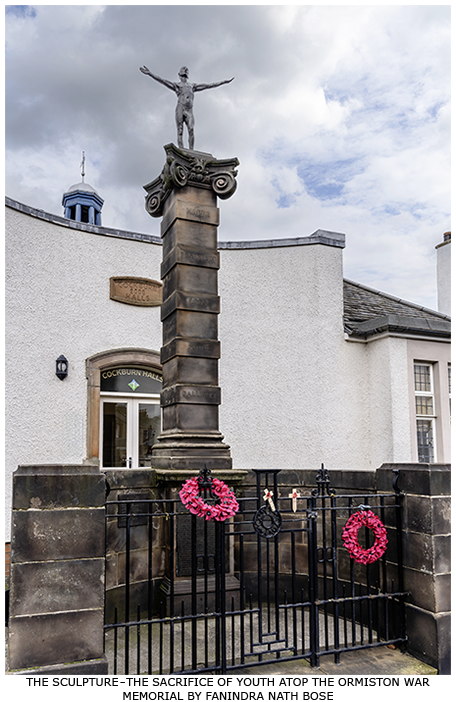
Much of his work remained in Britain rather than India.
The rise of the Bengal School and later Santiniketan modernism shifted scholarly attention towards painting, while sculpture occupied a smaller place in the national narrative.
Yet his achievements remain extraordinary.
He crossed continents at a time when few Indian artists travelled abroad, overcame institutional prejudice, studied under some of Europe’s finest sculptors, secured royal patronage, and established himself within the highest artistic circles of Scotland.
Reclaiming Fanindra Nath Bose
Today, as museums and scholars revisit neglected histories, Fanindra Nath Bose deserves renewed attention.
He was not merely an Indian artist working overseas.
He was one of the earliest cultural ambassadors of Indian sculpture, proving that artistic excellence could transcend geography, race, and empire.
Long before Indian artists became fixtures of international biennales and global auctions, Bose had already demonstrated that an artist from Bengal could stand confidently alongside Europe’s finest sculptors.
His story reminds us that the history of modern Indian art was never confined within national borders.
It was forged through journeys, exchanges, and remarkable individuals who quietly changed the course of history.
Endnotes
- Edinburgh College of Art archives and historical records relating to the institution’s founding and early students.
- Royal Scottish Academy records documenting Fanindra Nath Bose’s election and exhibition history.
- Percy Portsmouth’s contemporary observations on Bose’s craftsmanship and sculptural practice.
- Research on the New Sculpture movement and its influence on British sculpture in the late nineteenth and early twentieth centuries.
- Studies on Maharaja Sayajirao Gaekwad III’s patronage of the arts and commissions at Lakshmi Vilas Palace.
- National Museum Cardiff, Royal Scottish Academy, and Hunterian Museum collection records.
Selected Bibliography
- Edinburgh College of Art Archives.
- Royal Scottish Academy publications and exhibition catalogues.
- National Museum Cardiff collection records.
- Hunterian Museum, Glasgow collection documentation.
- Studies on the British New Sculpture movement.
- Research on Indian artists in Britain during the colonial period.
- Historical records relating to the Lakshmi Vilas Palace commissions.
Editorial Note
This article seeks to restore attention to Fanindra Nath Bose’s remarkable international career and should be read as an invitation for further archival research. Much of his oeuvre remains dispersed across British collections, presenting significant opportunities for future scholarship on the global history of modern Indian sculpture.
Comments
Join the Discussion
Please login to post comments.
Login