William Simpson and Edwin Lord Weeks: Two Orientalists and the Changing Gaze on India
How a Scottish documentarian and an American painter captured — and transformed — the Western image of nineteenth-century India
-- By Nanak Ganguly
Curator & Art Critic
The arrival of European artists in India during the late eighteenth and nineteenth centuries played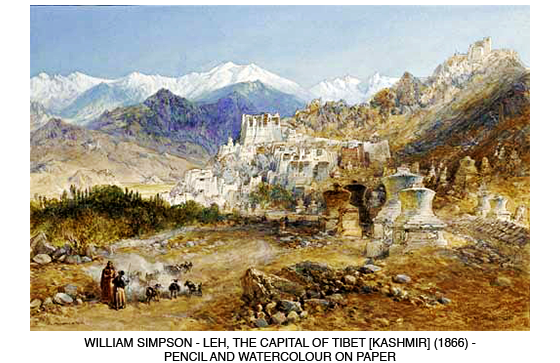 a decisive role in shaping how the subcontinent was imagined in the West. What began as the picturesque documentation of landscapes and monuments gradually evolved into a more complex visual language — part ethnographic record, part romantic fantasy, and part imperial narrative. Among the many artists who contributed to this visual archive, two figures stand out for the depth and range of their engagement with India: the Scottish artist William Simpson (1823–1899) and the American painter Edwin Lord Weeks (1849–1903). Though separated by a generation, both men produced bodies of work that reveal shifting attitudes toward India in the nineteenth century.
The foundation for this Orientalist visual tradition was laid by earlier travellers. William Hodges, the first professional landscape painter to visit India (1780–83), produced Select Views in India (1787), which introduced British audiences to the dramatic Indian landscape and ancient monuments. His work was followed by the monumental achievement of Thomas Daniell (1749–1840) and his nephew William Daniell (1769–1837). Between 1786 and 1793 the Daniells travelled extensively across northern and southern India, producing the celebrated six-volume Oriental Scenery (1795–1808) — 144 hand-coloured aquatints that remain among the most 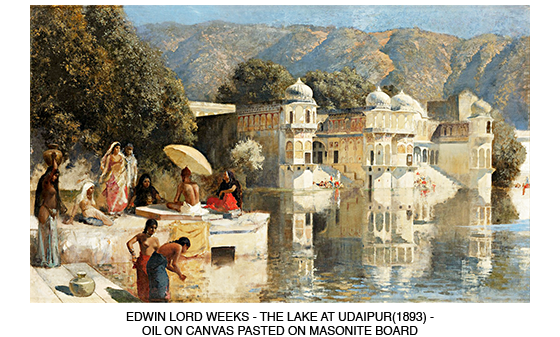 influential depictions of Indian architecture and scenery ever created. Their meticulous use of the camera obscura combined with artistic licence created images that were both accurate and romantically appealing. These early works established the visual vocabulary of the picturesque and the sublime that later artists would inherit, adapt, or react against.
By the mid-nineteenth century, the political landscape had changed dramatically. The uprising of 1857 had shaken British confidence and intensified curiosity about India. It was into this charged atmosphere that William Simpson arrived in Calcutta in October 1859. Commissioned by the publishers Day & Son to produce illustrations of the recent rebellion and its aftermath, Simpson joined Lord Canning’s viceregal progress through the country. Over the next three years he travelled an extraordinary distance — estimated at more than 22,000 miles — covering Punjab, the North-West Frontier, the Himalayas, Kashmir, central India, Bengal, and Madras.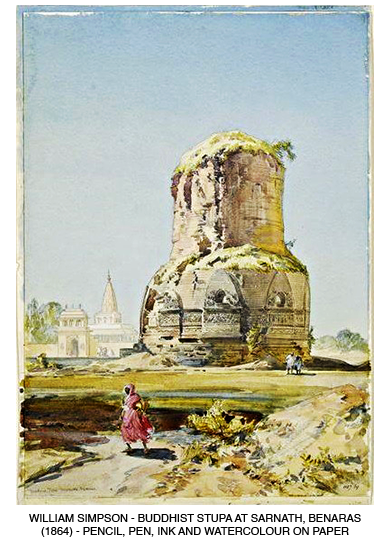 Simpson was not merely a topographical recorder. His sketchbooks, later published in part as Visions of India (1986), reveal an artist deeply interested in both the monumental past and the living present. He drew ancient Buddhist sites at Bhilsa (Sanchi), the source of the Ganges, the forts of Rajasthan, and the devastated cities of Lucknow and Cawnpore. At the same time he recorded the everyday — villagers, soldiers, religious ceremonies, and the changing face of a country recovering from conflict. His watercolours combine precise architectural detail with a sensitive observation of light and atmosphere. Unlike the Daniells, who worked largely before the full consolidation of British rule, Simpson’s India was one in which the British presence was inescapable. His images therefore carry an implicit narrative of restoration and imperial order, even as they document the richness of Indian civilisation.
Simpson’s work was intended for a major publication, India Ancient and Modern, but the financial collapse of Day & Son meant that only a limited number of chromolithographs appeared. Nevertheless, his hundreds of sketches and watercolours remain one of the most comprehensive visual records of mid-nineteenth-century India by any single European artist. They stand as both artistic achievement and historical document.
If Simpson represented the documentary, post-Mutiny British gaze, Edwin Lord Weeks embodied a later, more colourful and cosmopolitan vision. An American painter who trained in Paris under Léon Bonnat and Jean-Léon Gérôme, Weeks made three extended visits to India between 1882 and the early 1890s. Unlike most earlier British artists who worked under Company or official patronage, Weeks travelled as an independent artist-explorer, funding his journeys through the sale of paintings and his own travel writings.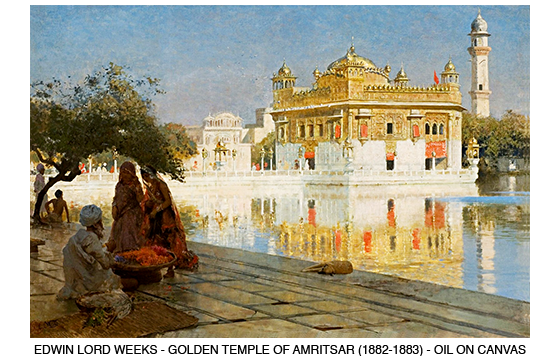
Weeks approached India with the eye of a painter trained in the academic Orientalist tradition yet deeply responsive to colour and atmosphere. His canvases are notable for their luminous quality, rich palette, and meticulous attention to architectural detail and daily life. He painted the Golden Temple at Amritsar, the palaces and lakes of Udaipur, the ghats of Benares, the Taj Mahal, and vibrant street scenes in Lahore, Delhi, and Bombay. His works often feature crowded markets, processions, and architectural splendour rendered with both ethnographic precision and romantic warmth. While he shared the Orientalist fascination with the “exotic,” Weeks’s paintings are less overtly imperial than those of many British predecessors. They convey a genuine delight in the visual richness of India — its colours, textures, and human variety — rather than a narrative of conquest or control.
Weeks also documented his travels in writing. His accounts reveal an artist who moved relatively freely across the subcontinent, sketching and photographing as he went (he made extensive use of photography as an aid to his painting). His large-scale canvases, such as scenes of Indian courts and religious festivals, brought the splendour of India to American and 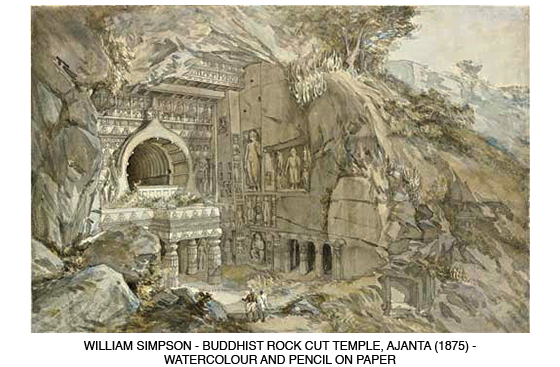 European audiences in a way that felt immediate and alive. In this sense, Weeks represents the maturation of Orientalist painting: more technically accomplished, more colourful, and less constrained by official narratives than the work of the Daniells or even Simpson.
Together, Simpson and Weeks illustrate two distinct but related moments in the nineteenth-century European engagement with India. Simpson’s India is one of documentation and recovery — a land whose ancient glories and recent upheavals needed to be recorded for a British public still coming to terms with the events of 1857. Weeks’s India is one of spectacle and sensuous detail — a land of colour, architecture, and human drama that could be celebrated on the grand scale of academic painting. Both men contributed to the construction of “India” as an idea in the Western imagination, yet their approaches differed significantly in tone, technique, and purpose.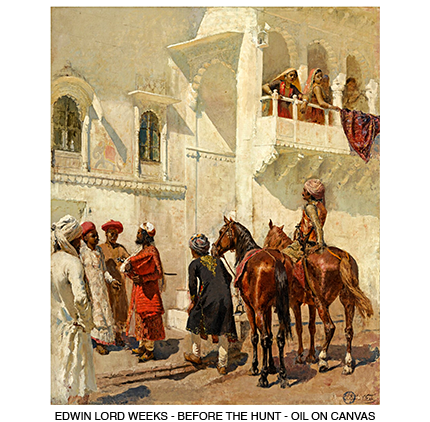
Their works also remind us that Orientalism was never a monolithic project. It encompassed the measured topographical views of the Daniells, the ethnographic curiosity of Solvyns and the Company School artists, the post-Mutiny documentation of Simpson, and the luminous, cosmopolitan vision of Weeks. Each generation of artists brought new technologies, new political contexts, and new aesthetic priorities to their encounter with India.
Today, the paintings and sketches of Simpson and Weeks continue to serve as valuable historical documents while also standing as significant artistic achievements in their own right. They allow us to see how two very different artists — one Scottish and documentary in temperament, the other American and painterly — responded to the same complex and changing country. In doing so, they help us understand not only nineteenth-century India but also the ways in which visual culture shaped, and continues to shape, our perceptions of the past.

Comments
Join the Discussion
Please login to post comments.
Login