Two Visions, One Art School: E.B. Havell, Percy Brown and the Making of Modern Indian Art
At the Government School of Art in Calcutta, two British principals introduced contrasting educational philosophies that profoundly influenced the evolution of modern Indian art. Rather than representing opposing camps, E.B. Havell and Percy Brown helped create a remarkably pluralistic artistic environment whose legacy continues to shape Indian art today.
-- Research & Compiled by Aakriti Art Gallery team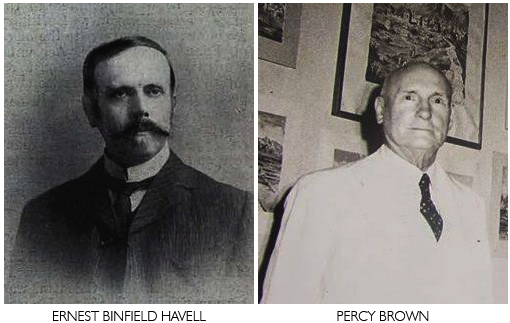 The history of modern Indian art is often narrated through celebrated artists—Abanindranath Tagore, Nandalal Bose, Jamini Roy, Rabindranath Tagore or the Progressive Artists’ Group. Far less attention is paid to the institutions and educators who shaped these artists before they developed their individual voices.
Among the most influential was the Government School of Art, Calcutta (now the Government College of Art & Craft), arguably the most important centre of artistic education in eastern India during the late nineteenth and early twentieth centuries. It was here that two British principals—Ernest Binfield Havell (1861–1934) and Percy Brown (1872–1955)—introduced two markedly different visions of art education.
One sought to revive India’s indigenous artistic traditions and restore cultural confidence under colonial rule. The other emphasised disciplined observation, technical excellence and the enduring value of European academic realism. Although their educational philosophies differed, together they created one of the richest and most influential artistic environments in colonial India.
The story of Indian modernism is therefore not one of artistic opposition, but of coexistence.
A Colonial Art School Before Reform
Established in 1854, the Government School of Art initially followed the model adopted throughout the British Empire. Students learned drawing from plaster casts, anatomy, perspective, geometry, modelling and decorative design. European academic realism was regarded as the universal language of artistic excellence.
By the closing decades of the nineteenth century, many Indian students had mastered these techniques with remarkable proficiency. Yet critics increasingly questioned whether this system merely produced competent imitators of European art rather than artists capable of expressing India’s own cultural identity.
It was into this debate that E.B. Havell entered.
Havell and the Rediscovery of Indian Aesthetics
Appointed Principal in 1896, E.B. Havell challenged the prevailing assumption that European academic realism represented the highest form of artistic achievement.
Unlike many colonial administrators, Havell believed that India already possessed one of the world’s greatest artistic traditions. Ajanta murals, Mughal miniatures, Rajput painting, Buddhist sculpture and classical temple art demonstrated sophisticated aesthetic principles that deserved equal respect alongside European art.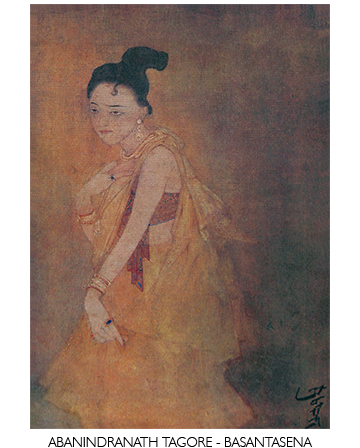
Working closely with Abanindranath Tagore, Havell transformed both the curriculum and intellectual atmosphere of the School. Students were encouraged to study Indian painting, indigenous craftsmanship and Asian artistic philosophies rather than merely copying Greco-Roman plaster casts.
His reforms coincided with the growing Swadeshi Movement, giving the revival of Indian artistic traditions a powerful cultural and political dimension.
For Havell, art education was not simply technical training—it was an act of cultural renewal.
Beyond Nationalism
Havell’s programme was often described as a rejection of European realism, but the reality was more nuanced.
He admired technical skill and careful observation. What he opposed was the unquestioned dominance of Victorian academic conventions in India. His aim was not to isolate Indian artists from the wider world but to encourage them to build modern art upon indigenous foundations.
His collaboration with Abanindranath Tagore, supported intellectually by figures such as Sister Nivedita, Ananda K. Coomaraswamy, and influenced by the Pan-Asian ideas of Okakura Kakuzō, laid the intellectual foundations of what would later become known as the Bengal School of Art.
Its emphasis on lyricism, symbolism, spiritual expression and historical continuity profoundly influenced Indian art during the early twentieth century.
Percy Brown and the Discipline of Observation
 When Percy Brown assumed the principalship in 1909, Indian art education entered another significant phase.
Brown has often been portrayed simply as the defender of European academic realism. Such characterisations, however, overlook the breadth of his contribution.
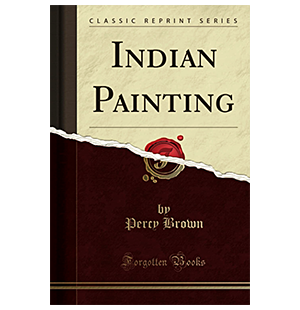
A distinguished educator, curator and later the first curator of the Victoria Memorial Hall, Brown combined rigorous academic training with deep scholarly interest in India’s artistic heritage. His landmark publications, including Indian Architecture and Indian Painting, remain important references even today.
Unlike Havell, Brown did not believe that academic realism and Indian artistic traditions were mutually exclusive. He maintained that mastery of drawing, anatomy, proportion and observation formed the essential foundation upon which any artistic language could be built.
Rather than replacing Havell’s legacy, Brown strengthened another equally important dimension of artistic education: technical discipline.
Academic Realism Finds Its Own Voice
During Brown’s tenure, artists continued to receive rigorous instruction in life drawing, portraiture and oil painting. This education produced some of the finest academic painters of twentieth-century India.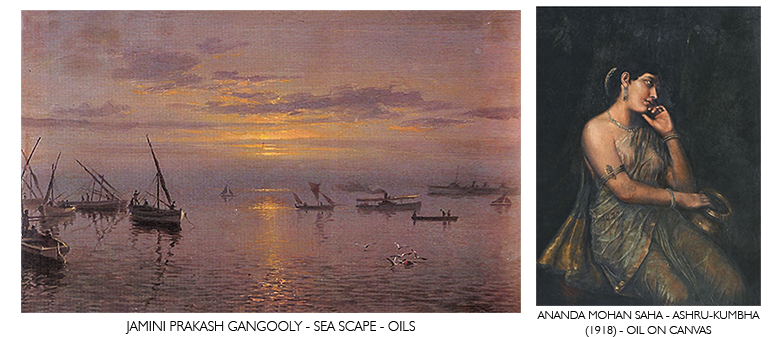
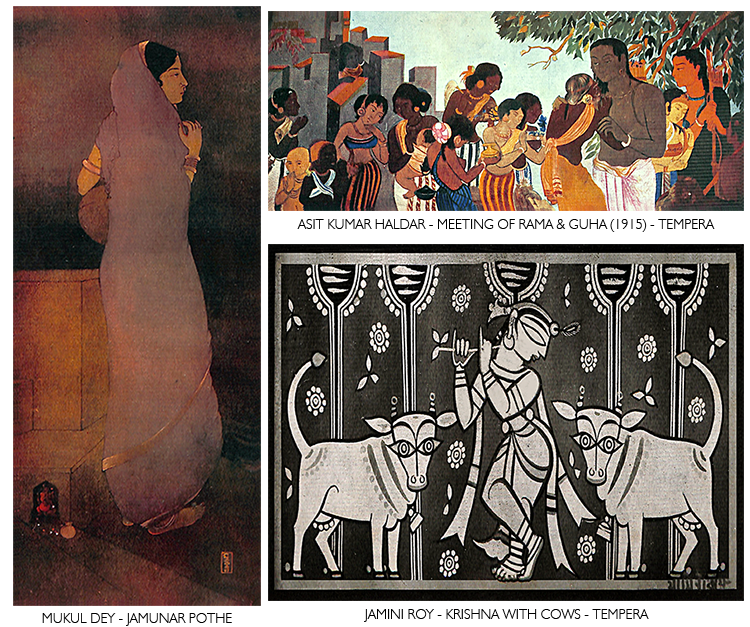
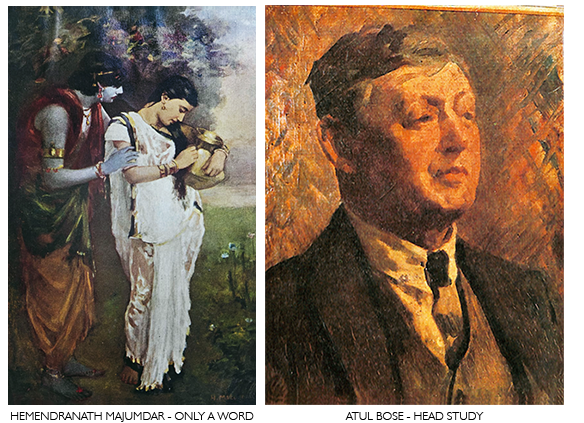
Artists such as Hemendranath Majumdar, Atul Bose, Jamini Prakash Gangooly, Basanta Kumar Ganguly, and Ananda Mohan Saha, demonstrated that academic realism could evolve into a distinctly Indian visual language without merely imitating Europe.
Their paintings reveal remarkable technical accomplishment while engaging deeply with Indian subjects, personalities and social life.
Recent research into Ananda Mohan Saha’s work—including the rediscovery of Ashru-Kumva (1918)—further demonstrates that academic realism continued to evolve alongside the Bengal School rather than disappearing beneath it.
 Students Between Two Worlds
The history of the Government School of Art cannot be divided neatly into two opposing camps.
Many artists experienced aspects of both educational philosophies during their careers.
Mukul Dey, for example, mastered academic drawing before pioneering etching in India and later engaging deeply with Santiniketan.
Asit Kumar Haldar, although closely associated with the Bengal School, possessed formidable academic skills acquired through systematic training.
Even Jamini Roy, who would later reject European naturalism in favour of Bengali folk traditions, first mastered academic realism before consciously abandoning it.
These examples remind us that Indian modernism developed through dialogue rather than ideological purity.
Beyond a False Binary
Art history has often privileged the Bengal School as the principal narrative of early modern Indian art.
This emphasis, while understandable, has sometimes overshadowed the equally important contributions of academic realist painters.
Both traditions sought to modernise Indian art, albeit through different methods.
The Bengal School looked to India’s historical artistic heritage for inspiration.
Academic realism sought excellence through observation, craftsmanship and technical mastery.
Neither approach existed in isolation.
Indeed, many artists moved fluidly between them.
Understanding this complexity allows us to move beyond simplistic binaries of “colonial” versus “nationalist” art.
A Richer Modernism
The coexistence of Havell’s revivalism and Brown’s academic realism ultimately strengthened Indian art rather than dividing it.
One restored confidence in India’s artistic past.
The other ensured that generations of artists acquired rigorous professional skills.
Together they produced an extraordinary diversity of artistic expression—from the lyrical wash paintings of Abanindranath Tagore to the powerful realism of Hemendranath Majumdar; from Nandalal Bose’s contextual modernism to the academic brilliance of Atul Bose; from the quiet poetry of Santiniketan to the technical refinement of portrait painters who remained committed to observation.
Modern Indian art emerged not from a single ideology but from the productive tension between multiple artistic traditions.
Reconsidering Their Legacy
More than a century later, the educational debate initiated by Havell and Brown remains remarkably relevant.
Should art education prioritise technical mastery or conceptual thinking?
Should artists look inward towards their own traditions or outward towards international influences?
The experience of the Government School of Art suggests that these need not be opposing choices.
Its greatest achievement was not choosing one philosophy over another, but creating an environment in which multiple artistic languages could flourish simultaneously.
The history of modern Indian art is richer precisely because Havell and Brown imagined different futures—and because generations of artists found ways to learn from both.
Their greatest legacy was not a style, but the freedom to choose one.
Editorial Note
The history of Indian modern art is often framed through artistic movements rather than the educators who shaped them. Yet institutions such as the Government School of Art in Calcutta played a decisive role in nurturing generations of artists who would define twentieth-century Indian art. This essay revisits two influential principals—E.B. Havell and Percy Brown—not as ideological adversaries but as educators whose differing philosophies collectively enriched Indian artistic practice. Their coexistence reminds us that Indian modernism evolved through dialogue, diversity and multiple pathways rather than a single, unified vision.
Endnotes
- E.B. Havell served as Principal of the Government School of Art, Calcutta, from 1896 to 1905, introducing reforms that encouraged the study of Indian artistic traditions.
- Percy Brown was Principal of the Government School of Art from 1909 to 1927 and later Curator of the Victoria Memorial Hall, Kolkata.
- Havell collaborated closely with Abanindranath Tagore in developing what later became known as the Bengal School of Art.
- Percy Brown’s Indian Painting and Indian Architecture remain important contributions to the historiography of Indian art.
- The Government School of Art produced artists representing both revivalist and academic realist traditions, demonstrating the coexistence of multiple artistic philosophies.
- Recent research on artists such as Ananda Mohan Shaha has renewed scholarly interest in Bengal’s academic realist tradition, which has often received less attention than the Bengal School.
- Jamini Roy, Mukul Dey and several other artists initially received academic training before developing highly individual artistic languages.
- The interaction between revivalism and academic realism should be understood as complementary rather than mutually exclusive in the development of modern Indian art.
Selected Bibliography
- Brown, Percy. Indian Painting. London: Oxford University Press.
- Brown, Percy. Indian Architecture (Buddhist and Hindu Periods). Bombay: D.B. Taraporevala.
- Coomaraswamy, Ananda K. Rajput Painting. Oxford University Press.
- Guha-Thakurta, Tapati. The Making of a New “Indian” Art: Artists, Aesthetics and Nationalism in Bengal. Cambridge University Press.
- Havell, E.B. Indian Sculpture and Painting. London: John Murray, 1908.
- Havell, E.B. The Ideals of Indian Art. London: John Murray, 1911.
- Mitter, Partha. Art and Nationalism in Colonial India, 1850–1922. Cambridge University Press.
- Siva Kumar, R. Santiniketan: The Making of a Contextual Modernism. National Gallery of Modern Art.
- Victoria Memorial Hall Archives, Kolkata.
- Government College of Art & Craft Archives, Kolkata.
Most read articles
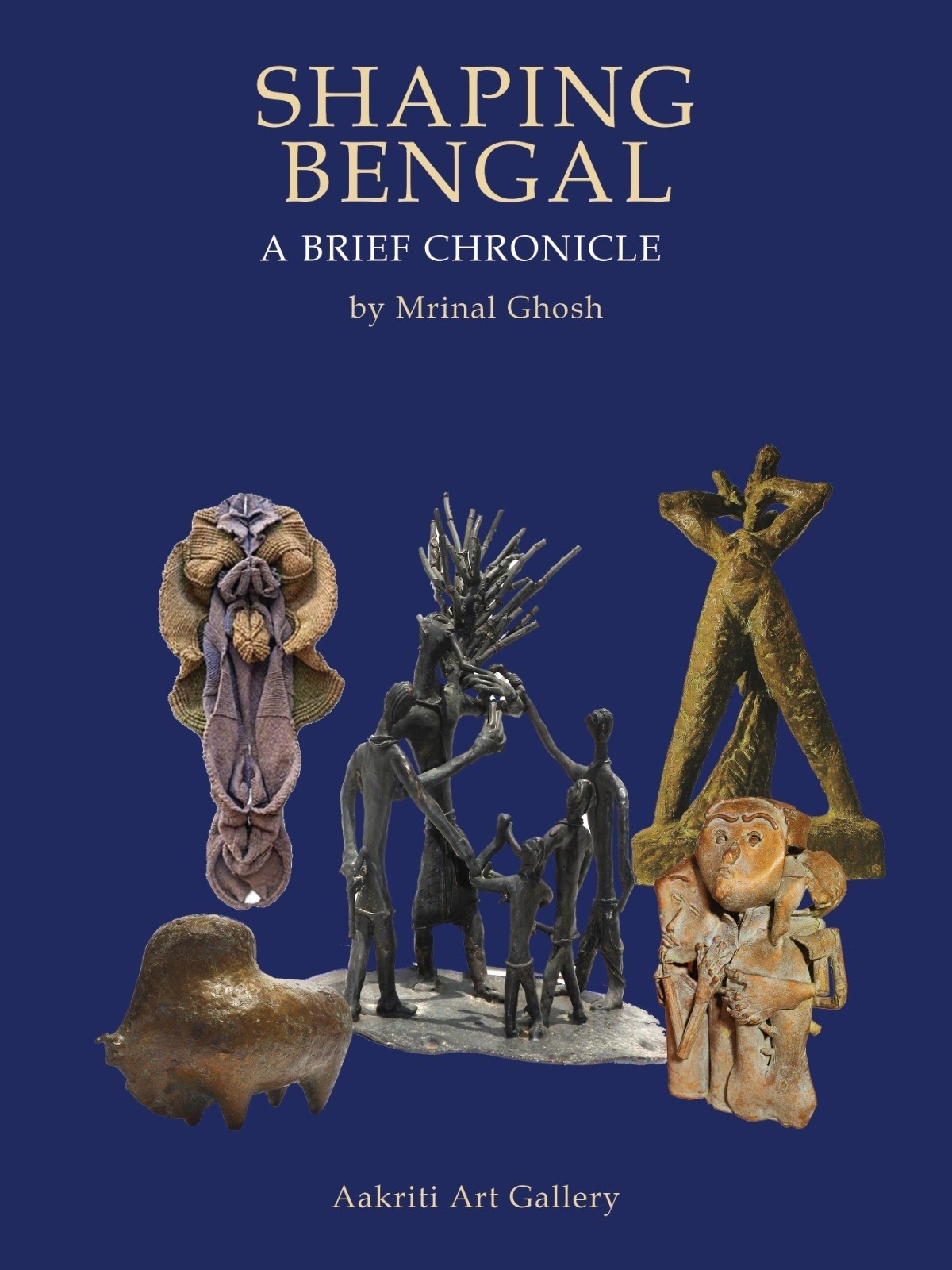
Shaping Bengal : A Chronicle of Modern Sculpture
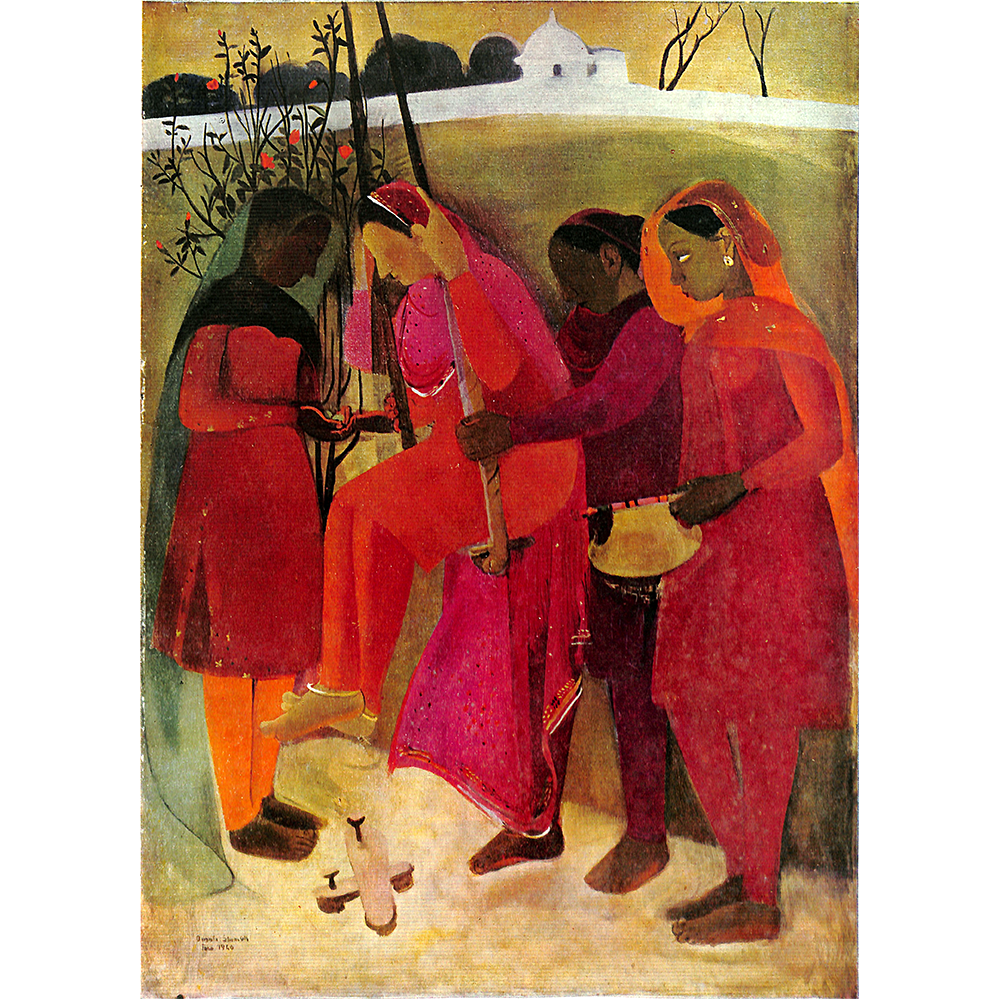
“Europe Belongs to Picasso… India Belongs Only to Me” || Why Amrita Sher-Gil Chose India as Her Artistic Destiny
A Star Amongst Too Many: Chandra Bhattacharjee at Birla Academy of Art & Culture
The Indian Art Market Comes of Age
The Resurgence of the Indian Art Market
Comments
Join the Discussion
Please login to post comments.
Login