Chaitanyadev Chattopadhyay and the Second Generation of the Bengal School
Published accounts of the Bengal School still concentrate on a small group of names: Abanindranath Tagore, Nandalal Bose, Kshitindranath Majumdar, Asit Kumar Haldar and their immediate circle. Painters who trained in the same rooms, exhibited in the same years and wrote for the same journals have often dropped out of the survey literature. Chaitanyadev Chattopadhyay (born January 1904; date of death not established) belongs to that second generation. The documentary record is incomplete, but it is no longer empty. What can be stated rests on training histories, periodical notices, a signed aesthetic essay, two catalogued picture-books and a small group of monochrome wash drawings inscribed in Bengali in a consistent hand.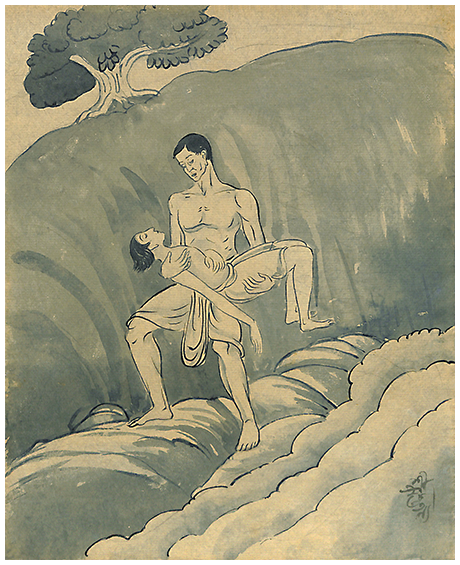
Training and affiliation
Chattopadhyay was the son of Jaminimohan Chattopadhyay and Subarnabala Devi. After the Entrance Examination at Uttarpara Government School he entered the Government School of Art, Calcutta, in 1922, during Percy Brown’s principalship. Preliminary instruction in the Indian style of painting was given by Ishwari Prasad Verma, then head of the Indian-painting department. Subsequent practice continued at the Indian Society of Oriental Art under Kshitindranath Majumdar. The sequence places him in the pedagogical line that ran from Abanindranath Tagore through the Society, rather than in the academic oil rooms of the colonial curriculum. A recent Asiatic Society publication includes him among artists connected with Abanindranath’s extended legacy, in a list that also names Nandalal Bose, Majumdar, Haldar, Sarada Charan Ukil, Hiranmoy Roy Chowdhury, Surendranath Kar and Bireshwar Sen. Inclusion in that list indicates affiliation, not equivalence of standing.
Periodical recognition
A contemporary notice in Prabasi, discussing mythological painting after Nandalal Bose, names Durgashankar Bhattacharya and Chaitanyadev Chattopadhyay among the few painters whose work was thought to continue that direction. Prabasi was a principal Bengali cultural monthly. The notice treats Chattopadhyay as a practising mythological painter, not merely as a student.
He also wrote criticism. In the Falgun issue of Bichitra he reviewed the annual exhibition of the Academy of Fine Arts. In remarks on Lalit Mohan Sen he praised Sen’s command of European oil, citing works including Sunlight and At the Door. The review is useful because it does not enforce a simple opposition between “Indian” wash and “Western” oil. A painter trained in the Oriental department could still recognise another method without abandoning his own.
Critical Collective preserves an essay published under the name Chaitanyadev Chattopadhyaya, “Art from the point of view of the artist.” The argument distinguishes two ways of knowing art: the spectator’s, which proceeds from seeing, and the artist’s, which proceeds from making. Spectators are many and artists few; on that ground the essay holds that, in questions of art, the maker’s view should be given weight. Art is described as the giving of new form to life and as a means of self-realisation. The language belongs to its period. The distinction it draws—between looking and making—is the essay’s durable point. It allows Chattopadhyay to be read as a painter who also wrote about practice.
Publications and extra-artistic notices
The digital catalogue of the University of Calcutta records a 1936 volume, Durgapuja-Chitrabali (entered as Dugapuja-Chitrabali), credited jointly to Sri Chaitanyadev Chattopadhyay and Sri Bishnupada Roy Choudry. A related Kalipuja-Chitrabali is catalogued under Bishnupad Roychowdhury and Chaitanyadeb Chattapadhyay. Festival picture-books of this kind link studio practice to Bengal’s public religious image-cycle. If complete copies can be compared with the wash drawings discussed below, they may supply the missing bridge between name and oeuvre.
The published diary of Bibhutibhushan Bandyopadhyay contains, for 28 January 1933, an editorial identification of “শিল্পী চৈতন্যদেব চট্টোপাধ্যায়.” The entry does not describe a picture. It places the name in a literary diary rather than only in an art-school register. A later memoir by Jyotirmoy Bhattacharya, writing of the household in which Soumitra Chatterjee grew up, refers to Chaitanyadev as a relative of Soumitra and as a student of Abanindranath, and states that the child watched him paint. The kinship has not been independently verified and should not be treated as established.
A history of the Chatterjee families of Uttarpara identifies him as the eldest son of the lawyer Jamini Mohan Chatterjee and describes him as both artist and revolutionary, convicted in connection with the Dakshineswar Bomb Case and later sent toward Kalimpong. The same source states that pictures appeared in Prabasi, Bharatbarsha and The Modern Review. Appearance in those journals is consistent with the Prabasi notice already cited and should be checked plate by plate. The bomb-case identification has not been corroborated by an independent judicial record, prison roll or contemporary newspaper report matching this painter. It remains a lead, not a fact of the biography.
Date of death, a full exhibition list and the claim that he became principal of the Indian Society of Oriental Art are likewise unverified. The responsible dating is therefore Chaitanyadev Chattopadhyay (1904–?).
The wash drawings
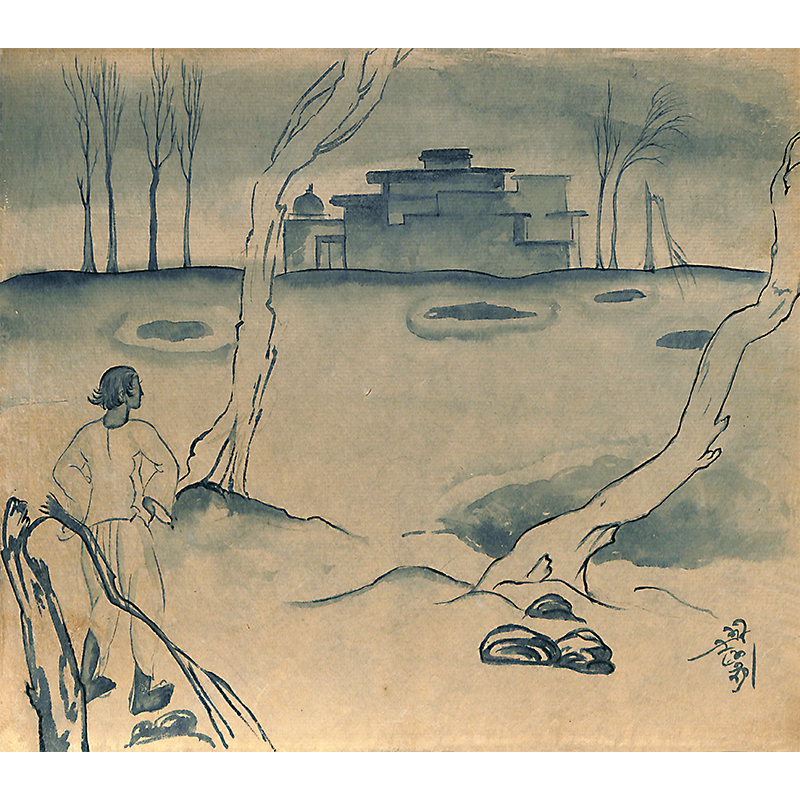
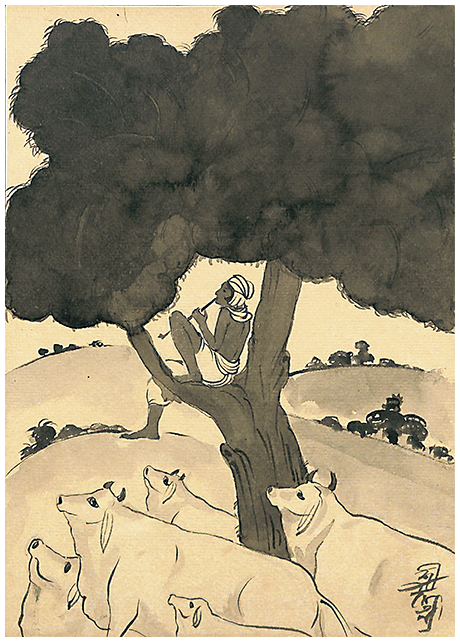
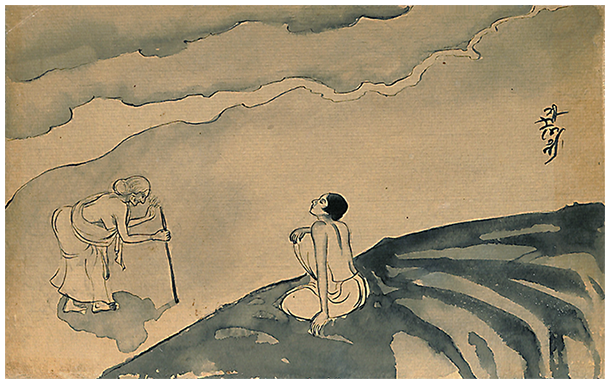
A group of monochrome drawings on toned paper—wash and ink line, mostly grey-blue or grey-brown—has been brought forward in connection with this research. Each 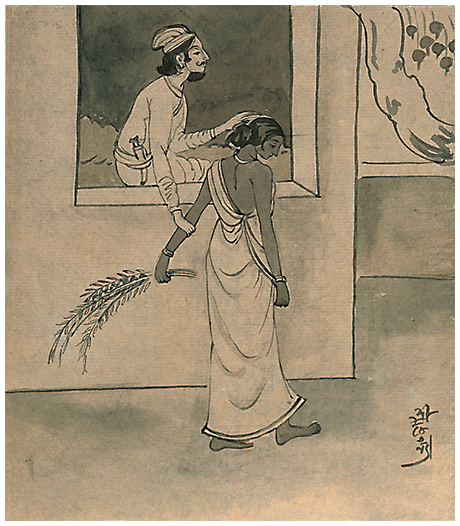 sheet carries a Bengali signature in a closely similar hand, usually at the lower left or lower right. Until the inscriptions are read against signed periodical plates, attribution remains provisional. The works can still be described as a coherent set.
The technique is consistent: a light ground; diluted wash for mass and weather; a wiry outline for the figure; little or no local colour. The method is that of the late Bengal School and the Oriental Society, closer to wash illustration than to oil. Subjects fall into several overlapping types.
Narrative and mythological sheets include a man carrying a recumbent figure across rocks beneath a hill-tree; a crowned standing figure beside a barred window, with a kneeling woman offering grain; a cowherd in a tree playing a flute above cattle; a woman seated on a rock in breaking water; a figure on a mountain path carrying a load while two others sit on a peak. Domestic and riverine sheets include a woman at the upper window of a white house, a boatman on the water, and heavy cloud; a woman in a sari touching hanging fruit at a doorway; a woman with a sheaf of grain turning away from a man at a window. Landscape and figure studies include a recumbent nude in an open landscape with distant buildings; two men in a forest, one stout and frontal; a woman with garlands on temple steps; a woman standing on a rise under piled cloud; a child and a jackal or fox among rocks; a narrow study of a fox.
What the set shows, if it is accepted as one hand, is not a single mythological specialism. Festival and Purana subjects sit beside river, house, cattle and animal studies. The Prabasi notice, which placed Chattopadhyay in the line of mythological painting after Nandalal, would account for only part of the group. The rest belongs to the broader wash practice of the 1920s and 1930s: the figure in landscape, the river house, the gopala motif, the lightly outlined female type inherited from the Society. Composition is generally simple—one or two figures, a tree or façade, a wash sky. Modelling is sparse. Emotion is carried by pose and interval rather than by facial detail.
These observations do not complete the oeuvre. They supply the kind of visual evidence the printed record has so far lacked. Comparison with plates in Prabasi, Bichitra, Bharatbarsha, The Modern Review and the two Chitrabali remains the necessary next step. Until that comparison is made, the drawings should be cited as a signed group associated with the inquiry, not as a closed catalogue.
Place in the literature
The interest of the case is structural. Second-generation Bengal School painters who neither founded a school nor entered the Progressive or Calcutta Group narratives have been easy to omit. Chattopadhyay’s name, however, is not an oral survival only. It appears in Prabasi, in Bichitra, in a Critical Collective essay, in a university catalogue and in a novelist’s diary. The drawings, if confirmed, would show a wash practice wider than the mythological label. Until the death date and the periodical plates are secured, the account should stay inside those limits. The second generation of the Bengal School will not be understood by repeating the first generation’s names. It will be understood by recovering the painters the journals once thought worth reviewing.
References
Asiatic Society publication listing artists in Abanindranath Tagore’s extended circle.
Prabasi, notice on mythological painting after Nandalal Bose.
Bichitra, Falgun issue, review of the Academy of Fine Arts annual exhibition.
Chaitanyadev Chattopadhyaya, “Art from the point of view of the artist,” Critical Collective.
University of Calcutta catalogue: Durgapuja-Chitrabali (1936); related Kalipuja-Chitrabali.
Bibhutibhushan Bandyopadhyay, published diary, 28 January 1933.
Jyotirmoy Bhattacharya, memoir referring to Soumitra Chatterjee’s childhood (kinship unverified).
Uttarpara Chatterjee family history (Dakshineswar Bomb Case claim unverified).
-- Research & Compiled by Aakriti Art Gallery team
Most read art news
How to Tell Whether a Print Is an Original Artist-Signed Impression or a Reproduction
The Work That Begins a Collection
Aakriti Art Gallery to Launch India’s First Integrated Art Platform Combining AI Advisory, Research, Archives, Publishing, and Art Acquisition
Aakriti Art Gallery Relaunches ‘GenNext’ as a Year-Round Platform for Emerging Artists
The Monumental World Within the Ordinary