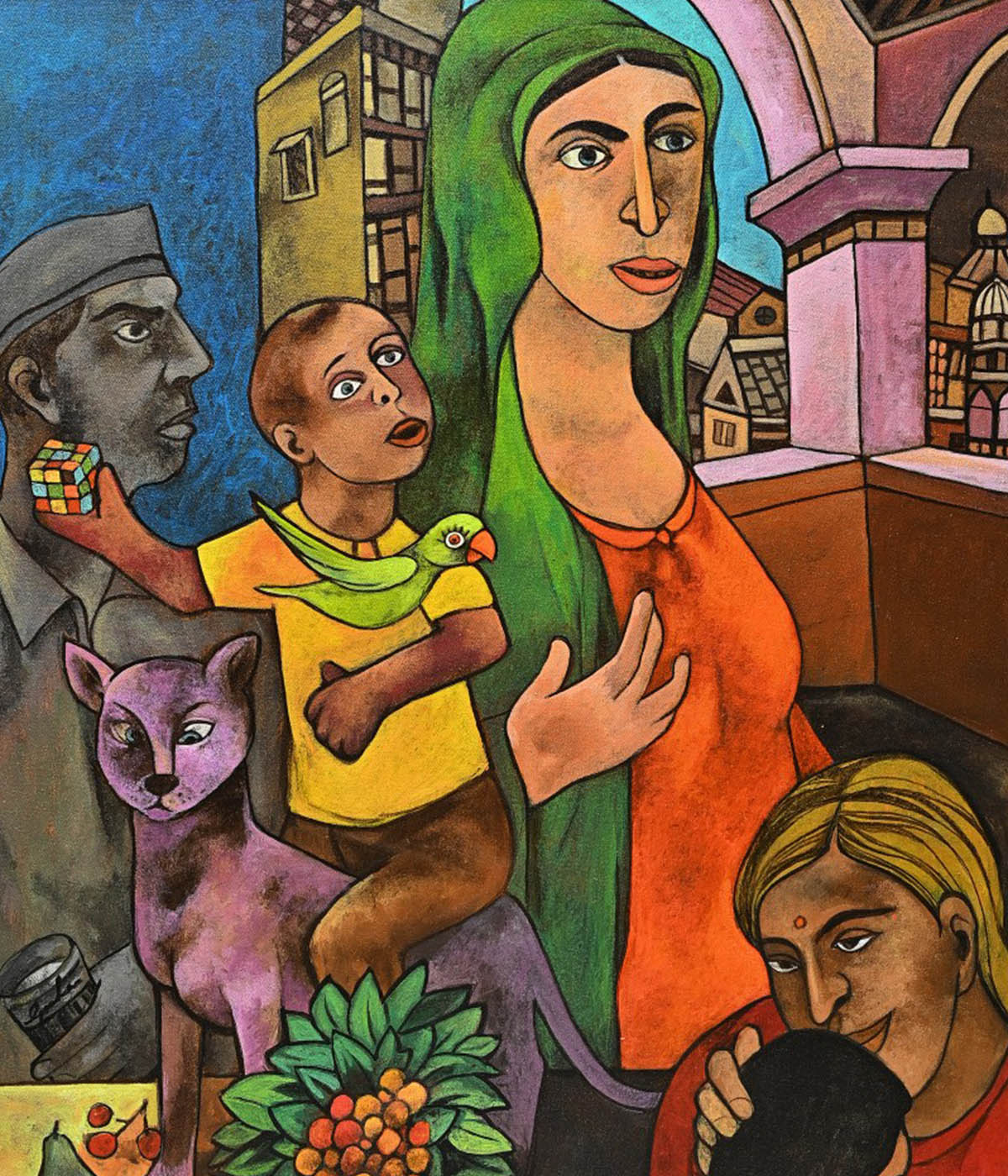
The Monumental World Within the Ordinary
Entering the Sculptural World of Asim Basu
-- By Sarmistha Maiti
Filmmaker, Art Critic and Curator
I went to Asim Basu’s studio to meet a sculptor. I came back thinking about the way we look at life, and about how much of it we usually fail to see.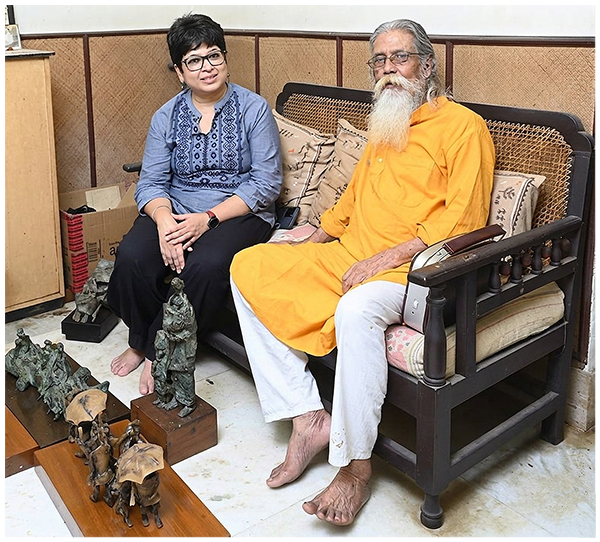
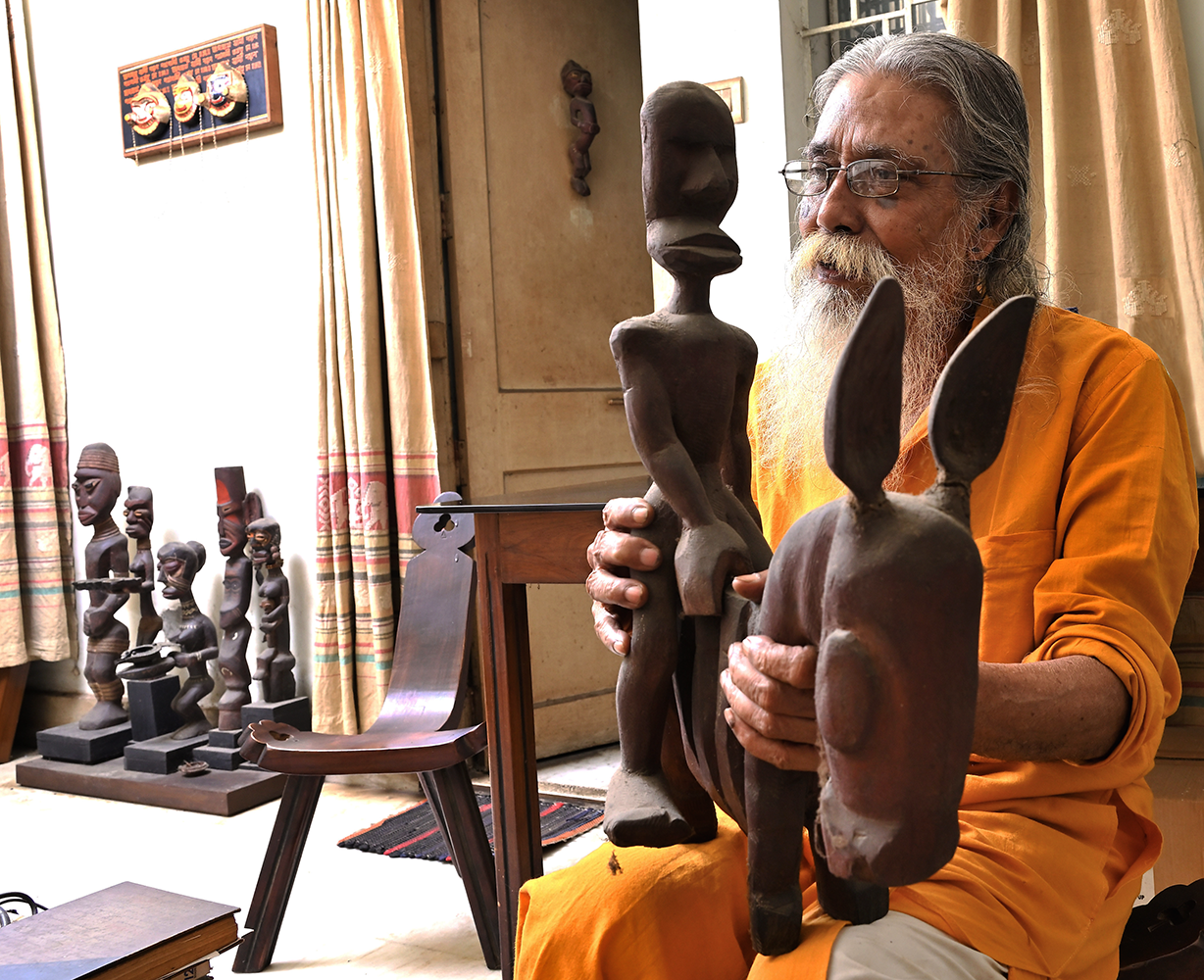
It was 22 Shravan (8 August), and the studio was already full of his world: sculptures, unfinished forms, wax, familiar objects, and the quiet presence of an artist who has spent a lifetime observing people. There was no sharp boundary here between the place where art is made and the place where life happens. Nothing seemed arranged to impress a visitor, and that was the first thing that drew me towards him.
Clad in a saffron kurta, the long white-bearded sahaj manush (simple human), carrying the earthy spirit of a meditative Baul, greeted me with such warmth that I felt I was meeting a young eighty-year-old boy I had somehow always known. I continued listening to him uninterruptedly, looking at life through his eyes, without realising when hour after hour had passed and dusk came knocking at the door.
“Life… That’s my inspiration.”
It was possibly the simplest statement I heard that day from Asim Basu, and it kept resonating long after I left. Born in 1947, Basu spoke without the self-consciousness that often accompanies conversations about an artist’s own work. His answers were direct, sometimes almost aphoristic. Living alone for the last five years in a cosy apartment near the Kolkata International Airport, he also shared deep memories of his wife, who passed away during the COVID-19 pandemic. Her presence, he said, remains all around him, keeping him smiling through every sigh and reminding him that life must move on.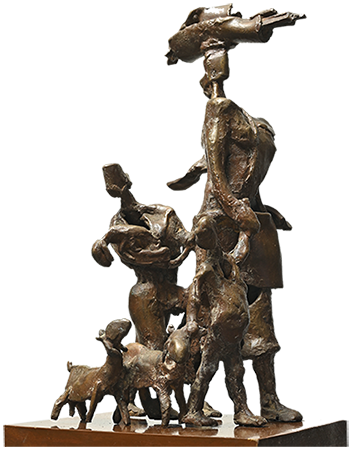
The more I looked at his sculptures, the more I realised that “life” for Basu is not an abstract philosophical proposition. It is something observed closely: people, their bodies, their gestures, their relationships, the objects they carry, the spaces they inhabit, the tenderness and struggle embedded in ordinary existence. He spoke of simplicity, of a mother’s love, of people on the street, of people going to work holding an umbrella, and of people from the elite world. There was no hierarchy in his gaze. The circumstances may differ, but the human impulses remain similar.
This is where one begins to understand Asim Basu. His story does not begin with sculpture. It begins with looking... with the way of seeing.
His first teacher was Ashoke Mukhopadhyay during his school years. He began his education in Santiniketan and later shifted to Beleghata in Kolkata. Coming from a working-class background, Basu encountered two very different landscapes and two very different rhythms of life. Santiniketan carries the memory of an artistic culture rooted in nature, openness and an expansive understanding of creativity; Beleghata belongs to another register altogether - the dense and intimate fabric of Kolkata’s everyday life.
He was strongly drawn towards tribal life during his Santiniketan days. Although he was only a child and in his early teens, the seeds sown then continued to grow throughout his artistic journey. He kept returning to the tribal space of nature, innocence and mundane existence, which gradually became part of the texture of his creative expression. Much later, African tribal forms also became an important influence on his sculptural vocabulary. But the attraction was already rooted in something more fundamental: an interest in lives and visual cultures that existed outside the polished conventions of the urban mainstream.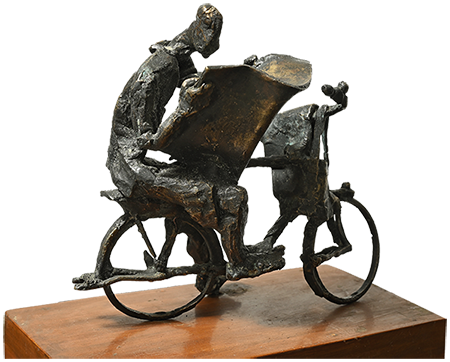
His educational journey was not linear. He graduated in Political Science but left that path and gained admission to the Government College of Art & Craft at the first opportunity. On paper, it looks like a change of profession. In retrospect, I wonder if it was really a departure at all. Political Science studies the structures through which people live together; art can penetrate beneath the layers of those same relationships through form, gesture and material. The political may have left the syllabus, but society remained in his field of vision.
At the Government College of Art, Basu studied modelling and sculpture under Chintamoni Kar and Sunil Pal. He was also exposed to commercial art. Yet modelling and sculpture drew him more deeply. What attracted him was, among other things, the open-air quality of working with form.
There is an interesting irony here. Space attracted him, and yet, as he would tell me many years later, “Space was always my problem…” Sitting in his residence-studio, where a 10’ × 12’ room serves as his dedicated working space, I could understand exactly what he meant. It is within this modest space that he spontaneously gives birth to different forms. In fact, this particular sentence about space is one of the keys to understanding his practice.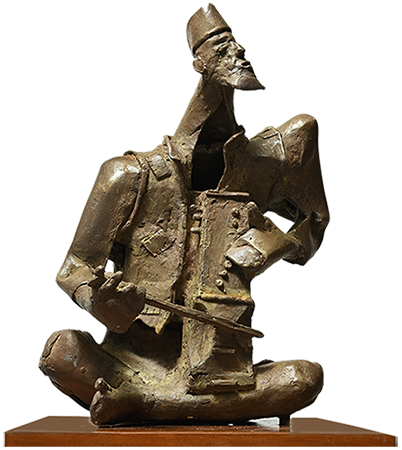
Sculpture is an art of physical occupation. Unlike painting, it cannot remain confined to a surface. It enters the room, interrupts movement, casts shadows and changes as the viewer moves around it. For an artist working within limited space, sculpture becomes a negotiation with the very condition of the medium.
Basu’s response was not to surrender to the limitation. Over the decades, he has carefully found a way of making scale psychological rather than merely physical.
“Monumental quality is there in my works,” he said calmly.
At the same time, he added, “Boro kaaj kori na.” (I don’t make large works.)
The statement contains a paradox that is central to his art. Monumentality does not necessarily require monumental dimensions. A small figure can possess an extraordinary density of presence. A group of modestly scaled figures can suggest an entire social landscape. Physical size and emotional scale are not the same thing. Basu’s sculptures ask us to reconsider what we mean when we call something monumental.
Before sculpture became the central language of his practice, Basu painted. He began exhibiting his paintings in the 1970s, with his first exhibition at Birla Academy in 1974. The painter did not disappear when the sculptor emerged. There is still something painterly in his sensitivity to composition, rhythm and the relationship between figures. But sculpture offered him something else: the possibility of making human presence occupy real space. His movement towards sculpture became increasingly pronounced in the 1980s, with recognition through Academy awards in 1986 and 1989.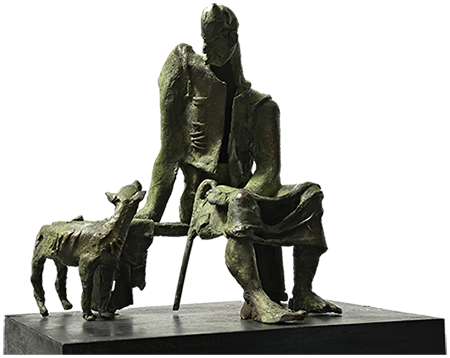
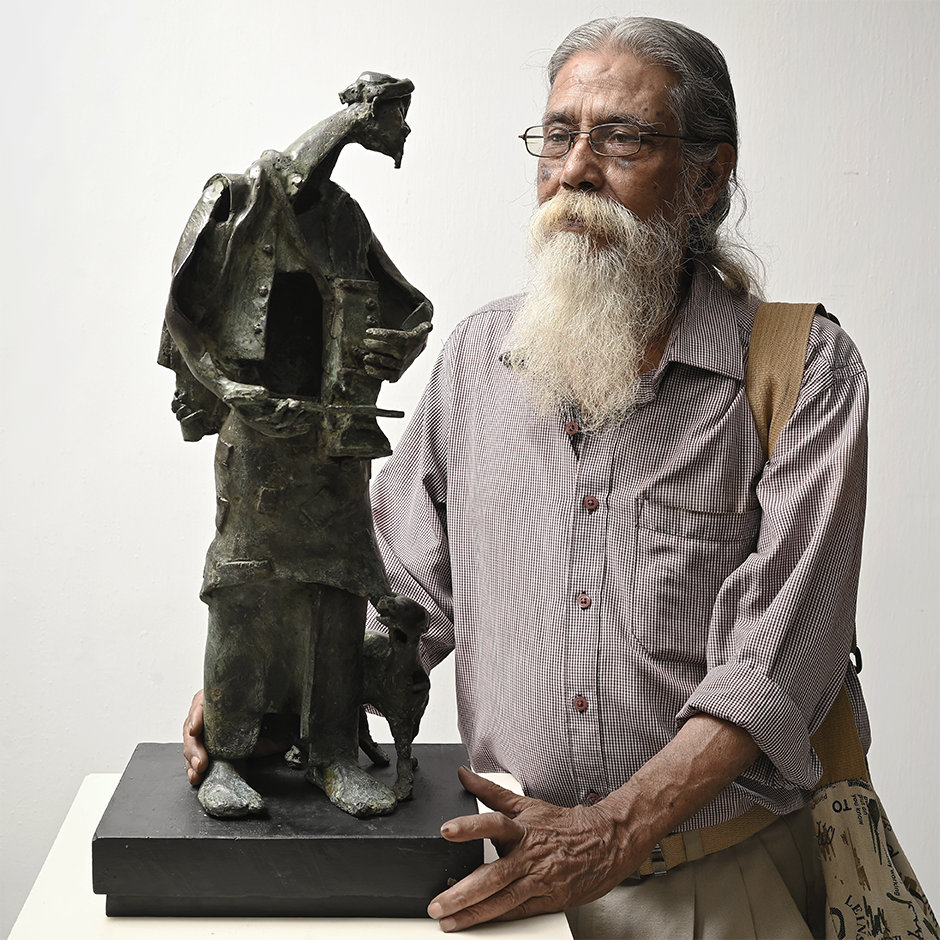
Basu works directly in wax. There is immediacy in that decision. Wax responds to touch in a way that makes the act of modelling almost inseparable from thought. The artist can add, subtract, compress and reshape. The material records the pressure of the hand. It remains vulnerable, provisional and changeable. Eventually, the wax travels to Bolpur for casting, where the work undergoes its transformation into bronze. There is something almost philosophical in this process. The material that carries the immediacy of the artist’s hand must eventually disappear for the more enduring form to emerge. What is fragile becomes permanent. What is temporary acquires another life.
Basu’s own life has also moved through very different worlds. At one point he worked at Kolkata Port. This phase is reflected strongly in his art. Once again, space became crucial, as did the working material. A port is a world of physical labour, weight, movement and balance. Bodies carry, pull, lift and wait. The human form is constantly engaged with gravity and resistance. For a sculptor, the port could almost be an anatomy lesson in life itself.
Here he worked especially with wood, which was abundantly available, and once again the provision of open space came to him. African tribal art (both human figures and everyday objects) began to become dominant in his works during this phase. A few such works still inhabit quiet corners of his studio, contributing a different scale and liveliness.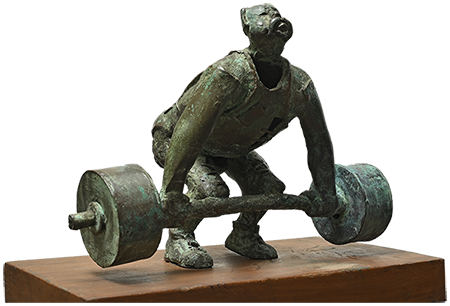
The port also offered something more important than physical observation. It offered proximity to working people, to the rhythms of labour, and to the dignity and exhaustion of ordinary existence. It belonged to the same world he had already been observing: the street, the worker, the family, the person who goes unnoticed.
Basu’s figures rarely seem interested in heroism for its own sake. Even when they acquire a monumental presence, they remain connected to lived experience. That connection becomes particularly fascinating when he talks about ordinary objects. He spoke with quiet intensity about the umbrella - the 'chhata' or 'chatri':
“You see… an umbrella can provide shade. It can become a walking stick and, when necessary, it can become something with which one fights back. So you understand how important an umbrella is in our life…”
It is such a simple observation, but it reveals something profound about his way of seeing. An object is not necessarily confined to its designated function. Life constantly alters its meaning. The umbrella becomes protection, support and resistance, depending on the circumstance.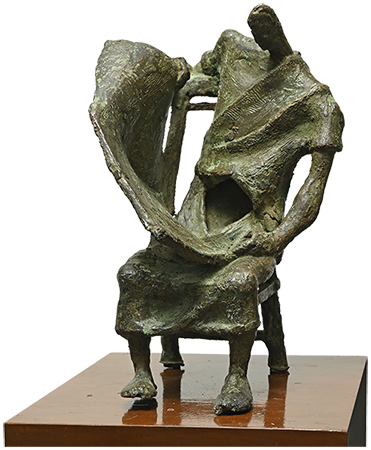
This is how Basu looks at the human figure too. A person is never merely a body. A mother carries tenderness, but also responsibility. A worker carries physical labour, but also dignity and vulnerability. A group of people carries not simply several individual bodies, but the invisible relationships between them.
His sculptures often seem to emerge from precisely that space between the individual and the collective. This is also where we can understand his interest in tribal and African forms. What seems to have attracted him was not simply an exotic visual vocabulary, but the ability of a simplified form to carry an enormous expressive charge.
African sculptural traditions have often demonstrated how abstraction can coexist with an intensely human presence. The body can be elongated, reduced, distorted or simplified without losing its emotional identity. Basu absorbed something of this language, but it did not remain foreign to him. It entered his own visual world and encountered the people, memories and social realities he had accumulated over a lifetime. That is how influence becomes authentic and gives birth to original works of art.
His sculptures have been collected overseas, especially by collectors in the United States, and widely in India as well. Yet the most revealing part of my visit was not a story about an award, an exhibition or an overseas collection. It was a sentence Basu offered almost casually:
“Make limitations your opportunities.”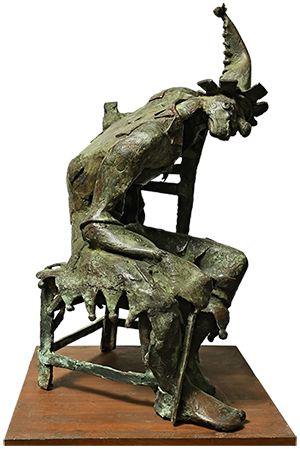
Exactly here, his earlier remark about space acquired another dimension.
The limitation is real. Space is scarce. Large works are difficult. Resources are never infinite. But instead of treating limitation merely as deprivation, Basu seems to have converted it into a condition of his practice. This idea reaches beyond sculpture. It is not only a philosophy of making, but also a philosophy of living.
One can either spend one’s life measuring what is unavailable or begin asking what can be created from what is available. For Basu, a limitation becomes a formal challenge. Limited space does not prevent monumentality; it forces him to discover another definition of it. A humble object does not remain ordinary; it becomes an entry point into multiple meanings. A fragile material does not signify weakness; it becomes the beginning of permanence.
The philosophy is present in every form of his work without being announced as philosophy. That is why the studio felt so intimate.
There was no attempt to separate the artist from his surroundings. The sculptures seemed to belong to the room, and the room seemed to belong to them. A radio, a shelf of books, furniture and unfinished forms shared the same visual field. The domestic and the artistic were not competing worlds. They were one world.
During our long conversation over tea and biscuits, Basu sometimes sat on his stool holding a group of figures in his lap. At other times, he kept working with wax, shaping different kinds of umbrellas and depicting a group of people in the rush of a working day. His hands held every work with compassion, protectively projecting his connection with each of them.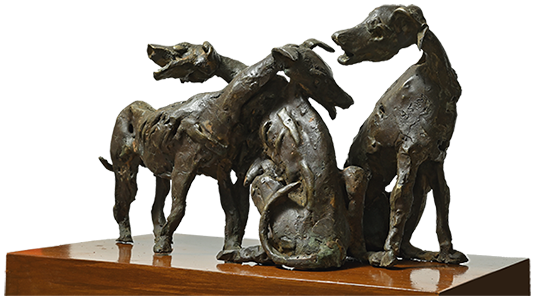
The sculptures retain their awkwardness, their irregularities and the physical evidence of having been touched. There is movement in them, but also vulnerability. They seem to belong to the unfinished state of life itself.
Basu’s work resists easy classification. It would be convenient to describe him simply as a figurative sculptor, or as an artist influenced by tribal forms, or as a sculptor of ordinary people. All of these descriptions contain something true, but none is sufficient. The consistency of his gaze is the most valuable aspect of his creation: how, through the transitions of history, he chose to retain the purity of seeing in whatever came his way and poured his emotions and effort into his sculptures.
From Santiniketan to Beleghata, from the attraction to tribal life to the years at Kolkata Port, from painting to modelling, from direct wax to bronze, from the umbrella to the human figure... there is a continuous interest in what lies beneath appearances.
He seems to ask: What else is there? What else is inside an ordinary object? What else is inside an ordinary life? What else can be made from a limitation? What else can a small form contain?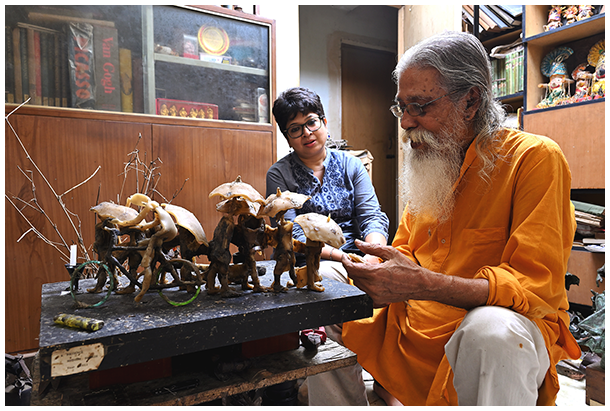
In these questions, one can sense the intellectual dimension of Basu’s work - not in theoretical declarations, but in his persistent questioning of categories: large and small, ordinary and extraordinary, fragile and permanent, individual and collective, limitation and possibility. His sculpture is rooted in the body, but the questions it raises are larger than the body. And yet, despite all these possibilities, Basu does not seem interested in making his work more complicated than life itself. There is a quiet directness in him. Perhaps that is why the word simplicity kept returning during our conversation.
Simplicity is often misunderstood as the absence of complexity. In Basu’s work, it feels closer to the opposite. It is the result of having looked long enough to know what can be left out. Basu appears to find possibilities where others might see only limitations. He looks at the everyday without reducing it to the mundane. He finds the monumental without needing monumental scale.
The quiet paradox of Asim Basu’s art is that he may not make large sculptures, but his sculptures make room for a large world: a world of workers and mothers, streets and tribal memories, tenderness and struggle, movement and stillness; a world where a humble object can contain three different lives, where wax can surrender itself to bronze, and where a limitation can become an opportunity.
Sarmistha Maiti is a two-time National Award-winning filmmaker, art critic and curator based in Kolkata. Her creative practice moves between cinema, art and cultural memory, exploring the people, places and stories that shape our visual world.
Most read art news
How to Tell Whether a Print Is an Original Artist-Signed Impression or a Reproduction
The Work That Begins a Collection

Aakriti Art Gallery to Launch India’s First Integrated Art Platform Combining AI Advisory, Research, Archives, Publishing, and Art Acquisition
Aakriti Art Gallery Relaunches ‘GenNext’ as a Year-Round Platform for Emerging Artists
The Monumental World Within the Ordinary