Sanat Kar: The Dark Poetry of the Printed Image
Dream, Memory and Experiment in the Work of a Master Printmaker
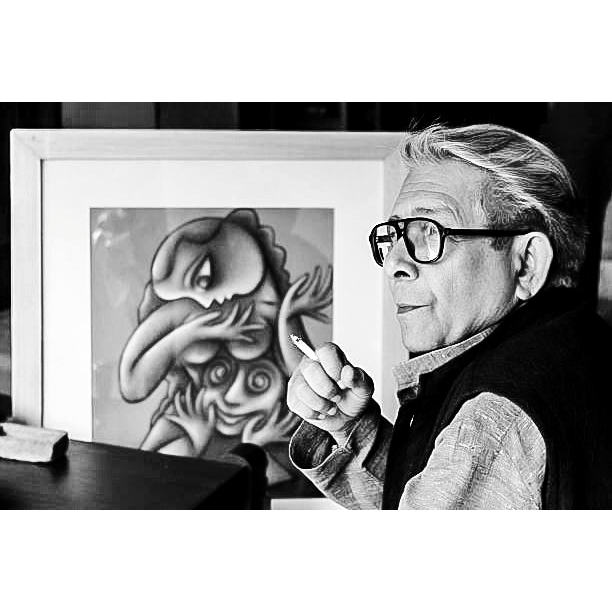
Sanat Kar’s art often seems to begin where ordinary vision ends.
Faces emerge from darkness. Bodies become elongated, spectral or dreamlike. Plants and human forms merge. Familiar objects take on an unsettling presence. The image 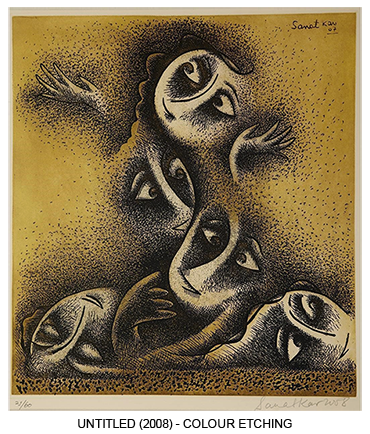 appears recognisable for a moment and then slips into another psychological register.
Kar once described his work as engaging with the “deep, dark recesses of the human mind.” That phrase offers an important key to his practice. His art was never simply about technical experiment, though he was one of India’s most inventive printmakers. Nor was it simply surreal in the conventional sense. His images emerged from memory, anxiety, fantasy and the uncertain terrain between waking life and dream.
Born in Kolkata in 1935, Kar graduated from the Government College of Art & Craft in 1955. He was a founding member of the Society of Contemporary Artists and began his career as a painter before becoming increasingly absorbed in printmaking. In 1974 he joined the Department of Graphic Art at Kala Bhavana, Santiniketan, where he became an influential teacher and later Professor Emeritus. Aakriti’s 2011 Creative Impulse interview with Kar records both his technical curiosity and his lifelong commitment to printmaking as a genuinely creative medium rather than a reproductive process.
Printmaking as Discovery
Kar’s importance lies partly in the way he treated technique as a site of invention.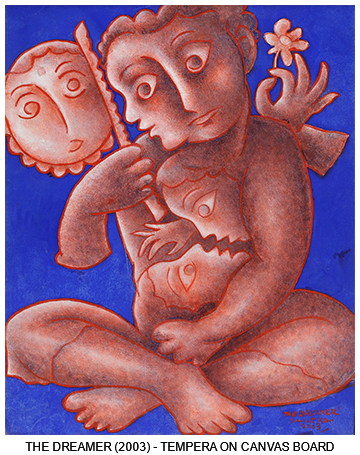
He experimented extensively with wood intaglio, cardboard engraving and unconventional matrices, developing processes that allowed him to obtain delicate tonalities, scarred surfaces and unexpected textures. His works from the 1970s and 1980s include etching, wood intaglio, sunmica and cardboard engraving, alongside tempera paintings and drawings.
For Kar, printmaking was never mechanical repetition.
Each surface offered resistance.
Each plate suggested possibilities.
The act of cutting, engraving, pressing and transferring an image became inseparable from the idea itself.
This is why the physical character of his prints matters so much. Lines seem scratched out of darkness. Textures appear worn, corroded or unearthed. Figures often seem less drawn than recovered.
The image feels as though it has been discovered rather than simply made.
The World of Dreams
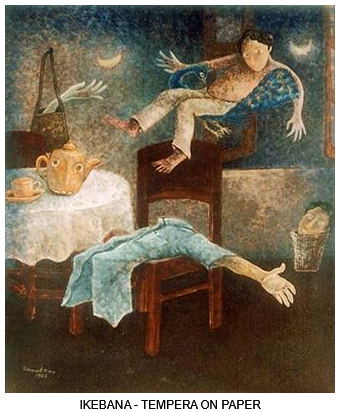 Titles associated with Kar’s work—Dreams, Ikebana, Leaves, Maya, Dreamers—suggest how consistently he returned to states of transformation and reverie.
Dreams allowed him to loosen the rules governing the visible world.
A face could become landscape.
A plant could become anatomical.
A human figure could dissolve into shadow.
This freedom gave his work psychological depth.
Yet Kar’s dream imagery is rarely comforting. There is often a sombre undertone: mortality, loneliness, vulnerability and the cyclical movement between life and decay.
The dream becomes not an escape from reality but another way of confronting it.
Nature Without Innocence
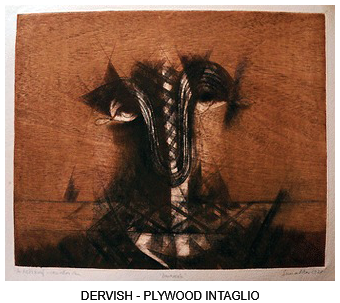 Nature appears repeatedly in Kar’s work, but rarely as picturesque landscape.
Leaves, roots, flowers and organic forms seem to grow into human bodies or emerge from them. His Ikebana and Leaves series transform botanical imagery into something introspective and sometimes unsettling.
Nature in these works is alive, but not necessarily benign.
Growth implies decay.
Birth implies mortality.
Beauty and unease coexist.
That duality gives Kar’s work much of its emotional force.
Darkness as a Language
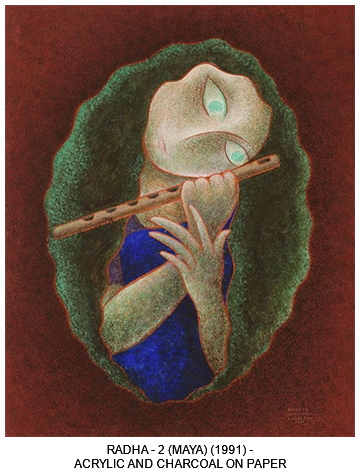 Black plays an important role in his visual vocabulary.
It is not simply background.
It becomes atmosphere.
Forms emerge from it and disappear back into it.
The darkness often appears to contain memory itself.
This is particularly effective in printmaking, where the relationship between ink and untouched paper can produce an extraordinary range of psychological effects. Kar understood how much could be suggested by what remains partially hidden.
He did not illuminate everything.
He allowed uncertainty to remain.
The Human Figure
Kar’s figures are frequently distorted or incomplete.
Faces may be reduced.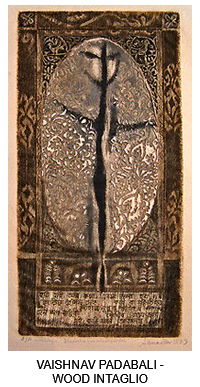
Bodies may stretch or fracture.
The effect is not caricature.
Rather, distortion becomes emotional.
The body carries psychological weight.
This places Kar within a broader generation of post-Independence artists who rejected idealised beauty in favour of more troubled images of human existence. Yet his approach remained distinctly personal. Where others confronted social violence directly, Kar often approached anxiety through dream, fantasy and metaphor.
The darkness was inward.
But it was never disconnected from the world outside.
Santiniketan and Experiment
Kar’s long association with Kala Bhavana is central to his legacy.
Santiniketan had always encouraged artists to treat material, craft and experimentation as interconnected forms of knowledge. Kar extended that tradition through printmaking.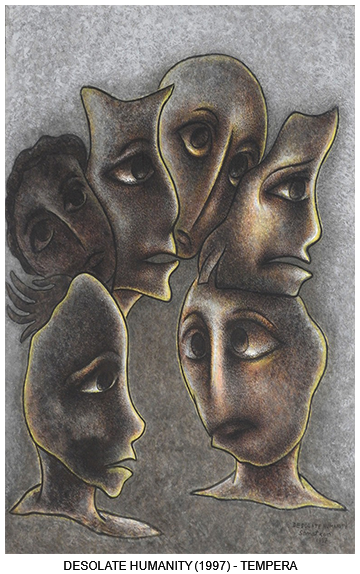
As teacher and administrator, he helped shape several generations of artists while continuing to experiment in his own studio. His importance therefore lies not only in individual artworks but in the culture of enquiry he helped sustain.
Aakriti’s earlier interview rightly described him as one of India’s most inventive printmakers. That distinction rests not simply on technical virtuosity but on his refusal to separate process from imagination.
Beyond Printmaking
Although best known for prints, Kar also worked extensively in tempera, ink, pastel and sculpture.
This matters because his imagery remained remarkably coherent across media.
The same dreamlike figures.
The same organic transformations.
The same brooding atmosphere.
The same fascination with what lies beneath the visible surface.
Technique changed.
The psychological enquiry remained.
The Quiet Radical
Sanat Kar’s work is easy to underestimate because it rarely announces itself loudly.
Its power accumulates slowly.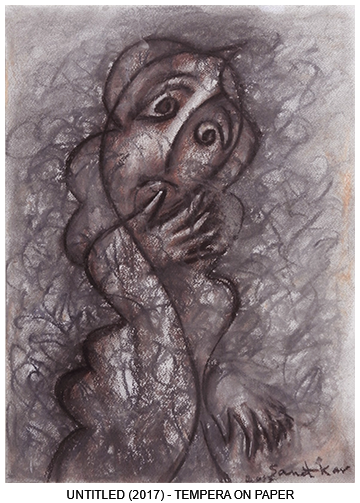
A print may initially appear delicate.
Then the image begins to disturb.
A face looks back.
A plant becomes a body.
Darkness acquires presence.
What seemed lyrical becomes uneasy.
This movement between beauty and discomfort is central to his art.
His radicalism lay not in spectacle but in persistence: decades spent exploring how far an image could move from observation into dream without losing emotional truth.
Sanat Kar transformed printmaking into a language of memory, uncertainty and inward experience.
His works remind us that the darkest images are not always those depicting violence.
Sometimes darkness lies in what cannot be named.
And that was precisely the territory he chose to explore.
-- Research & Compiled by Aakriti Art Gallery team
Most read art news
How to Tell Whether a Print Is an Original Artist-Signed Impression or a Reproduction
The Work That Begins a Collection
Aakriti Art Gallery to Launch India’s First Integrated Art Platform Combining AI Advisory, Research, Archives, Publishing, and Art Acquisition
Aakriti Art Gallery Relaunches ‘GenNext’ as a Year-Round Platform for Emerging Artists
The Monumental World Within the Ordinary