Shankar Ghosh: Between Figuration and Abstraction – A Reassessment of a Modern Master
A reassessment of Shankar Ghosh, one of modern India’s most accomplished sculptors, whose bronze forms bridged figuration and abstraction while expanding the language of Indian sculpture.
The Missing Sculptors of Indian Modernism
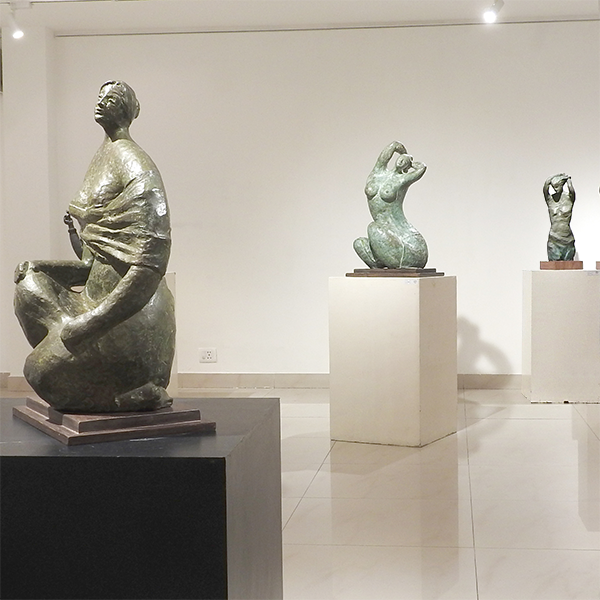
Among those who encountered his work, he was regarded as a sculptor of remarkable sensitivity and technical command. Yet outside specialist circles, his name is rarely discussed with the frequency his achievement deserves.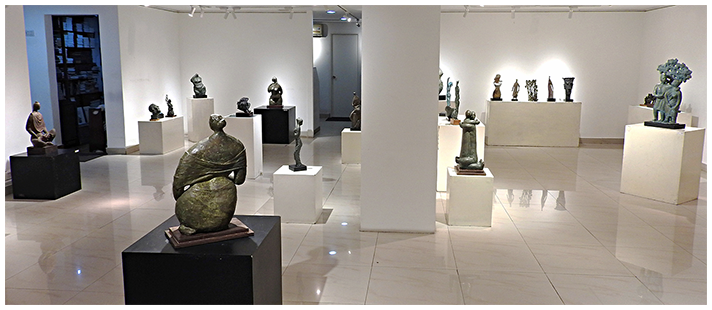 The recent exhibition Ethereal Forms: A Tribute to Shankar Ghosh, organised by Aakriti Art Gallery in 2024 to commemorate what would have been his 90th birth anniversary, offered an opportunity to revisit an artist whose work deserves a more prominent place in the history of modern Indian sculpture.
The question is not whether Shankar Ghosh was an accomplished sculptor. The surviving works make that evident. The more important question is why his contribution remains insufficiently recognised.
From Painting to Sculpture
Like many artists of his generation, Shankar Ghosh did not begin with sculpture as an inevitable destination.
Initially interested in painting, he entered the Indian College of Art in Kolkata. His artistic direction changed after exposure to sculpture and the possibilities it offered. He later studied sculpture at the Government College of Art & Craft, Kolkata, where he trained under some of the most respected sculptors of the period.
This transition proved decisive.
At a time when Indian sculpture was moving beyond academic realism and exploring modernist possibilities, Ghosh found a language uniquely suited to his temperament. Rather than pursuing either strict naturalism or complete abstraction, he developed an approach that distilled observed reality into essential forms.
Between Figure and Form
One of the most distinctive aspects of Shankar Ghosh’s sculpture is its position between figuration and abstraction.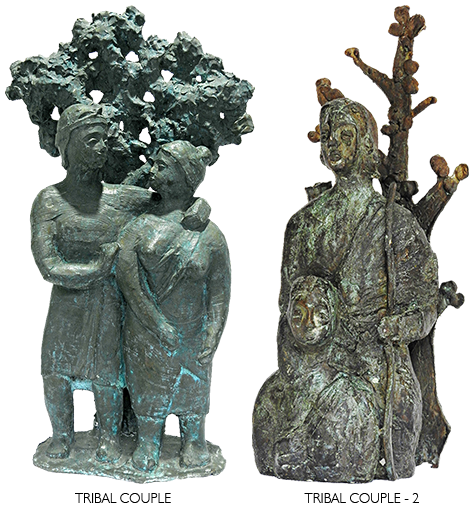
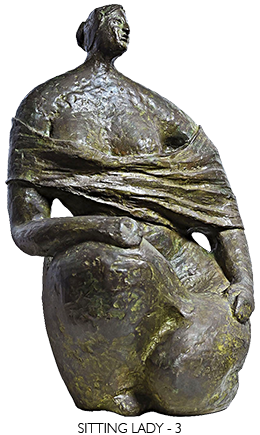
His works are recognisably rooted in the human figure. Yet they rarely seek anatomical accuracy or descriptive detail. Instead, forms are simplified, condensed and reorganised into rhythmic structures.
This quality can be seen in works such as Sitting Lady, where the human body becomes a compact arrangement of curves, planes and volumes. The figure remains identifiable, yet the sculpture operates equally as an exploration of mass, balance and spatial rhythm.
Similarly, Tribal Couple transforms human companionship into a sculptural dialogue between two interdependent forms. The work avoids sentimentality. Instead, it relies upon structure and proportion to convey emotional connection.
This ability to reduce complexity without sacrificing humanity was one of Ghosh’s greatest strengths.
The Language of Bronze
Bronze became Ghosh’s most powerful medium.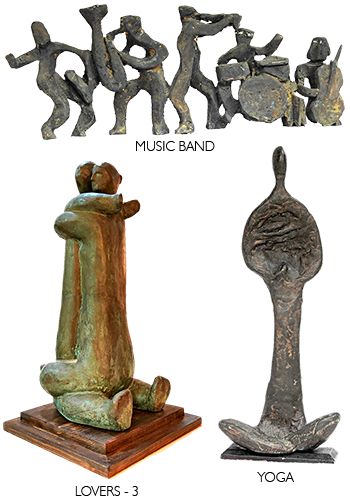
Many sculptors use bronze to celebrate permanence and monumentality. Ghosh used it differently. His bronzes possess weight, yet they often appear surprisingly light. Surfaces carry traces of modelling, while volumes seem to breathe and expand rather than merely occupy space.
Critic Siddharth Sivakumar, writing on the 2024 tribute exhibition, observed that Ghosh’s sculptures carry “a latent pulse with life,” transforming stillness into movement.
The observation is particularly relevant.
Whether depicting seated figures, musicians or abstracted human forms, Ghosh rarely allowed sculpture to become static. There is almost always an internal energy animating the work. Curves twist gently, surfaces catch light unexpectedly and forms seem poised between rest and motion.
This sense of contained movement distinguishes his sculpture from both academic realism and purely formal abstraction.
A Modernism Rooted in Experience
Unlike some modernists who pursued abstraction as an intellectual exercise, Ghosh remained deeply connected to lived experience.
His sculptures draw upon human relationships, rural life, music, labour and memory. Yet these themes are never narrated directly. Instead, they are absorbed into form.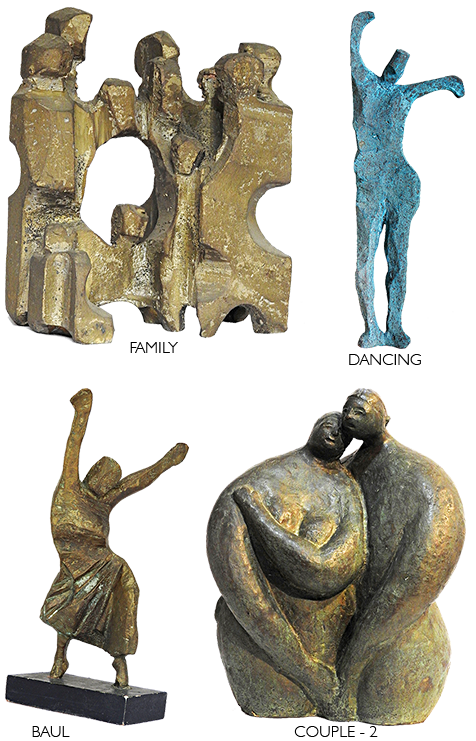
The Bengali art historian Mural Ghosh noted that Shankar Ghosh’s work emerged from observation of life but gradually moved beyond direct representation. Figures became increasingly simplified, eventually approaching abstraction without ever abandoning their human origins.
This evolution mirrors a broader trajectory within post-Independence Indian sculpture. Artists sought modern forms while remaining connected to local experience and cultural memory.
Ghosh’s achievement was to find a balance between these seemingly opposing impulses.
Beyond the Human Figure
Although the human figure remained central to his practice, Shankar Ghosh was not confined by it.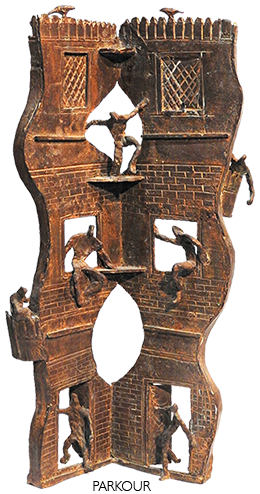
Works such as Parkour reveal a more adventurous sculptural imagination. Here the concern shifts from representation toward spatial construction. Openings, voids and structural relationships become as important as solid mass.
These works demonstrate that Ghosh’s artistic ambitions extended beyond figurative sculpture. He was interested in how forms interact with space, how emptiness can become an active sculptural element and how abstraction can emerge organically from observed reality.
This aspect of his work deserves far greater scholarly attention.
Why Recognition Has Been Limited
Several factors may explain why Shankar Ghosh remains less visible than many contemporaries.
First, sculpture itself occupies a smaller place within public discourse than painting. Large sculptures are more difficult to exhibit, reproduce and circulate.
Second, much of Ghosh’s career unfolded within Bengal’s artistic ecosystem rather than national market centres. While Bengal has produced some of India’s most important sculptors, many remain underrepresented within broader narratives of Indian modernism.
Third, Ghosh belonged to a generation that often prioritised practice over self-promotion. His reputation was built within artistic circles rather than through institutional visibility or market spectacle.
Yet none of these factors diminish the quality of the work itself.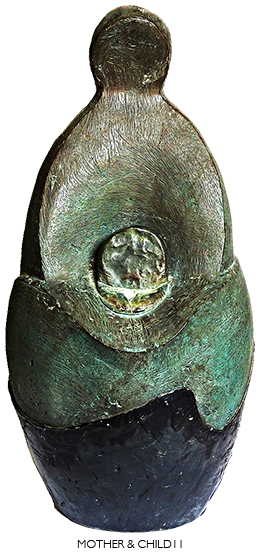
Why He Matters Today
The renewed interest in overlooked artists offers an opportunity to reconsider Shankar Ghosh’s place within Indian art history.
His sculptures demonstrate that modernism in India was not solely a story of painting. It was also shaped by artists who explored volume, space and material with equal ambition.
More importantly, his work reminds us that innovation need not announce itself loudly. Through subtle transformation of the human figure, careful understanding of material and deep engagement with form, Ghosh created a body of work that remains remarkably fresh today.
At a time when much contemporary art is driven by scale, spectacle and instant visibility, his sculptures reward slower looking.
Shankar Ghosh occupies a distinctive place in modern Indian sculpture. Working between figuration and abstraction, he developed a language that was both modern and deeply human. His sculptures distilled experience into form without losing emotional resonance.
The question is no longer whether his work deserves attention. The sculptures themselves answer that convincingly.
The real challenge is ensuring that artists such as Shankar Ghosh are no longer treated as footnotes within the history of Indian modernism. They belong within the main narrative. For without sculptors like Ghosh, the story of modern Indian art remains incomplete.
Bibliography
- Siddharth Sivakumar, “Metaphysical Engagement”, review of Ethereal Forms: A Tribute to Shankar Ghosh.
- Mural Ghosh, “Shankar Ghosher Bhaskarjo: 90-Tom Janmodine Shraddharghya”, Krittibas, September 2024.
- Exhibition Catalogue, Ethereal Forms: A Tribute to Shankar Ghosh, Aakriti Art Gallery, 2024.
- Archival material from Government College of Art & Craft, Kolkata.
- Aakriti Art Gallery archives.
-- Research & Compiled by Aakriti Art Gallery team
Most read art news
How to Tell Whether a Print Is an Original Artist-Signed Impression or a Reproduction
The Work That Begins a Collection
Aakriti Art Gallery to Launch India’s First Integrated Art Platform Combining AI Advisory, Research, Archives, Publishing, and Art Acquisition
Aakriti Art Gallery Relaunches ‘GenNext’ as a Year-Round Platform for Emerging Artists
The Monumental World Within the Ordinary