Amal Nath Chakladar and the poetics of looking
The Quiet Line
In the crowded genealogy of twentieth-century Bengal painting—revivalist wash, College Street academicism, Santiniketan lyricism, the urban angst of the Calcutta Group and its heirs—Amal Nath Chakladar occupies a place that is easy to miss and hard to replace. He did not found a movement. He did not advertise a manifesto. What he did, across six decades and with a craftsman’s obstinacy, was look: at a bird turning on the wing, at a cart bending with a road, at a leaf large enough to shelter two ducks, at a face stretched by time until it became architecture. The looking was the work.
Jogen Chowdhury, writing after Chakladar’s death on 21 July 2021, called him “an extraordinary, sensitive and original artist,” distinct from the other painters who had grown up inside the Bengal School. The distinction matters. Chakladar was trained in that climate and never disowned it. Tempera remained his home medium. Line remained his first instrument. Yet he refused the School’s favourite refuge—the endlessly recycled mythic tableau—as a default subject. Nature, labour, animals, the village path, the flight of waterbirds, the stoop of a wandering sadhu: these were enough. When myth did enter, as in a late Shiva seated on a tiger-skin among coiling cloud, it arrived as weather, not as illustration.
“Boundaries are abolished, and even the familiar subjected to interrogation.” — Calcutta Painters
Jangjai, Partition, and the First Room
In the only recorded interview he gave—published by Art Wave after his death, under the title “God, Nature and Art in My Life”—Chakladar answered the first question as a man who had thought about origins for a long time. There may or may not be a single memory that starts a painter, he said. What there is, always, is a childhood: a house, a family, a current of making. Sense of beauty, he thought, is innate; its colour depends on the air around the child.
His air was the village of Jangjai, in Mymensingh district of what was then East Bengal. The family house, he remembered, stood as handsome as the five zamindar houses of the place. His mother drew alpana for the pujas with real authority; he learned a little of that language from her. Life-size Kali images were made in the household for worship. At Durga-making time the brothers and sisters sat before the artisan. The eldest sister could form beautiful clay dolls; he put his hand to the same clay. The next brother, Arun—sharp, alert—would go to Kala Bhavana at Santiniketan a year ahead of him. After Partition Arun entered Santiniketan in 1954. Amal joined the Government College of Art, Calcutta, in 1955.
He was, by his own account, his mother’s boy. The cowshed was full; there was milk enough to make ghee with her. The first permission to paint, he said, came from that side of the house. He also collected small beautiful things: a piece of the chandelier glass, carved work from beside his room that he still kept in old age. His mother and aunts made patterned bronze; his job was to pull coloured thread from sari borders and wind it into balls. The hand learned patience before it learned a syllabus.
Partition ended Jangjai. In March 1948 the family of twelve—four sisters, six brothers, the parents—moved into a dilapidated two-storey house in Kanchananagar, on the edge of Burdwan town. Nobody could forget the house they had left. A bout of typhoid stopped his studies. When he rose from it he bought, with saved pocket money, paper and red and blue pencils, and drew his father’s sitting room. The father approved. Then the boy painted, on the upper parts of the inner windows and around the room, fragments of the lost ancestral house. That, he said later, was his first exhibition. He had been painting ever since.
“My first impulse to paint was to rebuild, with the most ordinary small objects, the memory of the house we had to leave after Partition.”
Between 1950 and 1954, still in Burdwan, he put himself through the equivalent of an art-school course: painting, clay modelling, commercial art. A large book on European painting came into his hands—he thought from a master at Burdwan Raj College. He copied Raphael’s Madonna in pencil. In 1955 he carried that sheet into the College interview. The sculptor Prodosh Dasgupta was on the board, praised the drawing, and told him to join the sculpture department.
Two years earlier, in 1953, a large district exhibition at Burdwan Town Hall had already given him a public. He sent a clay Taj Mahal, a life-size pineapple plant, a rose bush in flower—all modelled. The Taj Mahal sold for thirty rupees. It was his first sale. The ripe pineapple was praised. At the fairs he was already selling Krishnanagar-style clay work. The painter who would later be filed under tempera and the Bengal School began, quite simply, as a boy who could make a fruit that people wanted to touch.
College, a Bench by the Ganga, and a Circle at the Soda Fountain
The father could not easily pay for two sons in two art schools at once. Arun was already pointed toward Santiniketan; Calcutta looked impossible. Chakladar remembered being “mentally broken.” What he also remembered, without embarrassment, was a childhood faith in God. Late in life he thought that faith had taken him through more than one drop in the path.
After he did get in, an afternoon of on-the-spot sketching near Baghbazar turned into the story he never stopped telling. A canal from the Ganga ran into the city under a rail bridge. He crossed. He did not take the sketchbook out. A “strange attraction” walked him along the line in the channel of the current until there was no path. Tired, he climbed a steep stair from the water and found a dressed park. He lay down on a bench and slept. When he woke he was looking at a small temple-shaped plaque: the name of Abanindranath Tagore, with the dates of birth and death. He had been sleeping beside the place where the master’s body had been burned. He called the event aloukik—not of this world—and believed that from it he later found a new direction in painting. One may take the supernatural as one likes. What the story records, without dispute, is the kind of painter he was: a man for whom looking and reverence were not separate acts.
At the Government College of Art & Craft he took a First Class Diploma in Fine Arts, graduating in 1960. As a student he read the Renaissance and, with equal appetite, books on Chinese and Japanese art. Holbein, Botticelli and Dürer held him; Dürer’s engraving and etching held him most, he thought, because of an inborn pull toward nature. He had already begun to draw portraits before he left the College. A later Academy note put the synthesis cleanly: he had joined different styles “with a character of its own.” The home media were already named—tempera and watercolour.
In 1967 a few painter friends used to gather at the Soda Fountain in Dharmatala. Ganesh Pyne and Debi Prasad Saha were there from the first; Bikash Bhattacharjee, Dharmanarayan Dasgupta and Lalu Prasad Shaw came into the same adda. They talked about movements in India and abroad and hunted for a way of working that would be their own. Chakladar was in that room. He was also the one who, by his own later confession, never fully threw away the definition of Indian painting or the method of saying it. Kshitish Ray, reviewing the 1968 solo in Anandabazar Patrika, saw the same thing from outside: Chakladar was not ashamed to call himself a student of the Indian style, and he was trying to make a natural meeting of the ancient and the modern.
He was exhibiting before he had a diploma. The All India Fine Arts exhibitions at Hyderabad listed him in 1956, 1958 and 1959. In 1957 he showed in the centenary celebrations of the Sepoy Mutiny. A student work went to the World Youth Festival in Prague. The Kalidas exhibition gave him a prize; the college annual singled him out. By 1962 the State Lalit Kala Akademi and the Academy of Fine Arts, Calcutta, had both awarded him cash prizes. An All India show at Ujjain in 1965 added another. These are the unglamorous credentials of a professional who was already being noticed while still, in the city’s terms, a junior.
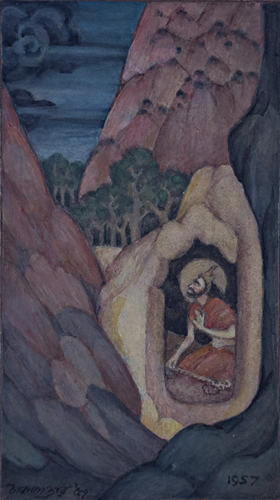
Cave hermit. Watercolour, 1957. Already the student is thinking in rock, recess and a single human scale.
The 1957 cave picture is useful because it is early and already complete as a thought. A saffron-clad figure sits inside a hollow of pink and ochre rock; beyond the cleft, trees and a dark water. The drawing is modest. The spatial invention is not. Chakladar understood, very young, that a figure is most eloquent when the world around it is allowed to be larger than the figure. That instinct would govern the bullock-cart landscapes of the 1980s as surely as it governs the late bird pictures.
Paper, Print, and the Hand before Colour
Before tempera made him a painter of record, the hand was a printmaker’s and a draughtsman’s. A 1958 lithograph—signed A. N. Chakladar, and annotated “Litho Prints”—shows two figures walking away down a village lane between thatched roofs. A dog crosses in the middle distance. The light is late. Nothing is picturesque in the calendar sense; the blackness of the lane is allowed to remain black. A woodcut or linocut of the same period sets boat-builders under a skeletal frame of poles and an umbrella, the white of the paper cut into the night like a blade. These are not student exercises in technique. They are already a subject: work, weather, the ordinary path.
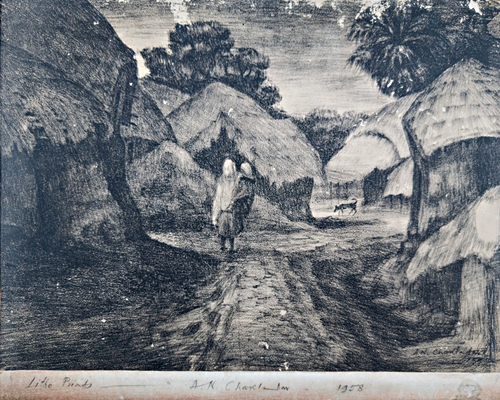
Village lane. Lithograph, 1958. The young printmaker trusts darkness more than anecdote.
Two studies of itinerant men with animals belong to the same years and tell us what kind of humanist he was. In a 1958 sketch an old wanderer walks with a staff, a monkey on his shoulder, a dog on a leash, the body lean and slightly comic in its burden. A related charcoal—denser, more finished—gives us a bearded man in a turban, a kid goat, a monkey at his feet and another riding the head, a small pot dripping from the right hand. These are cousins of the sadhu and the village performer, drawn without piety and without satire. Chakladar liked the companionship of species. He would keep that companionship for the rest of his life: duck and lotus, crane and sun, man and column, peacock and courtyard cat.
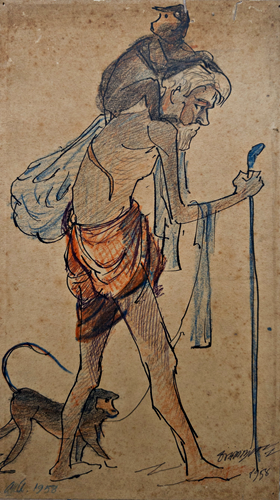
Wanderer with monkey and dog. Ink and crayon on paper, 1958.
A pencil sheet of 1971 (or thereabouts) is wilder: elephants on a ridge, cobras lifting from a thicket of flame-like verticals. A 1973 ink drawing of two figures at a table—cups, fruit, a bottle—breaks the faces into planes that recall cubism without quoting it. The Calcutta critic of 1981 would later speak, a little severely, of an “alpana-oriented cubism.” The phrase is half right. Chakladar knew what a modern plane could do. He simply refused to let the plane abolish the bird.
May 1968: The First Solo
The invitation card is still among the family papers. The Academy of Fine Arts, Calcutta, front gallery, Thursday 16 May 1968 at 6.30 p.m., open daily until 22 May. The joint honorary secretaries were Rathin Maitra and Gopal Ghose. The Mayor of Calcutta opened the exhibition and wrote, in a firm official hand, that it was a pleasure to do so, and that he wished the painter success. On the same guestbook Suniti Kumar Chatterji, from the National Library campus at Belvedere, called the show “a noteworthy experiment in combination of styles, generally with a character of its own.”
Desh reviewed it as a first one-man exhibition: twenty-seven paintings chosen from ten years of work, with sketches. Tempera was named as the principal medium. A reproduction of Abhisar appeared with the notice. The reviewer praised the artist where he stayed close to an observed mood—cloud, water, a figure crossing an atmospheric field—and was cooler where the picture seemed to argue a theory. That tension, between the seen and the schematised, is the real plot of Chakladar’s career. He never fully chose one side. The best pictures are those in which the scheme is a way of holding the seen, not a substitute for it.
An Academy booklet of the period reproduces The Bodhi Plant and already describes him as “one of the promising young painters of Bengal to-day.” Promise, in Calcutta, is a dangerous compliment. Many painters spent the next thirty years living on it. Chakladar went back to the studio.
A Language: Line, Five Colours, Tempera
In February 1970 the Hindi daily Sanmarg ran a long profile by Prabir Kumar under the series “Adhunik Kalakar.” It is the most useful contemporary statement of the painter’s own positions. Chakladar, the article says, was born on 26 October 1936; he took his diploma from the Government Art College in 1960 and later an art-appreciation qualification from Calcutta University. He had shown in Calcutta, Delhi, Hyderabad and Ujjain. He valued line and light-and-shade above a crowd of pigments. Five colours, he told the interviewer, were enough to make a picture. Western painting’s reliance on a full chromatic arsenal struck him as a way of courting the eye rather than building a form. He wanted the spectator to feel, in the finished work, the same absorption he had felt while painting it.
The claim is austere and a little proud, and the work largely keeps it. Even the late pictures, which can be warm with ochre and lake, are not lavish. A blue lotus is blue because it must be; the leaf that shelters the ducks is a structure of ribs, not a display of green. Tempera suited him because it dries to a matte, because it forces decision, because it belongs to the Indian workshop as oil belongs to the European easel. When he used watercolour it was with the same respect for transparency that the Hindusthan Standard’s critic, writing in 1981, called “the typical eastern know-how.” Oil and acrylic appear, but they do not change the grammar. The grammar is drawn.
“He is so deft in drawing lines as he wishes and his forms though sometimes exaggerated never cross over the limit of representation.” — A.M., The Hindusthan Standard, 14 March 1981
The Academy Again, 1981
Thirteen years after the first solo, Chakladar returned to the Academy of Fine Arts—this time in the West Gallery, through Bholagiri Kalamandir of Howrah—with a group of paintings and drawings from the previous decade. The English-language press was attentive. The Statesman of 11 March 1981 placed him in the institutional Bengal School of the 1950s and 1960s, with its “new emphasis on design and graphics,” and noted the tempera and watercolour practice. The tone was mixed. The critic found a “preconceived theory of design typical of a style prevalent in the fifties,” and spoke of an “Alpana-oriented cubism” that had once been a self-conscious attempt at Indianness. Then the notice turned, and the turn is the part worth keeping: Chakladar’s retrospective, the writer admitted, also showed a style “breaking away from this design.” Night Gazer, a watercolour of an owl, was “full of supercilious humour.” Composition Two was “a diabolic animal figure.” A small charcoal called Cry was “bold in concept.”
The Hindusthan Standard, three days later, was warmer. The unsigned critic A.M. called him an artist of “extraordinary calibre,” working in a style “branded as Indian” yet repeatedly stepping outside its formalities. The current exhibition, the notice said, restated a technique refined over ten years. Some compositions were “cabalistic”; others, like a portrait of birds in a cage that put the viewer in mind of Ramakrishna or Rabindranath, were immediately communicative. Sleeping Bird, in pen line and colour ink, spoke of “patience and dexterity.” The idealisation of form—the phrase became the headline—was not an escape from the world but a way of tightening it.
Anandabazar Patrika and Jugantar covered the same rooms in Bengali, folding Chakladar into the larger argument then current about the Academy’s mid-year shows: who was being seen, who was being left in the corridor, whether a civic institution could still make a serious claim on the city’s eye. He was not the only name. He was one of the names that made the argument worth having.
Bird, Water, Road: The Observed World
If one had to name the centre of the oeuvre, it would not be the portrait and it would not be the myth. It would be flight, and the ground under flight. A picture dated 1982 sends a pair of white bullocks and a covered cart down a pale, winding track through low hills. The driver is a dark comma. The road is the real protagonist: it turns, pales, loses itself, and the cartsman’s patience becomes a way of measuring distance. Soumitra Das, reviewing the 48th annual of Calcutta Painters in The Telegraph of 17 November 2012, found in a later river picture “a touch of poetry” and singled out Sand for its pointillist colour. After pages of complaint about repetition in the society’s rooms, Chakladar arrived as “a breath of fresh air.” That is not a small compliment from a critic who was not in the business of issuing them.
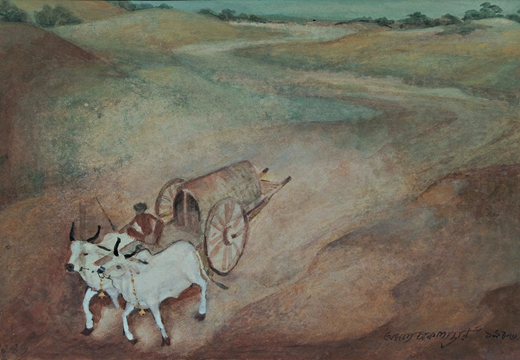
Bullock cart on a winding road. Tempera, 1982. The road is drawn as carefully as the animals.
The bird pictures of 2018–19 make the same wager at a different scale. One sends a flock of ducks or geese through a bare forest, turquoise in the wing, the trunks standing like pillars in a hall of dusk. Another gathers an immense spiral of waterbirds over a pale, map-like water, the inner ring tightening until the birds become sparks. A third, more frontal, drops a file of cranes past a huge orange sun and a screen of tree trunks. None of these is an ornithological plate. The flock is a rhythm. The forest is a colonnade. The sun is a disc the size of a thought.
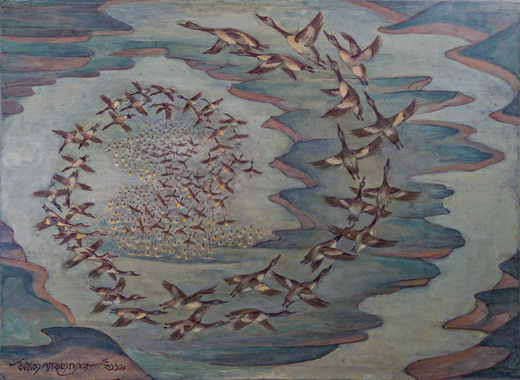
Spiral of waterbirds. Tempera, 2019. Observation turned into orbit.
A 2020 lotus picture brings the gaze back to the still water. A blue flower opens above a pale, trumpet-like leaf; two ducks rest in its shadow, heads tucked, the pond around them stained rust and olive. A bud waits at the left. The design is almost decorative, and then it is not: the leaf is too large, the ducks too particular, the water too slowly brushed. This is the Chakladar who had spent a lifetime refusing to let design eat the creature.
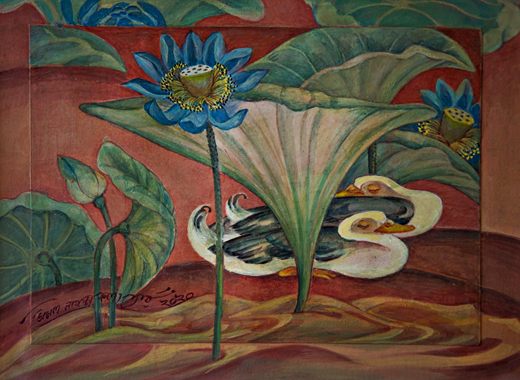
Lotus, leaf and ducks. Tempera, 2020. The late studio still trusted the shelter of a single form.
Face, Chamber, Myth
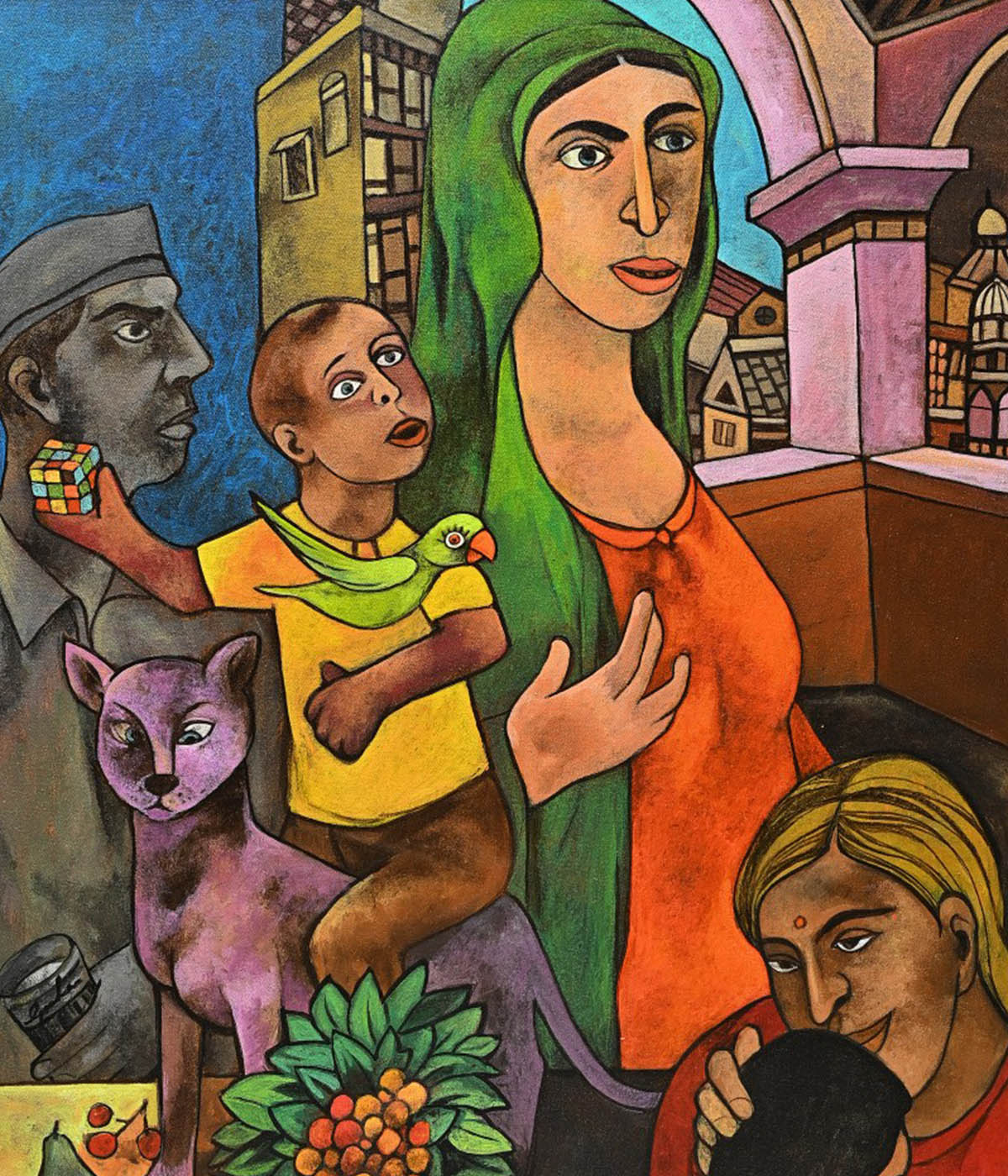
The human head, when he took it up late, is almost startling after so much weather. A 2020 portrait—annotated 1993–2020, as if the face had been waited for—presents an elongated oval, a pale ridge of nose, teeth just showing, the eyes not quite aligned. It is not a likeness in the passport sense. It is a head as a vessel of duration. Another 2020 interior sets a man in a dark cap against white columns and pink arches, the profile cut as sharply as a puppet’s, the ear a separate architecture. The chamber is unnamed. It could be a mosque, a haveli, a stage. What matters is the interval between the man and the pillar: looking as a kind of listening.
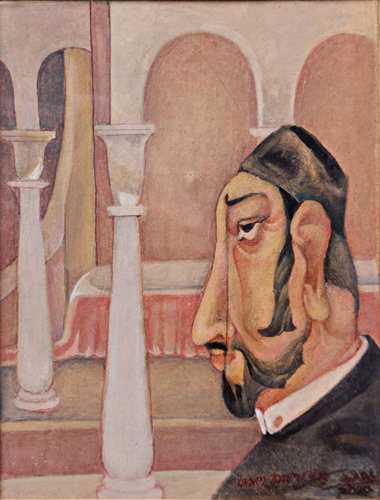
Man in an arched interior. Tempera, 2020. The column is as particular as the ear.
A large 2020 composition, double-dated 1972–2020, is the nearest thing in this group to a private allegory. A moon hangs in a green-blue sky. The mountain itself seems to stand up as a row of hooded figures. Below, a peacock-like bird turns on a pale ground beside a fallen fruit; to the right, a small courtyard holds a sleeping cat, a parrot, a woman in a doorway. The picture has the density of a remembered house. It also has the freedom of a painter who no longer needed to explain.
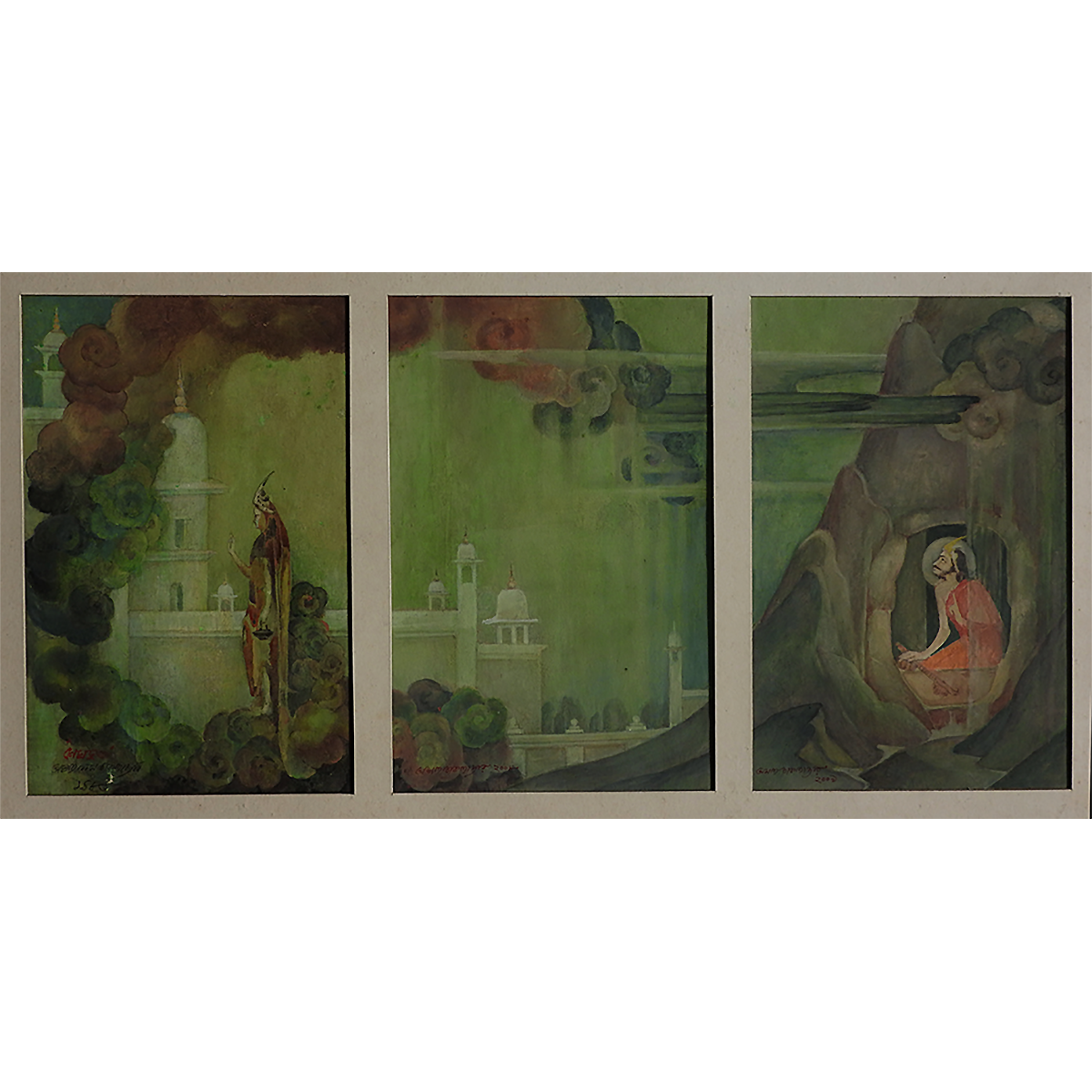
Shiva appears in another late sheet: four-armed, trident raised, damaru in the lower hand, snakes at the shoulders, seated on a tiger-skin among clouds that behave like theatre curtains. The body is slim, almost adolescent. The face is calm to the point of absence. This is not the roaring god of calendar art. It is Shiva as a climate—the same climate that, in other pictures, is a forest or a river.
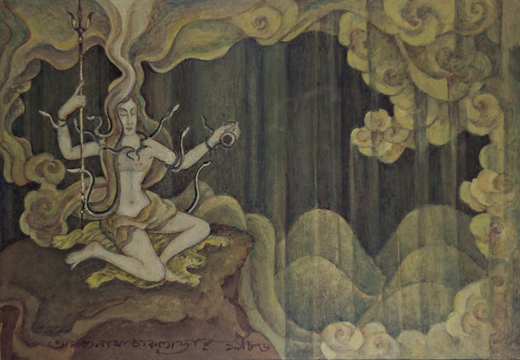
Shiva among clouds. Tempera, late work. Myth handled as atmosphere.
The Teacher, the Society, the Long Middle
Chakladar taught for years at his own college, rising to Assistant Professor at the Government College of Art & Craft. The fact is easy to file under biography and miss as an aesthetic clue. A teacher of drawing in that institution is obliged, daily, to believe that a line can still be taught. His own line never became automatic, but it did become responsible. Students, colleagues, the annual exhibitions of the college and of Calcutta Painters—he was a member of that society—kept him inside a civic conversation that the more spectacular careers sometimes left behind.
The middle decades are punctuated rather than dominated by one-man exhibitions. Centre Art Gallery’s teachers’ show in 1993 drew Rita Datta in The Economic Times, who paused over a Chakladar Christ “moving for the deep emotion it contains in its drawn face and melancholy eyes.” In May 1995 Gallery La-Mare showed twenty-two selected works in oil, tempera, acrylic and watercolour. Debashis Bhattacharya, in Pratidin, read the rooms as a statement about the Bengal School’s unfinished modernity: an artist still testing that inheritance against cubist structure, folk memory and a calm appetite for colour. The titles he listed—Market Corner, Angel Fish, Break Fast, Bird Shelter, The Messenger, The Family, Affection—are a catalogue of the everyday. Even the angel fish is a creature before it is a symbol.
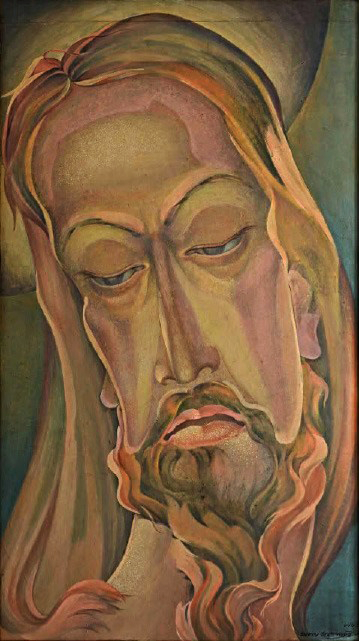
Christ The Contemplator. Tempera on Paper Pasted on Board. 1967-1993
Honours accumulated without becoming a legend. The Rajya Charukala Pradarshani award of the Government of West Bengal, recorded in 1987, is the official peak. He showed in Bengal Art Today at Hyderabad in 1992; in Manifestations: Indian Art in the Twentieth Century (DAG, 2003); in Indigenous Modernity at Aakriti Art Gallery in 2007; in DAG’s The Art of Bengal (New Delhi 2012, Mumbai 2014, New York 2016) and Navrasa (2020). Kishore Singh’s A Visual History of Indian Modern Art, Volume IV: Bengal Modernists (DAG, 2015) reproduces a 1967 tempera of a boy feeding pigeons—rags, a terracotta bowl, a forlorn mouth—and places it where it belongs: among the Bengal modernists who made an individual language without joining a school of publicity.
Last Pictures, Double Dates
Several of the late works carry two dates: 1993–2020, 1972–2020, 2018–2019. Painters do this when a canvas has been lived with, or when an old drawing is taken up again and finished in another season. In Chakladar’s case the habit feels consistent with the whole career. He was not an artist of ruptures. He was an artist of returns. The student who cut a village lane in litho in 1958 is recognisable in the old man who, in 2019, sent ducks through a forest. The difference is patience. The late colour is quieter. The late space is more willing to be empty.
He died in Kolkata on 21 July 2021. A digital circle, Artways India, marked the first anniversary with a memorial exhibition of works he had chosen himself, among them the hound that so often stands in for his feeling for animals—the same feeling that, in Yogen Chowdhury’s memorial note, distinguished him from the Bengal School’s other children. The paintings remain in public and private collections in India and abroad. Aakriti Art Gallery, which holds a body of the temperas—Saraswati (1985), The Deer, Grazing Horses (1986) among them—continues to place him where the market and the monograph can find him. The more important placement is still the one he chose: in front of a sheet of paper, with fewer colours than fashion required, drawing the thing until it held.
God, Nature, Art
Art Wave asked him, near the end, how he kept his art beside him as life shortened. The answer is the essay he never otherwise wrote. Visible reality in a picture, he said, means a reality that still has light and shade in it, because that is the air we live in. That is why he could not think of a picture with nature set aside. From childhood he had been “terribly attached” to the natural world. The addiction to gardening had not left him in old age: a scrap of ground, a tree planted, water poured every day. Oneness with nature was still the seed of imagination. When a person becomes one with nature and then speaks, that current of expression—the revelation of feeling—was what he found beautiful. Even in the last stretch of life the attraction had not gone. God, nature and art seemed to him bound as one thing. He did not feel the need to explain further.
“Even now, in my life, God, nature and art seem bound together. I do not feel any special need to explain more than that.”
Why He Matters
Bengal’s modern painting is often narrated as a sequence of positions: revival, rebellion, narrative figuration, the private myth of Pyne, the deformed lyric of Jogen, the city of Bikash. Chakladar does not occupy a chapter in that sequence so much as a margin that turns out to be a view. He kept the School’s technical piety—tempera, wash, the honour of the contour—and spent it on subjects the School had undervalued: the working animal, the unheroic road, the bird as a fact of weather. He took what he needed from cubism and from folk design and refused to become a cubist or a folklorist. He taught. He showed when there was something to show. He went back to the same problems in his eighties with a hand that had not grown cynical.
The Creative Impulse, in his case, was not a thunderclap. It was the decision, repeated for sixty years, that a line could still discover a world if the painter were willing to look longer than the fashion. Night Gazer’s owl, the two ducks under the lotus leaf, the cart on the pale road, the man listening beside a white column: these are not illustrations of a theory of Indianness. They are what remains when the theory has been used and put away. That is a rarer achievement than it sounds, and it is the reason this quiet painter is not a footnote.
Note on sources and names
The artist signed in both Roman and Bengali scripts. Published English usage varies among Amal Nath Chakladar, Amal Nath Chakladar, Amal Nath Chakladhar and Amal Nath Chaklader; all four refer to the same painter. This essay draws on his only recorded interview, “Amar Jibane Ishwar, Prakriti o Shilpa,” Art Wave, 15 August 2021; the artist’s press book (cuttings from Bardhaman, Desh, Anandabazar Patrika, Jugantar, Sanmarg, The Statesman, The Hindusthan Standard, The Economic Times, Pratidin and The Telegraph, 1960–2012); the Academy of Fine Arts invitation and guestbook for the May 1968 solo; the memorial note associated with Jogen Chowdhury; and the published gallery notes of Aakriti Art Gallery and DAG. Dates on individual works follow the inscriptions on the paintings and drawings discussed.
Selected public markers
– 1936 Born 26 October; childhood at Jangjai, Mymensingh district, East Bengal.
– 1948 After Partition, the family settles at Kanchananagar, on the edge of Burdwan.
– 1950–54 Self-directed training in painting, clay modelling and commercial art; copies Raphael; first sale (clay Taj Mahal, Rs 30) at Burdwan Town Hall, 1953.
– 1954–55 Elder brother Arun enters Kala Bhavana, Santiniketan (1954); Amal admitted to Government College of Art, Calcutta (1955), interviewed by Prodosh Dasgupta.
– 1956–59 All India Fine Arts exhibitions, Hyderabad; World Youth Festival, Prague; Sepoy Mutiny centenary exhibition, 1957.
– 1958 Lithographs and drawings of village life and itinerant figures.
– 1960 First Class Diploma, Government College of Art & Craft, Calcutta.
– 1967 Adda at the Soda Fountain, Dharmatala, with Ganesh Pyne, Debi Prasad Saha, later Bikash Bhattacharjee, Dharmanarayan Dasgupta and Lalu Prasad Shaw.
– 1962–65 State Lalit Kala, Academy of Fine Arts and Ujjain awards.
– 1968 First solo exhibition, Academy of Fine Arts, Calcutta, 16–22 May; opened by the Mayor of Calcutta.
– 1970 Sanmarg profile; further Calcutta exhibitions.
– 1981 Solo rooms at the Academy of Fine Arts (Bholagiri Kalamandir).
– 1987 Rajya Charukala Pradarshani award, Government of West Bengal.
– 1992 Bengal Art Today, Hyderabad.
– 1995 Gallery La-Mare, Calcutta, twenty-two works.
– 2003–16 DAG survey exhibitions.
– 2007 Four Men Show, Diversified Fantasy, at Aakriti Art Gallery.
– 2012 Calcutta Painters annual; noticed by Soumitra Das in The Telegraph.
– 2021 Died, Kolkata, 21 July. Only recorded interview published by Art Wave, 15 August.
Most read art news
How to Tell Whether a Print Is an Original Artist-Signed Impression or a Reproduction
The Work That Begins a Collection
Aakriti Art Gallery to Launch India’s First Integrated Art Platform Combining AI Advisory, Research, Archives, Publishing, and Art Acquisition
Aakriti Art Gallery Relaunches ‘GenNext’ as a Year-Round Platform for Emerging Artists
The Monumental World Within the Ordinary