WORLD ART MARKET REPORT
In the first half of 2026, the global art market delivered its strongest results in years. Christie’s posted 4.5 billion dollars, Sotheby’s a record 4.4 billion, and Heritage crossed 1.4 billion. But the real story lies beneath the headlines. This was not a broad recovery. It was a flight to structure. Capital moved decisively toward works with clear provenance, institutional history, and clean title. Estate collections cleared at extraordinary rates, while private sales rose to become an equal pillar of the market. Value is no longer only in the object. It is increasingly in the infrastructure around it — documentation, scholarship, and financial services. For collectors and institutions, the message is clear: quality still commands a premium, but only when it is supported by structure. This is the World Art Market Report 2026 – Mid-Year Review.
1. Executive Overview
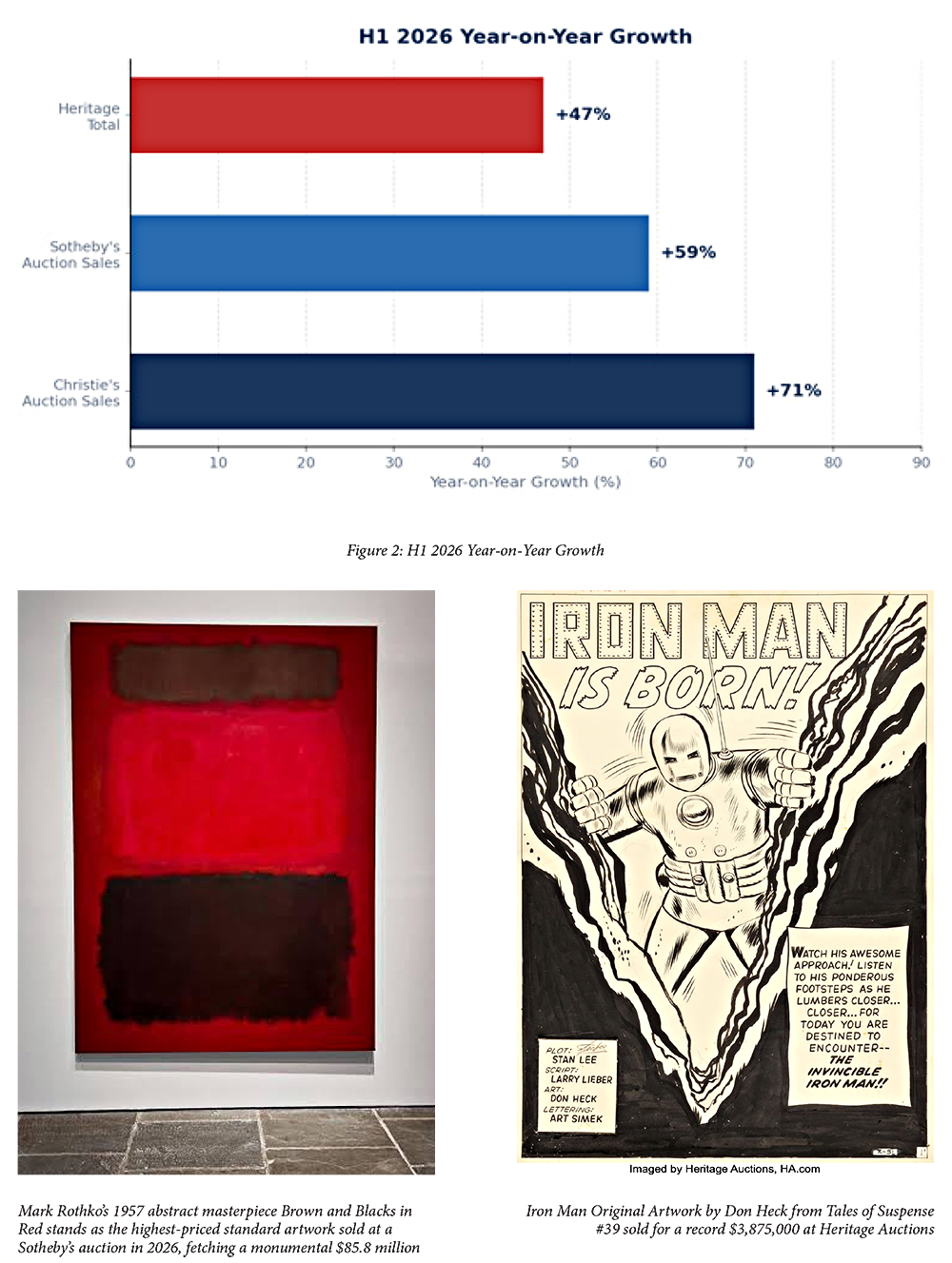
The first half of 2026 delivered the strongest half-year results for the major auction houses in several years, while leading art fairs reported robust attendance and selective but solid commercial performance. Combined public auction sales at Christie’s, Sotheby’s and Phillips approached $7 billion, a year-on-year increase of approximately 70%. Christie’s posted $4.5 billion (its best half in five years), Sotheby’s a record $4.4 billion, and Heritage Auctions a mid-year record of $1.41 billion.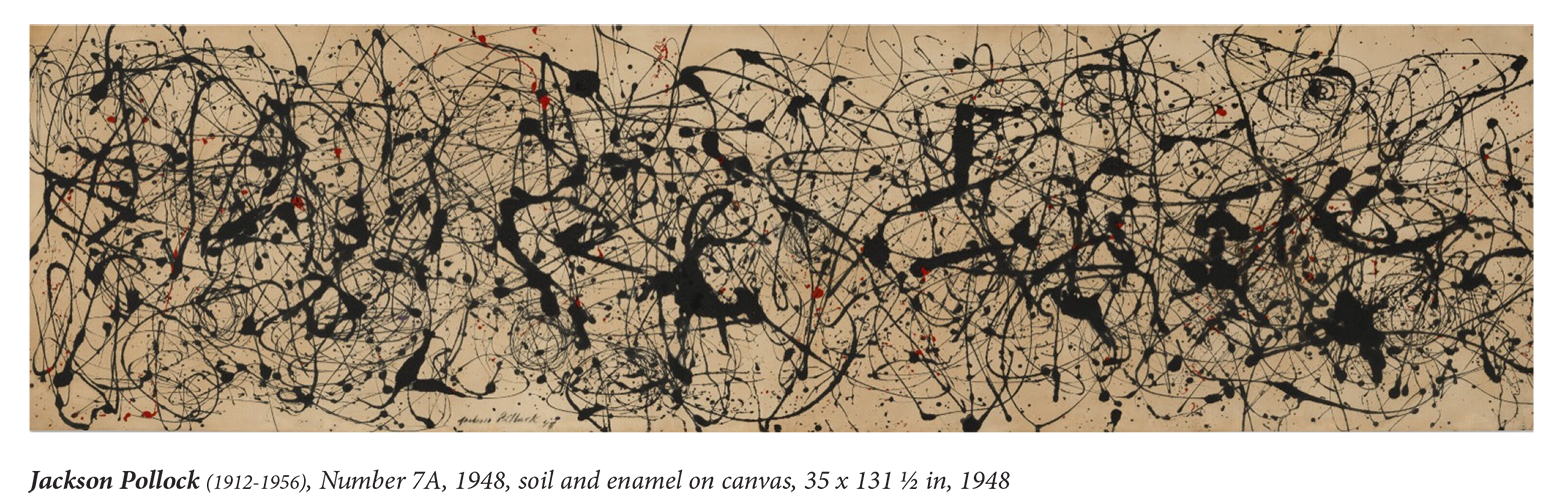
Yet the composition of these results is more revealing than the totals. Capital is concentrating on works with documented provenance, institutional history and clear title. Single-owner and estate collections are clearing at 95-96% rates. Private sales have become a core pillar rather than a secondary channel. Art-finance and lending infrastructure continues to expand. This is not a broad-based recovery across all price points and categories; it is a flight to structure.
The Art Basel & UBS Global Art Market Report 2026 (covering full-year 2025) provides the wider context: global sales rose 4% to $59.6 billion, with public auction sales up 9% and the dealer sector up 2%. The mid-year 2026 data suggests the recovery has accelerated at the top end while remaining selective elsewhere.
2. Major Auction House Performance - H1 2026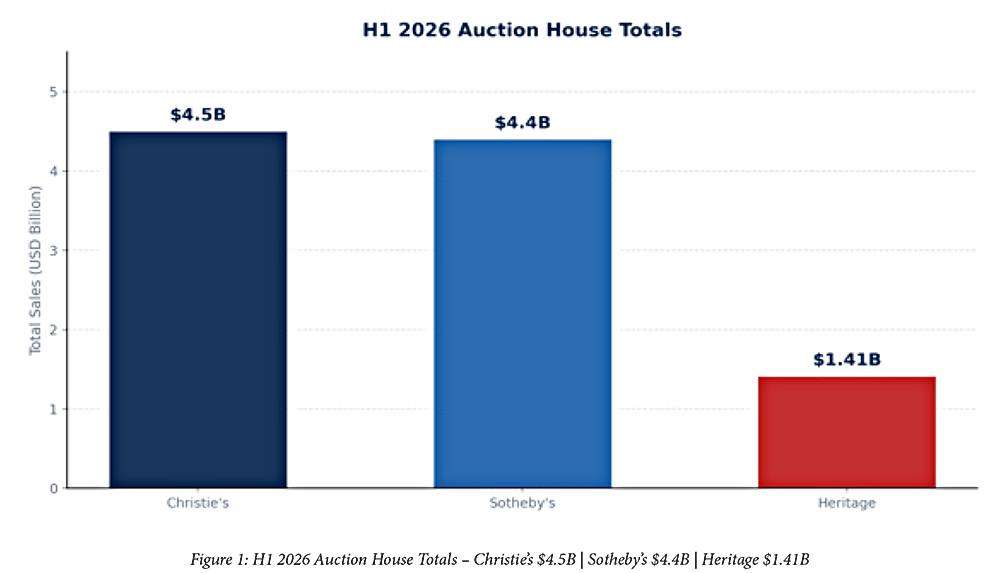
Christie’s - $4.5 Billion
Total revenue: $4.5 billion (strongest first half in five years). Public auction sales: $3.5 billion (+71% YoY). Private sales: >$1 billion. Sell-through by lot: 91%. The 20th- & 21st-century category contributed $2.3 billion (+79%). Old Masters rose 232% to $183 million. Key drivers were the S.I. Newhouse collection ($630.8 million) and works from Agnes Gund. Top prices included Jackson Pollock’s Number 7A (1948) at $181.2 million, Constantin Brancusi’s Danaide at $107.6 million, and Mark Rothko’s No. 15 at $98.4 million.
Sotheby’s - Record $4.4 Billion
Total: $4.4 billion (house record). Public auction sales rose 59%. Private-treaty sales reached an all-time high of $826 million (+52%). Estate and single-owner collections cleared at 96% sell-through. The Joe Lewis collection realised approximately $392.6 million (GBP 296 million) in London - the most expensive single-owner sale in European history. Impressionist & Modern and Contemporary categories led. Online-only sales grew 31% to $188 million.
Heritage Auctions - $1.41 Billion Mid-Year Record
Heritage posted more than $1.41 billion through June 2026 (+47% YoY), the highest mid-year total in its 50-year history. Strength was broad across collectibles (comics, trading cards, sports memorabilia, watches and luxury items), illustrating that the preference for graded, documented and liquid assets extends well beyond fine art.
Combined Picture
Across Christie’s, Sotheby’s and Phillips, global auction sales totalled approximately $6.77-6.9 billion in H1 2026, up nearly 70% year-on-year. Single-owner collections accounted for roughly 32% of the total. Sell-through rates remained high (90-91%). Online channels continued to expand, attracting a higher proportion of new and younger buyers.
3. Art Fair Performance - 2026 Season to Date
Art Basel Hong Kong 2026 (March)
Attendance reached a record 91,500 visitors. Galleries reported steady sales across price points, with activity sustained beyond VIP days. Notable transactions included: David Zwirner - Liu Ye, Snow White (2006) for $3.8 million and Marlene Dumas for $3.5 million; Hauser & Wirth - Louise Bourgeois works at $2.95 million and $2.2 million, George Condo at $2.3 million; Bastian - Picasso Le peintre et son modele (1964) for approximately EUR 3.5 million ($4.0 million); White Cube - first-day sales of roughly GBP 4 million including a Tracey Emin painting at GBP 1.2 million. A Modigliani at Pace carried a $13.3 million asking price. The fair reinforced Hong Kong’s position as the primary Asian meeting point for international collectors.
Art Basel (Basel) 2026 (June)
Early reports indicated strong institutional and private demand. High-profile placements included multi-million-dollar works by Picasso and other blue-chip artists. The fair continued to function as the most important global barometer for the primary and secondary markets simultaneously.
Frieze New York 2026 (May)
The fair recorded major museum acquisitions alongside solid commercial results. White Cube led reported sales with two El Anatsui sculptures: LuwVor I (2025) at $2.2 million and MivEvi III (2025) at $1.9 million. Attendance and institutional engagement were described as strong.
TEFAF Maastricht 2026 (March)
More than 50,000 visitors attended. Sales were characterised by a clear preference for exceptional quality and provenance - consistent with the broader market theme. Dealers in Old Masters, antiquities and high-end decorative arts reported solid results, aligning with the Art Basel/UBS observation that older and secondary-market sectors showed stronger growth than contemporary in 2025.
4. Structural Shifts: Flight to Structure & Infrastructure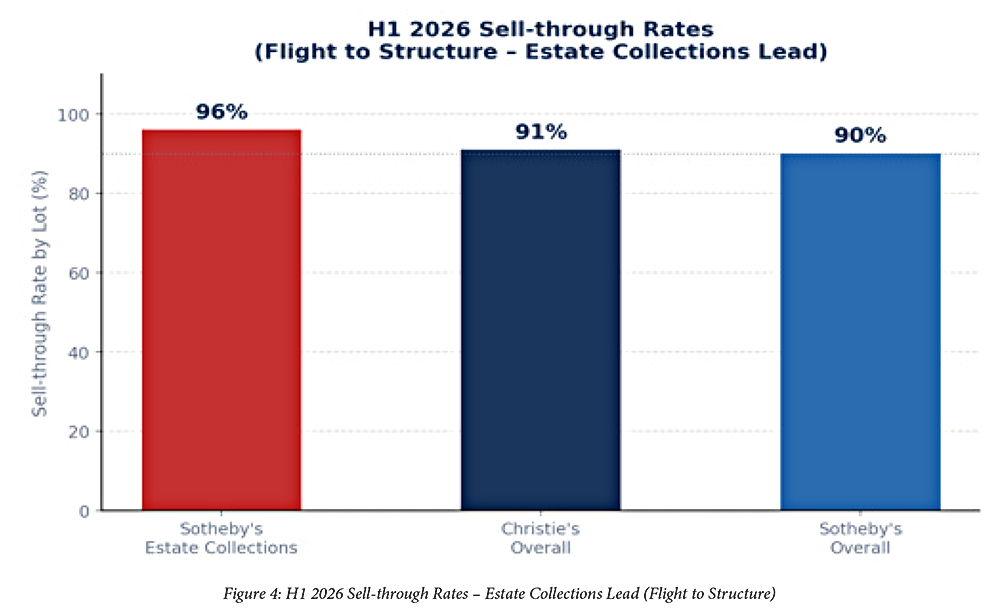
Several interconnected trends are reshaping the market:
• Provenance premium: Works with clean title, published catalogues raisonnes, museum exhibitions and prior auction history command a clear structural premium and higher sell-through.
• Private sales as equal pillar: Sotheby’s $826 million private-treaty figure and Christie’s >$1 billion private sales demonstrate that negotiated transactions are no longer secondary.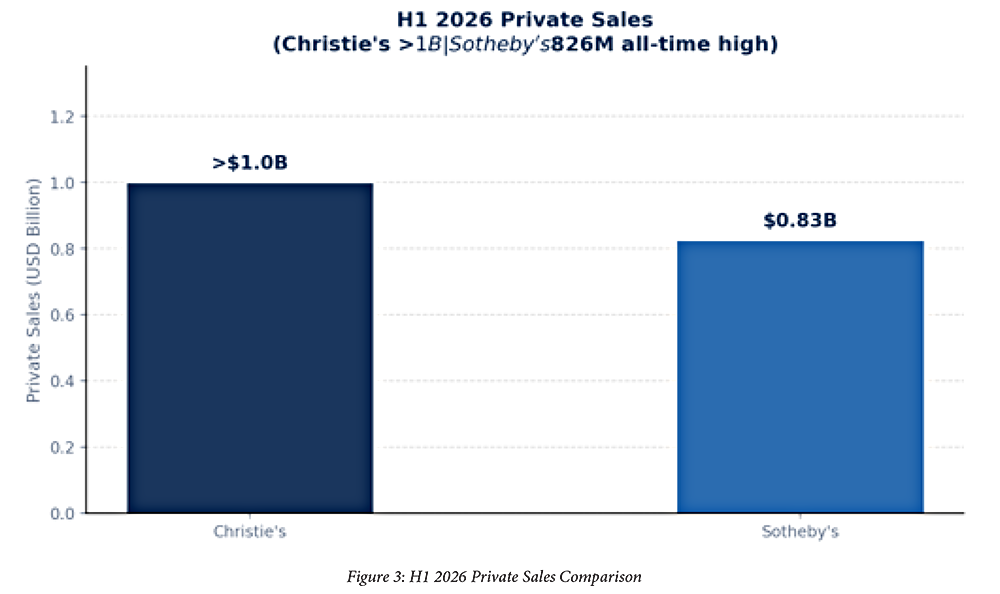
• Art finance expansion: Lending against collections, structured liquidity and advisory services are growing rapidly. The departure of Evan Beard (architect of Bank of America’s art-lending business) to launch a firm described as operating like an art market merchant bank is emblematic.
• Selectivity by price point: The recovery is concentrated at the high end and in well- documented material. Mid- and lower-tier works without strong infrastructure continue to face greater resistance.
• Online and hybrid channels: Both auction houses and fairs report continued growth in online participation and you
5. Regional Dynamics and Category Performance
The United States remains the largest market, driven by New York’s marquee sales and strong domestic collecting. London continues to host major single-owner sales (Joe Lewis). Hong Kong and the broader Asian market showed resilience at Art Basel Hong Kong, with significant participation from regional and international buyers. European Old Masters and design performed strongly at TEFAF and in the June sales.
By category (H1 2026 auction data): Impressionist & Modern and Post-War & Contemporary dominated value. Old Masters showed sharp percentage gains from a lower base. Collectibles (Heritage) demonstrated that documented, graded assets outside traditional fine art are attracting substantial capital.
6. Implications for Collectors, Galleries and Emerging Markets
The global flight to structure raises the documentation and scholarship bar for all participants. Artists, estates and galleries that invest in catalogues, clear ownership records, exhibition history and critical writing will be better positioned to attract international capital. Those that do not risk remaining confined to local or regional markets.
At the same time, the extreme concentration of capital at the very top of the Western modern and contemporary markets creates relative-value opportunities lower down the quality pyramid - particularly for mid-career and senior artists from India and other non-Western contexts whose work is of genuine quality but still under-documented relative to its artistic merit. The competitive advantage is increasingly the quality of the infrastructure surrounding the object.
7. Outlook for the Second Half of 2026 and Beyond
The second half will test whether the first-half strength can be maintained without an equivalent volume of trophy estates. Key watch-points include:
• Continued outperformance of well-provenanced single-owner and estate material.
• Further growth in private sales and art-finance offerings by the major houses.
• Persistence of softness in under-documented mid-tier material.
• International interest in non-Western modernisms that can meet the new standard of structure and scholarship.
• Performance of the autumn fair season (Frieze London, Art Basel Paris, etc.) and the major November New York sales.
The world art market in mid-2026 is stronger, more selective and more infrastructure-dependent than it has been in recent years. For collectors and institutions prepared to prioritise quality of documentation alongside quality of the object, the opportunity set remains substantial.
Prepared for Talk Art / Art Insights | Aakriti Art Gallery, Kolkata | July 2026; Primary sources: Christie’s, Sotheby’s, Heritage Auctions H1 2026 releases; Art Basel & UBS Global Art Market Report 2026; Artnet News, Observer, Artsy, ARTnews, TEFAF & Frieze official communications.
Disclaimer
This report is prepared for informational and editorial purposes only (Talk Art / Art Insights, Aakriti Art Gallery). All figures are drawn from publicly released auction-house results, official art-fair communications, and the Art Basel & UBS Global Art Market Report 2026. Auction totals are as reported by the houses (usually including buyer’s premium). Private-sale figures are those disclosed by the houses and may not capture the full private market. Art-fair sales are based on gallery-reported transactions and are therefore incomplete by nature. Global market size figures for 2025 are estimates compiled by Arts Economics for the Art Basel & UBS report. Numbers are subject to later revision by the reporting organisations. This document does not constitute investment advice, valuation opinion, or a recommendation to buy or sell any artwork. Readers should conduct their own due diligence and consult qualified professionals before making collecting or investment decisions.
Data Sources & Notes
1. Christie’s H1 2026 results – official release and contemporaneous reporting (Artnet News, ARTnews, Observer), July 2026.
2. Sotheby’s H1 2026 results – official release; private-treaty sales figure of $826 million and estate sell-through rates as reported July 2026.
3. Heritage Auctions mid-year 2026 results – official press release, July 2026 ($1.41 billion).
4. Combined auction totals and category breakdowns – aggregated from house releases and secondary reporting (Artnet, Observer).
5. Art Basel Hong Kong 2026 – official Art Basel communications and gallery-reported sales (Artsy, Observer, Artnet), March–April 2026.
6. Frieze New York 2026 – Frieze and gallery reports (Artsy), May 2026.
7. TEFAF Maastricht 2026 – TEFAF official statements and contemporaneous sales reports, March 2026.
8. Art Basel (Basel) 2026 – preliminary fair communications and press coverage, June–July 2026.
9. Global market size and 2025 growth figures – The Art Basel & UBS Global Art Market Report 2026, authored by Dr Clare McAndrew / Arts Economics (published March 2026).
10. Additional context on private sales, art lending and structural trends – contemporaneous analysis (Observer, Artnet, LinkedIn commentary by market participants), July 2026.
Prepared for Talk Art / Art Insights • Aakriti Art Gallery, Kolkata • July 2026
Most read art news
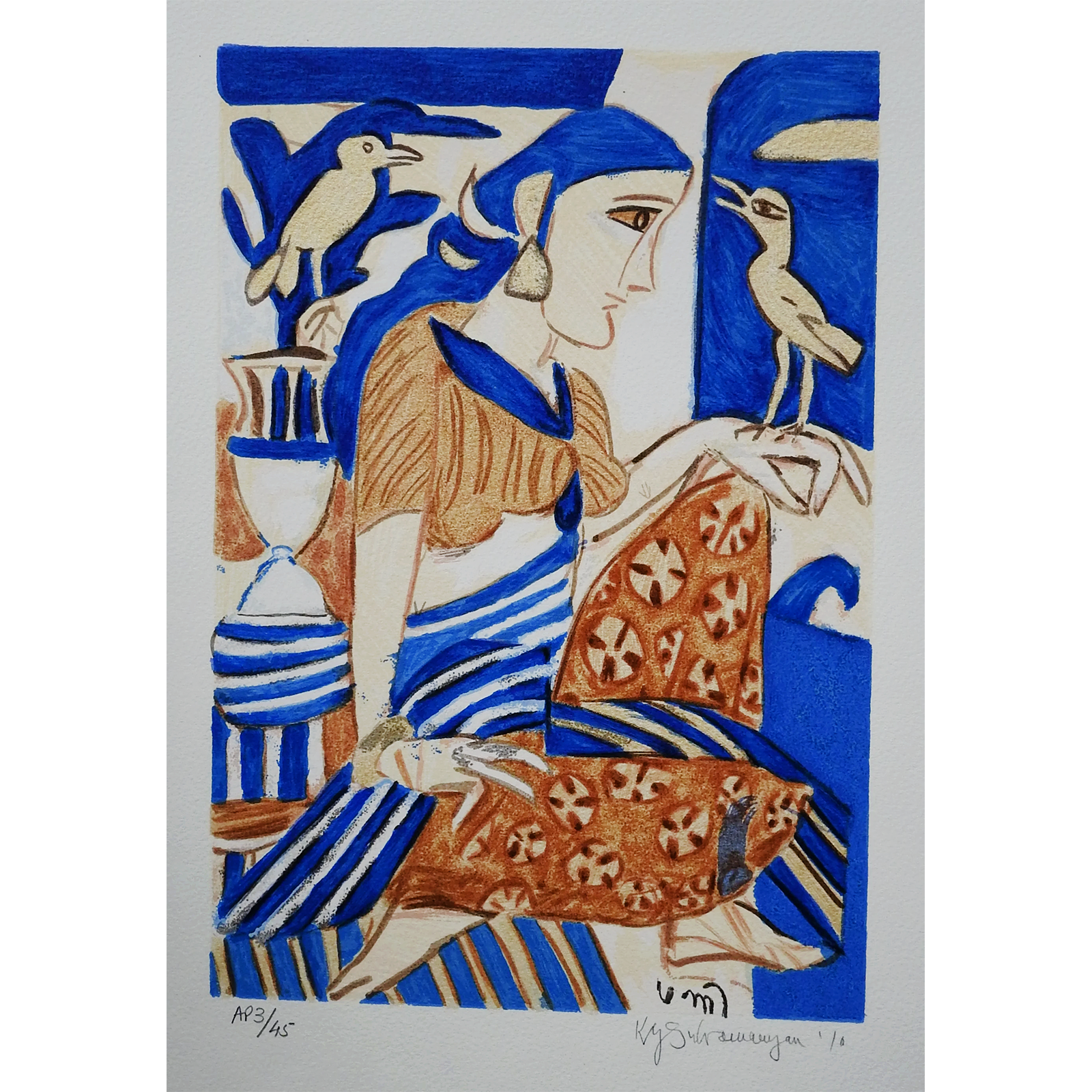
How to Tell Whether a Print Is an Original Artist-Signed Impression or a Reproduction
The Work That Begins a Collection

Aakriti Art Gallery to Launch India’s First Integrated Art Platform Combining AI Advisory, Research, Archives, Publishing, and Art Acquisition
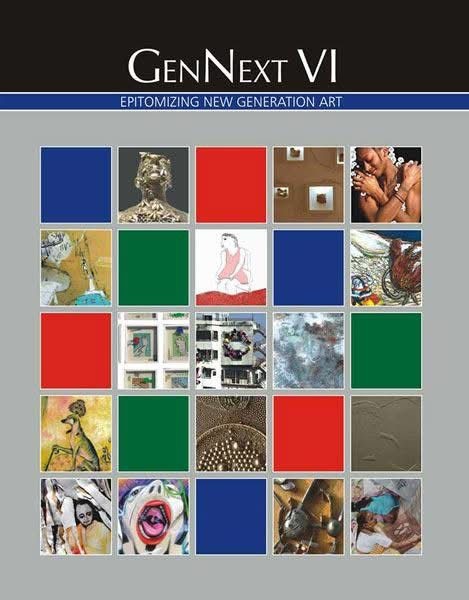
Aakriti Art Gallery Relaunches ‘GenNext’ as a Year-Round Platform for Emerging Artists
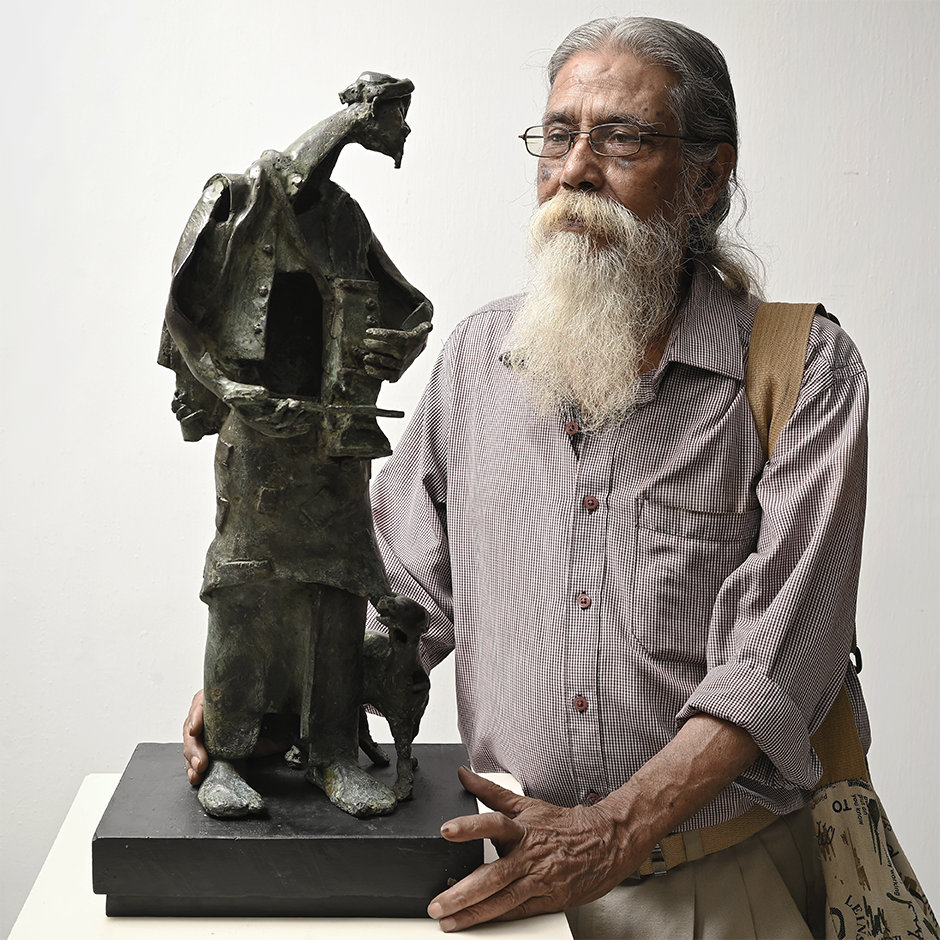
The Monumental World Within the Ordinary